Cañas Silvia, Tosi Nicole, Núñez-Gómez Vanesa, Del Rio Daniele, Mena Pedro, Aguilera Yolanda, Martín-Cabrejas María A
Department of Agricultural Chemistry and Food Science, Universidad Autónoma de Madrid, 28049, Madrid, Spain.
Institute of Food Science Research, CIAL (UAM-CSIC), 28049, Madrid, Spain.
Curr Res Food Sci. 2024 Nov 17;9:100930. doi: 10.1016/j.crfs.2024.100930. eCollection 2024.
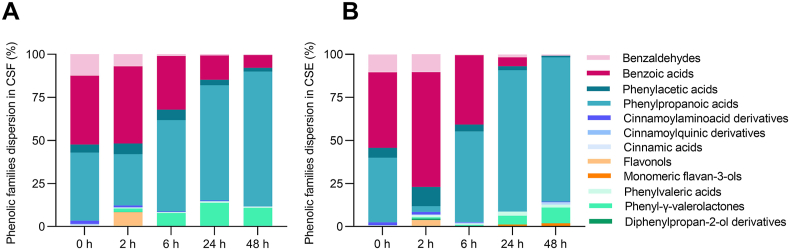
Cocoa shell is a by-product generated by the cocoa processing industry, notable for its high content of phenolic compounds and methylxanthines, and recognized for their biological properties. The majority of cocoa phenolic compounds are not absorbed in the small intestine and reach the colon, where they can be catabolized by the gut microbiota, influencing their bioavailability and bioactivity. This research aimed to study the changes that phenolic compounds from cocoa shell flour (CSF) and extract (CSE) undergo during colonic fermentation after gastrointestinal digestion, using an model and a targeted metabolomics approach. A decrease in the concentration of most parental phenolic compounds was observed, with a simultaneous increase in phenyl-γ-valerolactones, phenylvaleric acids, and phenylpropanoic acids. Benzoic acids, phenylpropanoic acids, phenylacetic acids, and benzaldehydes were the compounds found in the highest concentrations. Additionally, phenolic compounds in CSF were metabolized more slowly than those in CSE. This may be due to the matrix effect that protects the compounds from degradation during colonic fermentation. These findings further support the potential of cocoa shells as a food ingredient rich in phenolic compounds and bioavailable metabolites, which may exert beneficial effects in the colon and at the systemic level.
可可壳是可可加工行业产生的一种副产品,以其高含量的酚类化合物和甲基黄嘌呤而闻名,并因其生物学特性而受到认可。大多数可可酚类化合物在小肠中不被吸收,而是到达结肠,在那里它们可以被肠道微生物群分解代谢,从而影响其生物利用度和生物活性。本研究旨在使用体外模型和靶向代谢组学方法,研究可可壳粉(CSF)和提取物(CSE)中的酚类化合物在胃肠道消化后的结肠发酵过程中所经历的变化。观察到大多数母体酚类化合物的浓度降低,同时苯基-γ-戊内酯、苯基戊酸和苯丙酸的浓度增加。苯甲酸、苯丙酸、苯乙酸和苯甲醛是浓度最高的化合物。此外,CSF中的酚类化合物比CSE中的代谢得更慢。这可能是由于基质效应保护了化合物在结肠发酵过程中不被降解。这些发现进一步支持了可可壳作为富含酚类化合物和生物可利用代谢物的食品成分的潜力,这些成分可能在结肠和全身水平上发挥有益作用。