Omura Kohei, Ide Kaori, Takahashi Masashi, Furusawa Yu, Kobayashi Masanori, Miyagawa Yuichi, Fujiwara-Igarashi Aki, Teshima Takahiro, Kubo Yoshiaki, Yasuda Akiko, Yoshida Karin, Hayakawa Noriyuki, Kobayashi Masato, Momoi Yasuyuki
Scientific activity support team, ARKRAY Marketing Inc., Yousuien-nai, 59 Gansuin-cho, Kamigyo-ku, Kyoto 602-0008, Japan.
Tokyo University of Agriculture and Technology, Department of Veterinary Medicine, Laboratory of Veterinary Internal Medicine, 3-5-8 Saiwaicho, Fuchu City, Tokyo, Japan.
Vet Anim Sci. 2024 Nov 26;27:100414. doi: 10.1016/j.vas.2024.100414. eCollection 2025 Mar.
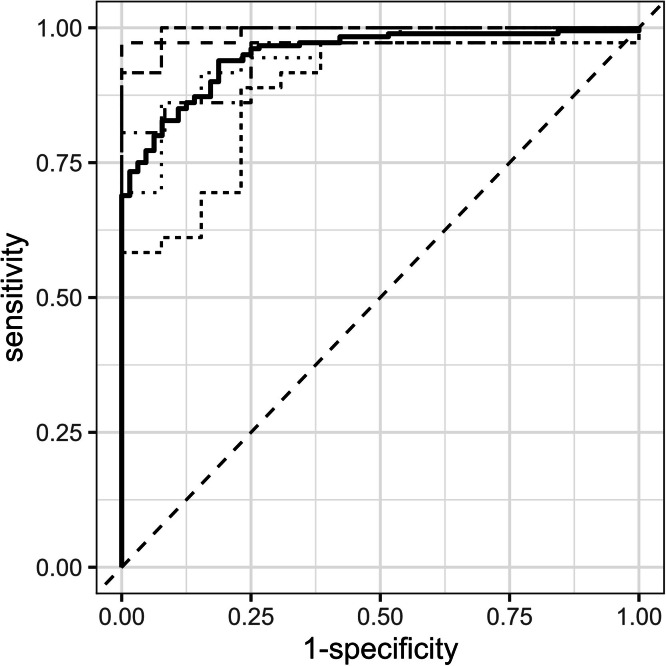
In the veterinary field, the utility of disease-identification models that use comprehensive circulating microRNA (miRNA) profiles produced through measurements based on next-generation sequencing (NGS) remains unproven. To integrate NGS technology with automated machine learning (autoML) to create a comprehensive circulating miRNA profile and to assess the clinical utility of a disease-screening model derived from this profile. The study involved dogs diagnosed with or being treated for various diseases, including tumors, across multiple veterinary clinics ( = 254), and healthy dogs without apparent diseases ( = 91). miRNA was extracted from EDTA-treated plasma, and a comprehensive analysis was conducted of one million reads per sample using NGS. Then autoML technology was applied to develop a diagnostic model based on miRNA. Among these models, the one with the highest performance was chosen for evaluation. The diagnostic model, based on the comprehensive circulating miRNA profile developed in this study, achieved an AUC score of 0.89, with a sensitivity of 85 % and a specificity of 88 % for the disease samples. The miRNA-based diagnostic model demonstrated high sensitivity for disease groups and has the potential to be an effective screening test. This study indicates that a comprehensive miRNA profile in dog plasma could serve as a highly sensitive blood biomarker.
在兽医领域,利用基于下一代测序(NGS)测量产生的综合循环微小RNA(miRNA)谱的疾病识别模型的实用性尚未得到证实。为了将NGS技术与自动化机器学习(autoML)相结合,以创建综合循环miRNA谱,并评估源自该谱的疾病筛查模型的临床实用性。该研究涉及在多个兽医诊所(n = 254)被诊断患有各种疾病(包括肿瘤)或正在接受治疗的犬只,以及没有明显疾病的健康犬只(n = 91)。从经乙二胺四乙酸(EDTA)处理的血浆中提取miRNA,并使用NGS对每个样本进行100万次读数的综合分析。然后应用autoML技术基于miRNA开发诊断模型。在这些模型中,选择性能最高的模型进行评估。基于本研究中开发的综合循环miRNA谱的诊断模型,疾病样本的曲线下面积(AUC)得分为0.89,灵敏度为85%,特异性为88%。基于miRNA的诊断模型对疾病组表现出高灵敏度,并且有可能成为一种有效的筛查测试。这项研究表明,犬血浆中的综合miRNA谱可以作为一种高度敏感的血液生物标志物。