Lu Ying, Wang Zhouyu, Zhang Danmeng, Luo Ningning, Yang Hui, Chen Dongsheng, Huang Haixin
Department of Oncology, The Fourth Affiliated Hospital of Guangxi Medical University, Liuzhou, 545000, China.
The State Key Laboratory of Neurology and Oncology Drug Development, Jiangsu Simcere Diagnostics Co., Ltd, Nanjing Simcere Medical Laboratory Science Co., Ltd, Nanjing, 210002, China.
Cell Mol Neurobiol. 2024 Dec 18;45(1):6. doi: 10.1007/s10571-024-01515-z.
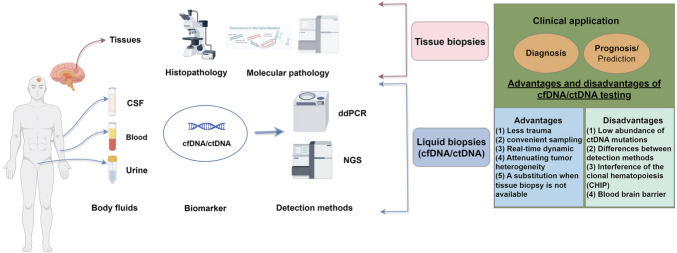
Glioma is the most common primary malignant brain tumor. Despite significant advances in the past decade in understanding the molecular pathogenesis of this tumor and exploring therapeutic strategies, the prognosis of patients with glioma remains poor. Accurate diagnosis of glioma is very important for the treatment and prognosis. Although the gold-standard method for the diagnosis and prognosis prediction of patients with glioma is tissue biopsy, it still has many limitations. Liquid biopsy can provide information on the auxiliary diagnosis and prognosis of gliomas. In this review, we summarized the application of cell-free DNA (cfDNA) and circulating tumor DNA (ctDNA) in the auxiliary diagnosis and prognosis of glioma. The common methods used to detect ctDNA in gliomas using samples including blood and cerebrospinal fluid (CSF) and the detection techniques for ctDNA, including droplet digital PCR (ddPCR) and next-generation sequencing (NGS), were discussed. Detection of ctDNA from plasma of patients with brain tumors remains challenging because of the blood-brain barrier (BBB). CSF has been proposed as a medium for ctDNA analysis in brain tumors, and mutation detection using plasma ctDNA was less sensitive than CSF ctDNA sequencing. Moreover, ongoing relevant clinical studies were summarized. Finally, we discussed the challenges, and future directions for the studies on ctDNA in glioma.
胶质瘤是最常见的原发性恶性脑肿瘤。尽管在过去十年中,在了解该肿瘤的分子发病机制和探索治疗策略方面取得了重大进展,但胶质瘤患者的预后仍然很差。准确诊断胶质瘤对于治疗和预后非常重要。虽然胶质瘤患者诊断和预后预测的金标准方法是组织活检,但它仍然有许多局限性。液体活检可以提供有关胶质瘤辅助诊断和预后的信息。在本综述中,我们总结了游离DNA(cfDNA)和循环肿瘤DNA(ctDNA)在胶质瘤辅助诊断和预后中的应用。讨论了使用包括血液和脑脊液(CSF)在内的样本检测胶质瘤中ctDNA的常用方法以及ctDNA的检测技术,包括液滴数字PCR(ddPCR)和下一代测序(NGS)。由于血脑屏障(BBB),从脑肿瘤患者血浆中检测ctDNA仍然具有挑战性。脑脊液已被提议作为脑肿瘤中ctDNA分析的介质,并且使用血浆ctDNA进行突变检测比脑脊液ctDNA测序的敏感性更低。此外,还总结了正在进行的相关临床研究。最后,我们讨论了胶质瘤中ctDNA研究的挑战和未来方向。