
低密度脂蛋白胆固醇与多种癌症的综合孟德尔随机化分析
Comprehensive Mendelian randomization analysis of low-density lipoprotein cholesterol and multiple cancers.
作者信息
Liang Hengchang, Tang Chunling, Sun Yue, Wang Mingwei, Tong Tong, Gao Qinquan, Xie Hui, Tan Tao
机构信息
Faulty of Applied Sciences, Macao Polytechnic University, Macao, 999078, People's Republic of China.
Centre for Craniofacial and Regenerative Biology, King's College London, London, SE1 9RT, UK.
出版信息
Discov Oncol. 2024 Dec 18;15(1):798. doi: 10.1007/s12672-024-01684-9.
PURPOSE
The aim of this study was to investigate the causal relationship between low-density lipoprotein cholesterol (LDL-C) and five cancers (breast, cervical, thyroid, prostate and colorectal) using the Mendelian Randomization (MR) method, with a view to revealing the potential role of LDL-C in the development of these cancers.
METHODS
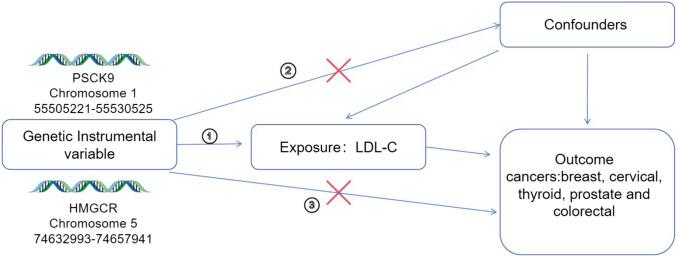
We used gene variant data and disease data from the Genome-Wide Association Study (GWAS) database to assess the causal relationship between LDL-C and each cancer by Mendelian randomisation analysis methods such as inverse variance weighting and MR-Egger. Specifically, we selected Proprotein convertase subtilisin/kexin type 9 (PCSK9) and 3-hydroxy-3-methylglutaryl-CoA reductase (HMGCR), genes associated with LDL-C levels, as instrumental variables, extracted the corresponding single nucleotide polymorphism (SNP) data and analysed the associations of these SNPs with five cancers.In addition, sensitivity analyses and heterogeneity tests were performed to ensure the reliability of the results.
RESULTS
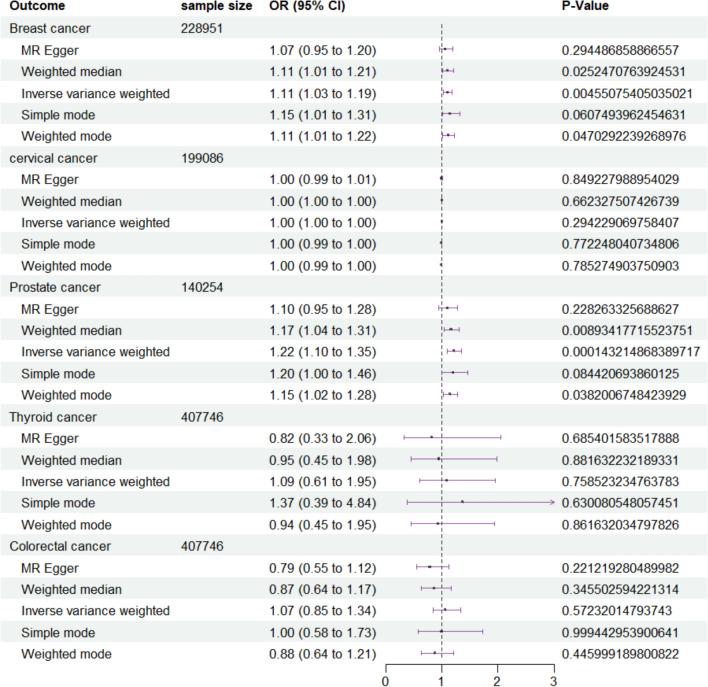
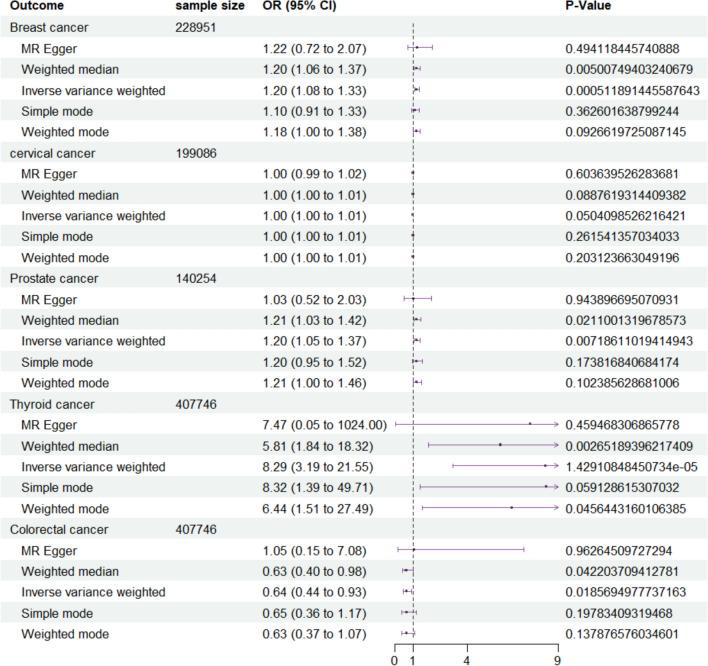
The analyses showed that when using HMGCR gene, LDL-C were significantly and positively associated with breast (OR:1.200, 95% CI:1.082-1.329, p = 0.001), prostate (OR:1.198, 95% CI:1.050-1.366, p = 0.007), and thyroid cancers (OR:8.291, 95% CI:3.189- 21.555, p = 0.00001) were significantly positively correlated, whereas they were significantly negatively correlated with colorectal cancer (OR:0.641, 95% CI:0.442-0.928, p = 0.019); the results for cervical cancer were not significant (p = 0.050). When using the PCSK9 gene, LDL-C levels were significantly and positively associated with breast (OR:1.107, 95%:CI 1.031-1.187, p = 0.005) and prostate (OR:1.219, 95%:CI 1.101-1.349, p = 0.0001) cancers, but not with cervical (p = 0.294), thyroid cancer (p = 0.759) and colorectal cancer ( p = 0.572).
CONCLUSION
Analyses using both the HMGCR and PCSK9 genes have shown that LDL-C may be a potential risk factor for breast and prostate cancer, while analyses of the HMGCR gene have also suggested that LDL-C may increase the risk of thyroid cancer and decrease the risk of colorectal cancer.
目的
本研究旨在采用孟德尔随机化(MR)方法研究低密度脂蛋白胆固醇(LDL-C)与五种癌症(乳腺癌、宫颈癌、甲状腺癌、前列腺癌和结直肠癌)之间的因果关系,以揭示LDL-C在这些癌症发生发展中的潜在作用。
方法
我们使用来自全基因组关联研究(GWAS)数据库的基因变异数据和疾病数据,通过逆方差加权和MR-Egger等孟德尔随机化分析方法评估LDL-C与每种癌症之间的因果关系。具体而言,我们选择与LDL-C水平相关的前蛋白转化酶枯草溶菌素/kexin 9型(PCSK9)和3-羟基-3-甲基戊二酰辅酶A还原酶(HMGCR)基因作为工具变量,提取相应的单核苷酸多态性(SNP)数据,并分析这些SNP与五种癌症的关联。此外,进行了敏感性分析和异质性检验以确保结果的可靠性。
结果
分析表明,使用HMGCR基因时,LDL-C与乳腺癌(OR:1.200,95%CI:1.082-1.329,p = 0.001)、前列腺癌(OR:1.198,95%CI:1.050-1.366,p = 0.007)和甲状腺癌(OR:8.291,95%CI:3.189-21.555,p = 0.00001)显著正相关,而与结直肠癌显著负相关(OR:0.641,95%CI:-0.442-0.928,p = 0.);宫颈癌的结果不显著(p = 0.050)。使用PCSK9基因时,LDL-C水平与乳腺癌(OR:1.107,95%:CI 1.031-1.187,p = 0.005)和前列腺癌(OR:1.219,95%:CI 1.101-1.349,p = 0.0001)显著正相关,但与宫颈癌(p = 0.294)、甲状腺癌(p = 0.759)和结直肠癌(p = 0.572)无关。
结论
使用HMGCR和PCSK9基因进行的分析均表明,LDL-C可能是乳腺癌和前列腺癌的潜在危险因素,而对HMGCR基因的分析还表明,LDL-C可能增加甲状腺癌的风险并降低结直肠癌的风险。
 Zotero 插件