Hossain Kazi, Erata Eda, Schiapparelli Lucio, Soderling Scott H
Department of Cell Biology, Duke University Medical School, Durham, North Carolina, USA.
Department of Neurobiology, Duke University Medical School, Durham, North Carolina, USA.
eNeuro. 2024 Dec 18;12(1). doi: 10.1523/ENEURO.0532-24.2024.
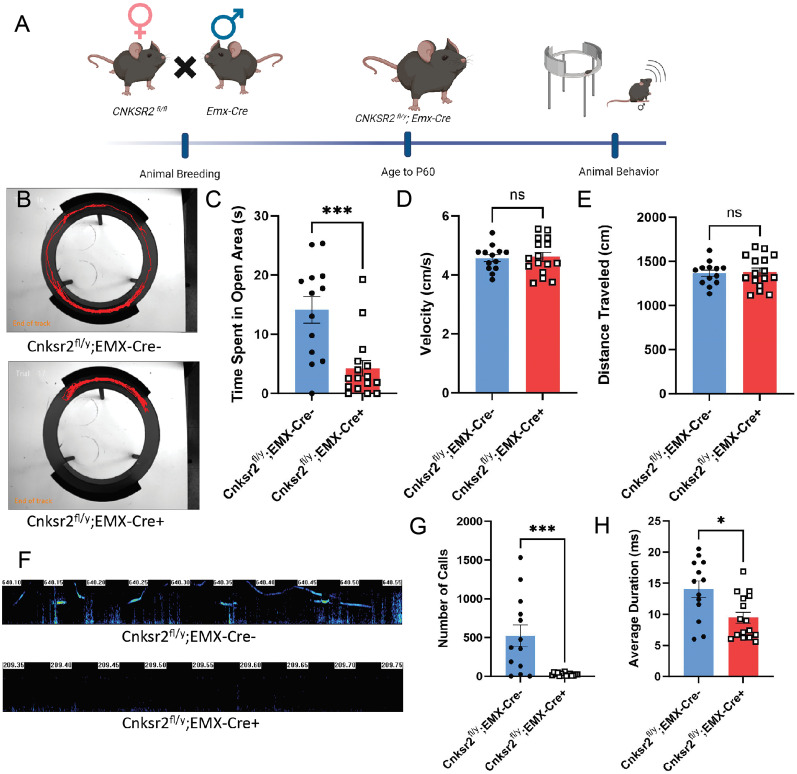
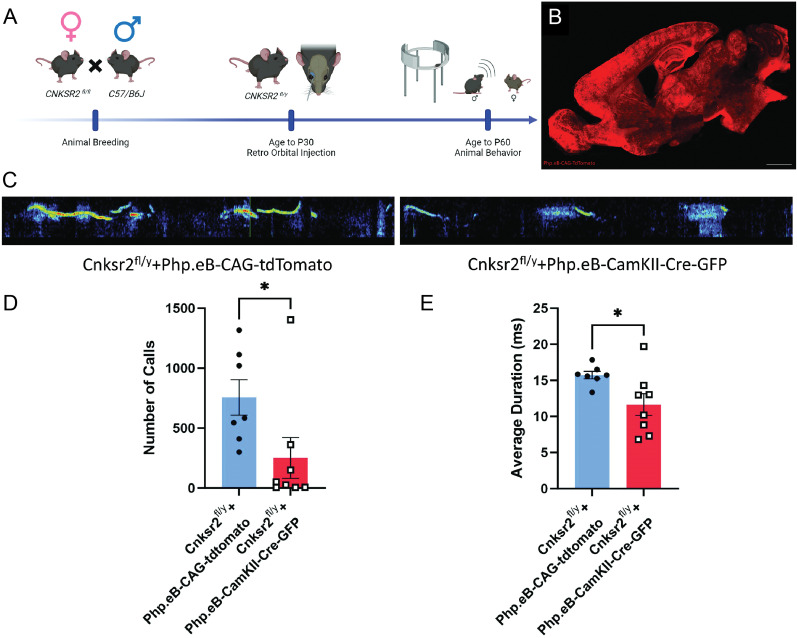
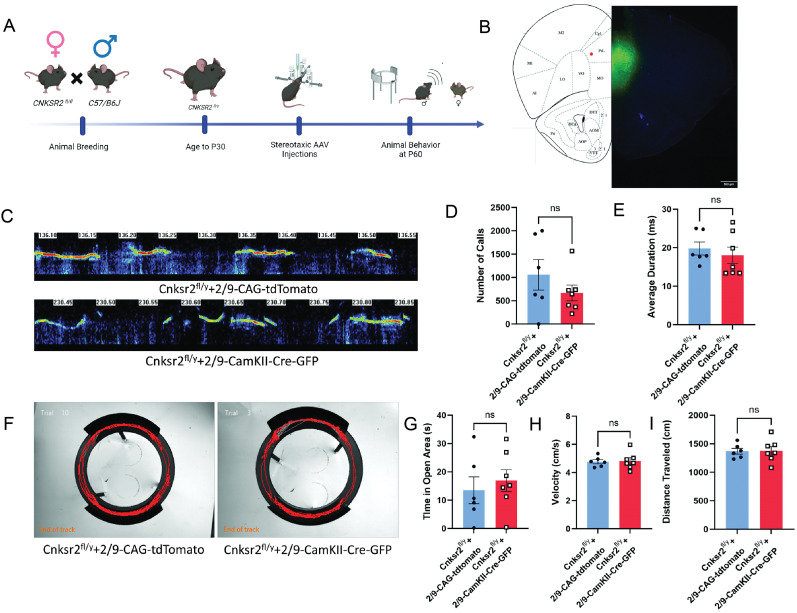
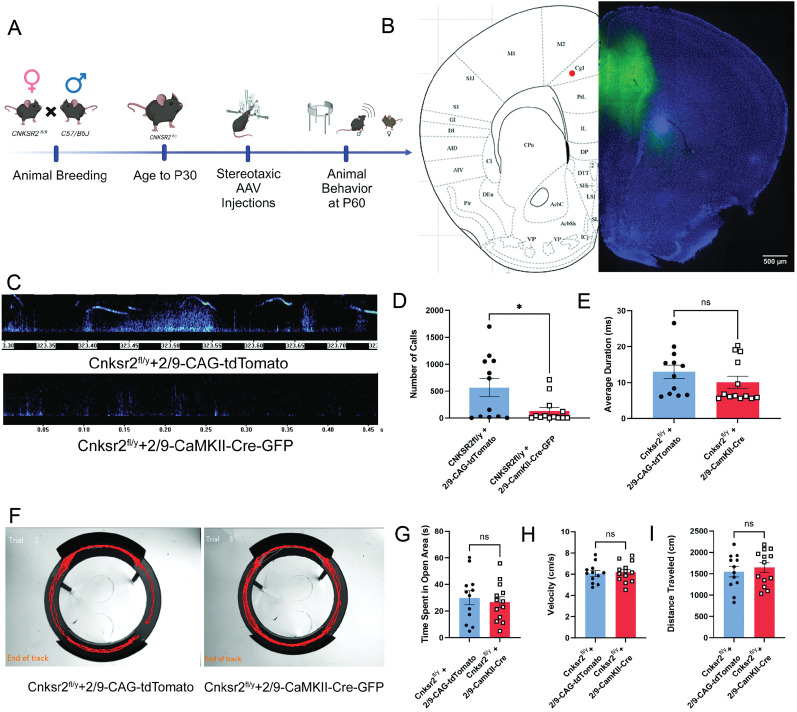
Epilepsy Aphasia Syndrome (EAS) is a spectrum of childhood disorders that exhibit complex co-morbidities that include epilepsy and the emergence of cognitive and language disorders. CNKSR2 is an X-linked gene in which mutations are linked to EAS. We previously demonstrated Cnksr2 knockout (KO) mice model key phenotypes of EAS analogous to those present in clinical patients with mutations in the gene. Cnksr2 KO mice have increased seizures, impaired learning and memory, increased levels of anxiety, and loss of ultrasonic vocalizations (USV). The intricate interplay between these diverse phenotypes at the brain regional and cell type level remains unknown. Here we leverage conditional deletion of the X-linked Cnksr2 in a neuronal cell type manner in male mice to demonstrate that anxiety and impaired USVs track with its loss from excitatory neurons. Finally, we further narrow the essential role of Cnksr2 loss in USV deficits to excitatory neurons of the Anterior Cingulate Cortex (ACC), a region in mice recently implicated in USV production associated with specific emotional states or social contexts, such as mating calls, distress calls, or social bonding signals. Together, our results reveal Cnksr2-based mechanisms that underlie USV impairments that suggest communication impairments can be dissociated from seizures or anxiety. Furthermore, we highlight the cortical circuitry important for initiating USVs. Epilepsy-Aphasia Syndromes are at the severe end of a spectrum of cognitive-behavioral symptoms that are seen in childhood epilepsies and are currently an inadequately understood disorder. The prognosis of EAS is frequently poor and patients have life-long language and cognitive disturbances. We show that the deletion of Cnksr2 specifically within glutamatergic neurons of the anterior cingulate cortex leads to ultrasonic vocalization impairments, providing an important new understanding of the modulation of vocal communication.
癫痫性失语综合征(EAS)是一系列儿童疾病,表现出复杂的共病情况,包括癫痫以及认知和语言障碍的出现。CNKSR2是一个X连锁基因,其突变与EAS相关。我们之前证明,Cnksr2基因敲除(KO)小鼠模型具有EAS的关键表型,类似于该基因发生突变的临床患者所表现出的表型。Cnksr2基因敲除小鼠癫痫发作增加、学习和记忆受损、焦虑水平升高以及超声波发声(USV)丧失。这些不同表型在脑区和细胞类型水平上的复杂相互作用仍不清楚。在这里,我们利用雄性小鼠中神经元细胞类型特异性条件性缺失X连锁的Cnksr2基因,以证明焦虑和USV受损与兴奋性神经元中该基因的缺失有关。最后,我们进一步将Cnksr2缺失在USV缺陷中的关键作用缩小到前扣带回皮质(ACC)的兴奋性神经元,该区域在小鼠中最近被认为与特定情绪状态或社交背景(如求偶叫声、求救叫声或社交联系信号)相关的USV产生有关。总之,我们的结果揭示了基于Cnksr2的机制,这些机制是USV受损的基础,并表明沟通障碍可能与癫痫发作或焦虑无关。此外,我们强调了启动USV的重要皮质回路。癫痫性失语综合征处于儿童癫痫中所见的一系列认知行为症状的严重一端,目前是一种了解不足的疾病。EAS的预后通常很差,患者有终身的语言和认知障碍。我们表明,在前扣带回皮质的谷氨酸能神经元内特异性缺失Cnksr2会导致超声波发声受损,这为语音交流的调节提供了重要的新认识。