Regnault Antoine, Bunod Laurine, Loubert Angely, Brose Marcia S, Hess Lisa M, Maeda Patricia, Lin Yan, Speck Rebecca M, Gilligan Adrienne M, Payakachat Nalin
Modus Outcomes, a THREAD Company, Lyon, France.
Sidney Kimmel Medical College, Thomas Jefferson University, Philadelphia, PA, USA.
J Patient Rep Outcomes. 2024 Dec 19;8(1):149. doi: 10.1186/s41687-024-00823-8.
This psychometric analysis generated evidence to support the use of the Functional Assessment of Cancer Therapy item GP5 (GP5) as a measure of tolerability and confirms the appropriateness of categorizing "high side-effect burden" using a rating of 3 or 4 (score ranges 0-4) in patients with advanced/metastatic RET-mutant medullary thyroid cancer (MTC).
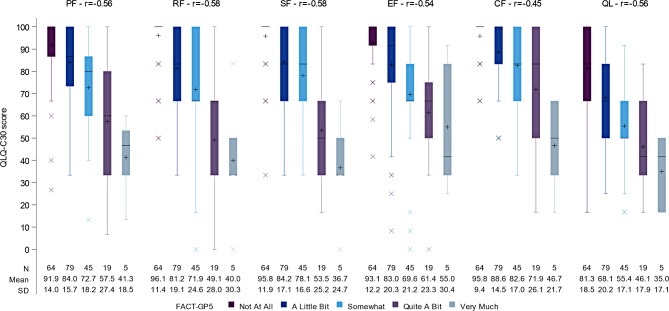
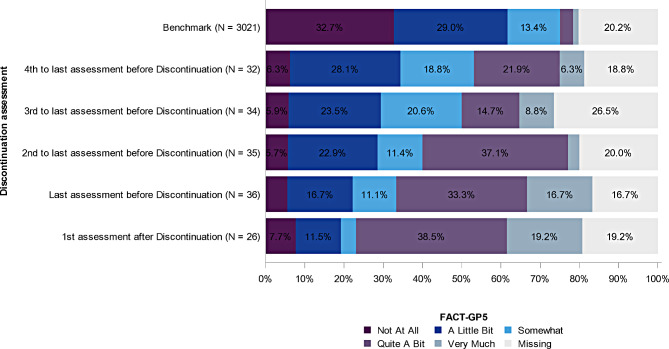
Blinded, pooled interim data from the safety population (n=290) enrolled in the phase 3 LIBRETTO-531 trial (NCT04211337) were used. Intraclass correlation coefficients (ICC) were calculated for test-retest reliability using data from cycles 1-2 post-baseline. Construct validity was evaluated by examining the correlations of GP5 ratings with (a) symptomatic adverse events (AEs; measured by the PRO-CTCAE), and (b) functioning scores of EORTC QLQ-C30. The ability to detect change over time was examined by Cochrane-Mantel-Haenszel tests for GP5 ratings and PRO-CTCAE. The relationship of "high side-effect burden" categories with QLQ-C30 functioning scores was examined.
ICCs for the GP5 ratings after cycle 1 ranged between 0.80 and 0.85, indicating good reliability. Correlations between GP5 and PRO-CTCAE items ranged from 0.18 to 0.62 and ranged from -0.37 to -0.50 for QLQ-C30 functioning scores, consistent with study assumptions. Post-baseline GP5 ratings showed significant associations with PRO-CTCAE scores (p<0.001). Participants with GP5 ratings of 3 or 4 had worse physical function than those with GP5 ratings of 0 to 2 (p<0.0001).
This analysis generated evidence supportive of the psychometric properties of the GP5 as a fit-for-purpose measure to assess treatment tolerability in patients with advanced/metastatic MTC. The definition of "high side-effect burden" was associated with the clinical feature of tolerability.
这项心理测量分析产生了证据,支持使用癌症治疗功能评估项目GP5(GP5)作为耐受性的衡量指标,并确认在晚期/转移性RET突变型甲状腺髓样癌(MTC)患者中,使用3或4级(评分范围0 - 4)对“高副作用负担”进行分类是合适的。
使用了3期LIBRETTO - 531试验(NCT04211337)中安全人群(n = 290)的盲态汇总中期数据。使用基线后第1 - 2周期的数据计算组内相关系数(ICC)以评估重测信度。通过检查GP5评分与(a)症状性不良事件(AEs;通过PRO - CTCAE测量)和(b)EORTC QLQ - C30功能评分的相关性来评估结构效度。通过Cochrane - Mantel - Haenszel检验评估GP5评分和PRO - CTCAE随时间变化的检测能力。研究了“高副作用负担”类别与QLQ - C30功能评分的关系。
第1周期后GP5评分的ICC在0.80至0.85之间,表明信度良好。GP5与PRO - CTCAE项目之间的相关性在0.18至0.62之间,与QLQ - C30功能评分的相关性在 - 0.37至 - 0.50之间,与研究假设一致。基线后GP5评分与PRO - CTCAE评分显示出显著相关性(p < 0.001)。GP5评分为3或4的参与者的身体功能比评分为0至2的参与者更差(p < 0.0001)。
该分析产生的证据支持GP5的心理测量特性,可作为评估晚期/转移性MTC患者治疗耐受性的适用指标。“高副作用负担”的定义与耐受性的临床特征相关。