Kimura Yuka, Suga Mayuko, Nakamura Kayo, Tabata Hidetsugu, Oshitari Tetsuta, Natsugari Hideaki, Takahashi Hideyo
Department of Medicinal Chemistry, Faculty of Pharmaceutical Sciences, Tokyo University of Science, 2641Yamazaki, Noda-Shi, Chiba, 278-8510, Japan.
Department of Medicinal Chemistry, Faculty of Pharma Sciences, Teikyo University, Itabashi-Ku, Tokyo, Japan.
Pharm Res. 2024 Dec;41(12):2363-2375. doi: 10.1007/s11095-024-03802-2. Epub 2024 Dec 18.
Drug photodegradation is a matter of great concern because it can result in potency loss and adverse side effects. This study examines the light-induced degradation of dacarbazine catalyzed by vitamin B and flavin adenine dinucleotide (FAD) under light-emitting diode (LED) or fluorescent light irradiation.
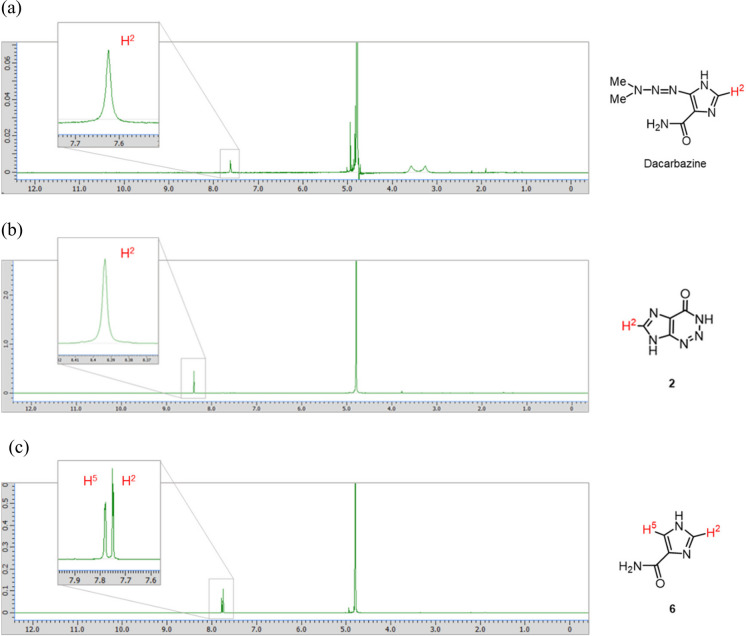
Dacarbazine was irradiated with LED (405 nm) or fluorescent light in the presence of various equivalents of vitamin B or FAD. The photodegradation of the drug in DO was monitored by H nuclear magnetic resonance spectroscopy.
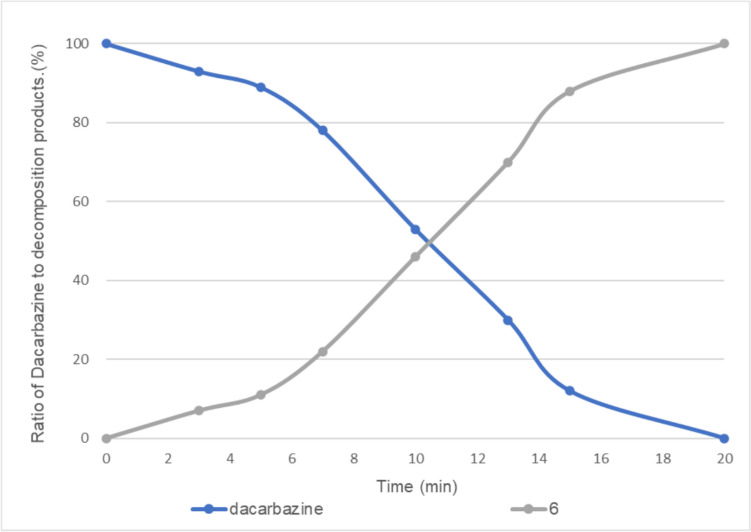
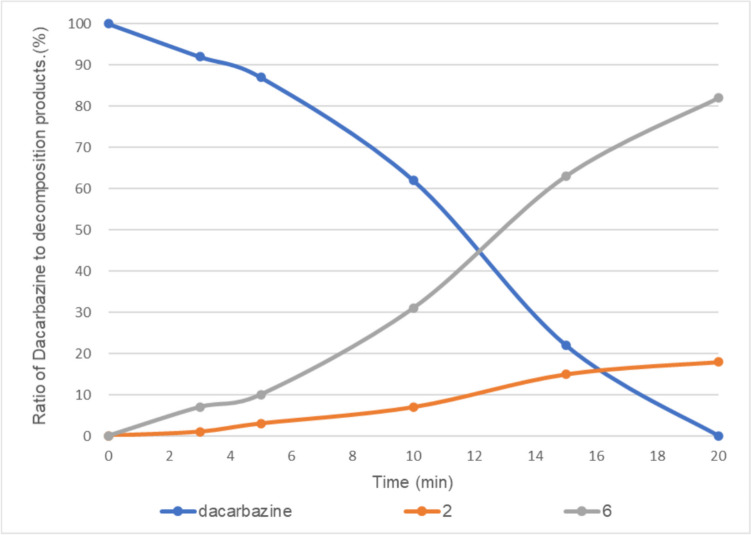
Dacarbazine dissolved in DO decomposed in the presence of vitamin B or FAD under irradiation with LED or fluorescent light. The decomposition products were 2-azahypoxanthine 2, which has previously been observed after light irradiation in the absence of vitamin B, and 1H-imidazole-5-carboxamide 6, a new product formed in the presence of vitamin B. Irradiation with LED light was more effective than irradiation with fluorescent light in degrading dacarbazine.
Vitamin B and FAD induced dacarbazine photodegradation. Thus, the interfusion of vitamin B or FAD under excessive light exposure should be avoided during the intravenous administration of dacarbazine.
药物光降解是一个备受关注的问题,因为它可能导致效力丧失和不良副作用。本研究考察了在发光二极管(LED)或荧光照射下,维生素B和黄素腺嘌呤二核苷酸(FAD)催化的达卡巴嗪光致降解。
在不同当量的维生素B或FAD存在下,用LED(405nm)或荧光对达卡巴嗪进行照射。通过氢核磁共振光谱监测药物在重水中的光降解。
溶解在重水中的达卡巴嗪在维生素B或FAD存在下,经LED或荧光照射会发生分解。分解产物为2-氮杂次黄嘌呤2(此前在无维生素B光照后已观察到)和1H-咪唑-5-甲酰胺6(在维生素B存在下形成的一种新产物)。LED光照在降解达卡巴嗪方面比荧光照射更有效。
维生素B和FAD可诱导达卡巴嗪光降解。因此,在静脉注射达卡巴嗪期间,应避免在过度光照下维生素B或FAD的混入。