Münick Philipp, Zielinski Jasmin, Strubel Alexander, Gutfreund Niklas, Dreier Birgit, Schaefer Jonas V, Schäfer Birgit, Gebel Jakob, Osterburg Christian, Chaikuad Apirat, Knapp Stefan, Plückthun Andreas, Dötsch Volker
Institute of Biophysical Chemistry and Center for Biomolecular Magnetic Resonance, Goethe University, Frankfurt, Germany.
Department of Biochemistry, University of Zurich, 8057, Zurich, Switzerland.
Cell Death Dis. 2024 Dec 18;15(12):909. doi: 10.1038/s41419-024-07304-2.
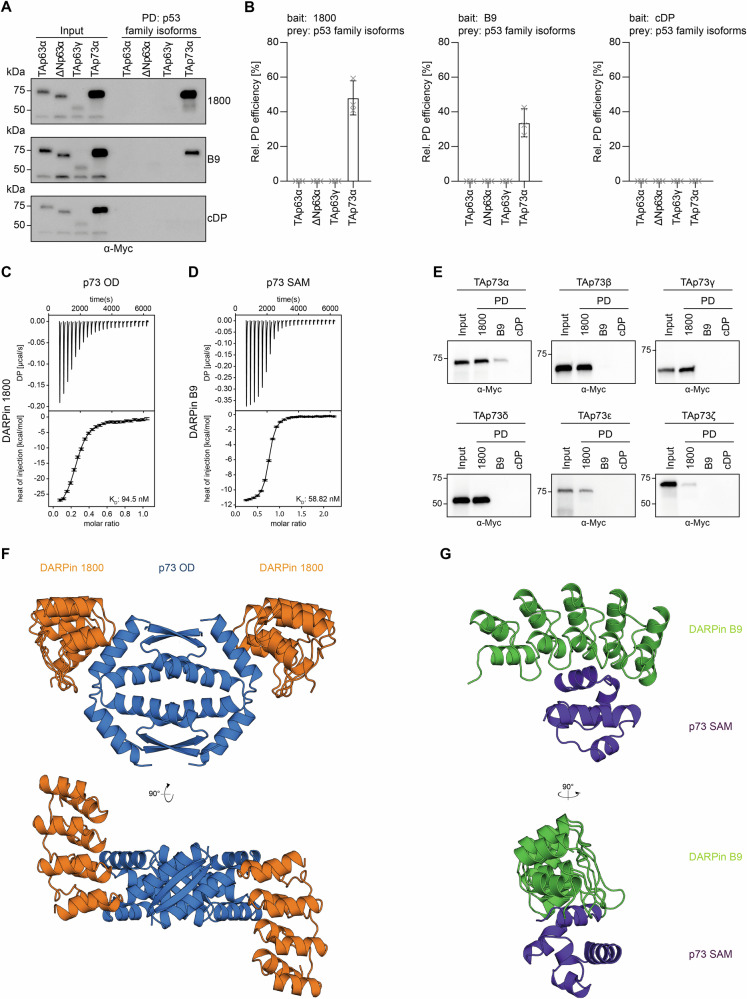
The concept of Targeted Protein Degradation (TPD) has been introduced as an attractive alternative to the development of classical inhibitors. TPD can extend the range of proteins that can be pharmacologically targeted beyond the classical targets for small molecule inhibitors, as a binding pocket is required but its occupancy does not need to lead to inhibition. The method is based on either small molecules that simultaneously bind to a protein of interest and to a cellular E3 ligase and bring them in close proximity (molecular glue) or a bi-functional molecule synthesized from the chemical linkage of a target protein-specific small molecule and one that binds to an E3 ligase (Proteolysis Targeting Chimeras (PROTAC)). The further extension of this approach to bioPROTACs, in which a small protein-based binding module is fused directly to an E3 ligase or an E3 ligase adaptor protein, makes virtually all proteins amenable to targeted degradation, as this method eliminates the requirement for binding pockets for small molecules. Designed Ankyrin Repeat Proteins (DARPins) represent a very attractive class of small protein-based binding modules that can be used for the development of bioPTOTACS. Here we describe the characterization of two DARPins generated against the oligomerization domain and the SAM domain of the transcription factor p73, a member of the p53 protein family. The DARPins can be used for (isoform-)selective pulldown experiments both in cell culture as well as primary tissue lysates. We also demonstrate that they can be used for staining in cell culture experiments. Fusing them to the speckle type POZ protein (SPOP), an adaptor protein for cullin-3 E3 ligase complexes, yields highly selective and effective degraders. We demonstrate that selective degradation of the ΔNp73α isoform reactivates p53.
靶向蛋白降解(TPD)的概念已被引入,作为经典抑制剂开发的一种有吸引力的替代方法。TPD可以将可进行药物靶向的蛋白质范围扩展到小分子抑制剂的经典靶点之外,因为它需要一个结合口袋,但占据该口袋并不一定导致抑制作用。该方法基于两类分子:一类是小分子,它同时结合目标蛋白和细胞E3连接酶并使它们紧密靠近(分子胶);另一类是双功能分子,由目标蛋白特异性小分子与结合E3连接酶的分子通过化学连接合成(蛋白酶靶向嵌合体(PROTAC))。这种方法进一步扩展到生物PROTAC,即基于小蛋白的结合模块直接与E3连接酶或E3连接酶适配蛋白融合,使得几乎所有蛋白质都适合靶向降解,因为这种方法消除了对小分子结合口袋的需求。设计的锚蛋白重复蛋白(DARPins)是一类非常有吸引力的基于小蛋白的结合模块,可用于生物PROTAC的开发。在这里,我们描述了针对转录因子p73(p53蛋白家族成员)的寡聚化结构域和SAM结构域产生的两种DARPins的特性。这些DARPins可用于细胞培养以及原代组织裂解物中的(异构体)选择性下拉实验。我们还证明它们可用于细胞培养实验中的染色。将它们与斑点型POZ蛋白(SPOP)(一种cullin-3 E3连接酶复合物的适配蛋白)融合,可产生高度选择性和有效的降解剂。我们证明,ΔNp73α异构体的选择性降解可重新激活p53。