Proietti Checchi Martina, Tarantino Samuela, Papetti Laura, Ursitti Fabiana, Monte Gabriele, Sforza Giorgia, Voci Alessandra, Ruscitto Claudia, Valeriani Massimiliano
Developmental Neurology Unit, Bambino Gesù Children's Hospital, IRCCS, Rome, Italy.
Systems Medicine Department, Tor Vergata University of Rome, Rome, Italy.
J Headache Pain. 2024 Dec 18;25(1):218. doi: 10.1186/s10194-024-01934-9.
Several studies examined stress factors in both adult and pediatric patients with migraine, but few of them have analyzed coping strategies adopted to deal with stressful events in pediatric age. In particular, some of these studies have focused on specific migraine populations or have not employed standardized instruments. Our study used a standardized tool to investigate the coping strategies adopted by patients with primary migraine in dealing with stressful events. We aimed at exploring: 1) Coping responses to stressful events and their possible association with migraine characteristics such as headache frequency, pain intensity and use of prophylactic treatment; (2) Potential differences in anxiety and depression symptoms based on migraine characteristics, and (3) Association between migraine characteristics, coping strategies, and psychological aspects.
We studied 81 adolescents (mean age 13.8 ± 1.6 years; 18 M and 63 F). They were divided into: (1) high frequency (weekly to daily episodes) and low frequency (≤ 4 episodes per month); (2) mild and severe pain; (3) need for prophylactic treatment or not. To evaluate patients' anxiety, depression and coping strategies we used respectively SAFA-A, SAFA-D and CRI-Y questionnaires.
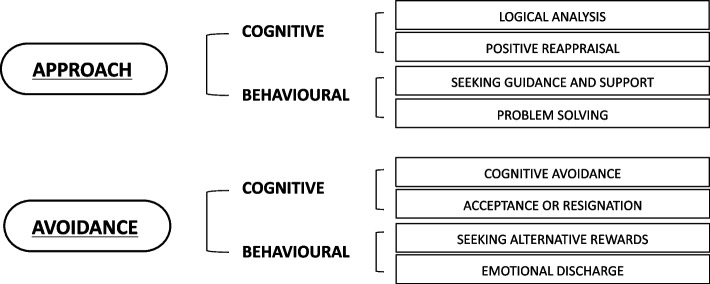
School and socialization represent the most commonly reported stressful events among our patients with migraine. Patients with high frequency of headache tend to adopt maladaptive coping strategies in "Logical Analysis" (p = 0.012), "Positive Reappraisal" (p = 0.002) and "Total Approach" (p = < 0.001). Moreover, patients with a high frequency of headache showed higher anxiety and depression scores (p = < 0.050). On the other hand, lower scores in some subscales of anxiety and depression emerged in high frequency patients who used "Logical Analysis" maladaptively (p = < 0.050).
Adolescents with a more disabling migraine pattern tend to employ maladaptive coping strategies focused on active behavioral responses to the stressful events.
多项研究探讨了成年和儿科偏头痛患者的应激因素,但很少有研究分析儿科患者应对应激事件所采用的应对策略。特别是,其中一些研究聚焦于特定的偏头痛人群,或者未使用标准化工具。我们的研究使用标准化工具来调查原发性偏头痛患者应对应激事件所采用的应对策略。我们旨在探究:1)对应激事件的应对反应及其与偏头痛特征(如头痛频率、疼痛强度和预防性治疗的使用)的可能关联;(2)基于偏头痛特征的焦虑和抑郁症状的潜在差异;以及(3)偏头痛特征、应对策略和心理方面之间的关联。
我们研究了81名青少年(平均年龄13.8±1.6岁;18名男性和63名女性)。他们被分为:(1)高频(每周至每日发作)和低频(每月≤4次发作);(2)轻度和重度疼痛;(3)是否需要预防性治疗。为了评估患者的焦虑、抑郁和应对策略,我们分别使用了SAFA - A、SAFA - D和CRI - Y问卷。
学校和社交是我们偏头痛患者中最常报告的应激事件。头痛频率高的患者在“逻辑分析”(p = 0.012)、“积极重新评价”(p = 0.002)和“总体应对方式”(p = <0.001)方面倾向于采用适应不良的应对策略。此外头痛频率高的患者焦虑和抑郁得分更高(p = <0.050)。另一方面,在适应不良地使用“逻辑分析”的高频患者中,焦虑和抑郁的一些子量表得分较低(p = <0.050)。
偏头痛模式更严重的青少年倾向于采用以对应激事件的积极行为反应为重点的适应不良应对策略。