Huang Suiqing, Chen Jiantao, Chu Tongxin, Luo Li, Liu Quan, Feng Kangni, Li Zeyu, Hou Jian, Wu Zhongkai
Department of Cardiac Surgery, First Affiliated Hospital of Sun Yat-sen University, 58 Zhongshan II Rd, Guangzhou, 510080, China.
School of Pharmaceutical Sciences, Sun Yat-sen University, Guangzhou, China.
BMC Infect Dis. 2024 Dec 18;24(1):1440. doi: 10.1186/s12879-024-10350-y.
This study aimed to summarize the pathogenic spectrum of infective endocarditis (IE) and analyze the risk factors for poor prognosis in surgical patients in a tertiary hospital in China.
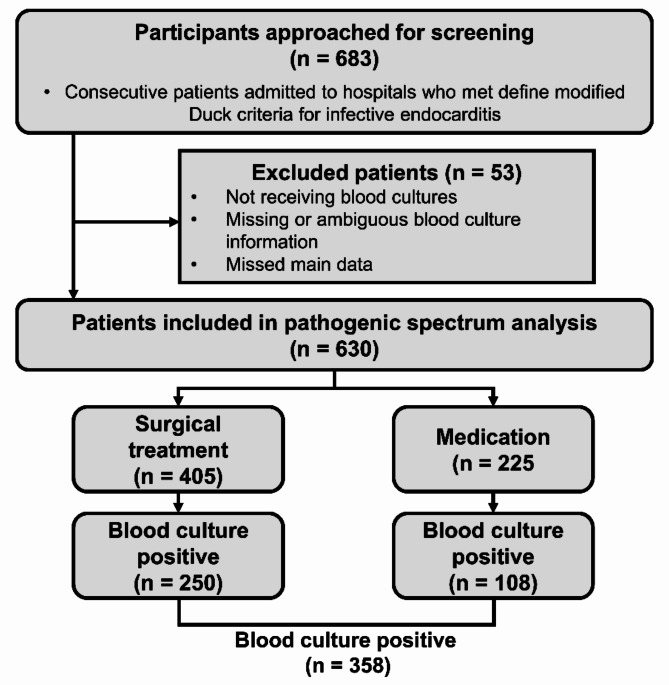
We retrospectively included patients diagnosed with IE between January 2013 and January 2022. The pathogenic spectrum was summarized; the risk factors for early postoperative mortality and embolic events were analyzed using multivariate logistic regression.
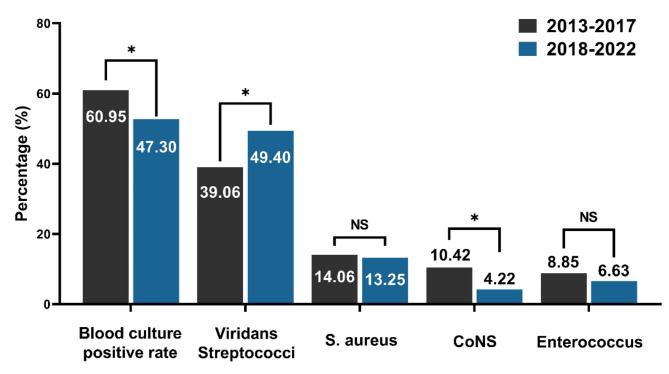
Among 630 patients who underwent blood cultures, the positivity rate was 56.83%. The most prevalent pathogens were viridans streptococci, Staphylococcus aureus, enterococci, and coagulase-negative staphylococci (CoNS). The prevalence of viridans streptococci significantly increased in the surgically treated group, compared to the medically treated group (50.80% vs. 27.78%, P < 0.001), while that of CoNS decreased (5.60% vs. 12.04%, P = 0.034). There has been a declining trend in the blood culture positivity in recent years compared to earlier years (2018-2022 vs. 2013-2017 = 60.95% vs. 47.30%, P = 0.037), with an increasing trend in viridans streptococci and a decreasing trend in CoNS. Multivariate logistic regression analysis identified male gender, coronary artery disease, platelet count < 100 × 10/L, albumin < 35 g/L, elevated creatinine, and prosthetic valve as independent risk factors for early postoperative mortality. Risk factors for embolic events included recent cerebral infarction within 3 months, history of peripheral vasculopathy, and hemoglobin (Hb) < 90 g/L.
Viridans streptococci predominates as the most common IE pathogen, with its incidence rising recently, especially among surgical patients. Blood culture positivity is decreasing. Understanding risk factors for early postoperative mortality and embolic events is crucial for optimizing patient management and prognosis.
Not applicable.
本研究旨在总结感染性心内膜炎(IE)的致病谱,并分析中国一家三级医院手术患者预后不良的危险因素。
我们回顾性纳入了2013年1月至2022年1月期间诊断为IE的患者。总结致病谱;采用多因素logistic回归分析术后早期死亡和栓塞事件的危险因素。
在630例行血培养的患者中,阳性率为56.83%。最常见的病原体是草绿色链球菌、金黄色葡萄球菌、肠球菌和凝固酶阴性葡萄球菌(CoNS)。与内科治疗组相比,手术治疗组草绿色链球菌的患病率显著增加(50.80%对27.78%,P<0.001),而CoNS的患病率下降(5.60%对12.04%,P=0.034)。与早年相比,近年来血培养阳性率呈下降趋势(2018 - 2022年对2013 - 2017年=60.95%对47.30%,P=0.037),草绿色链球菌呈上升趋势,CoNS呈下降趋势。多因素logistic回归分析确定男性、冠状动脉疾病、血小板计数<100×10⁹/L、白蛋白<35g/L、肌酐升高和人工瓣膜是术后早期死亡的独立危险因素。栓塞事件的危险因素包括3个月内近期脑梗死、外周血管病病史和血红蛋白(Hb)<90g/L。
草绿色链球菌是最常见的IE病原体,其发病率最近有所上升,尤其是在手术患者中。血培养阳性率在下降。了解术后早期死亡和栓塞事件的危险因素对于优化患者管理和预后至关重要。
不适用。