Xia Yu, Pang Linhong, Tang MingJing, Luo Zhiling, Ma Min, Wang Huadan, He Liping, Duo Lin, Zhu Da, Pan Xiangbin
Department of Scientific Research and Chronic Disease Management, Fuwai Yunnan Hospital, Chinese Academy of Medical Sciences, Affiliated Cardiovascular Hospital of Kunming Medical University, Kunming, 650102, China.
School of Public Health, Kunming Medical University, Kunming, 650500, China.
BMC Public Health. 2024 Dec 18;24(1):3461. doi: 10.1186/s12889-024-20891-1.
Available evidence falls short in assessing the risk of long-term outcomes among individuals with hypertension residing at various altitudes. We aimed to investigate the association between residential altitude and the risk of all-cause and cardiovascular disease (CVD) mortality among hypertensive patients.
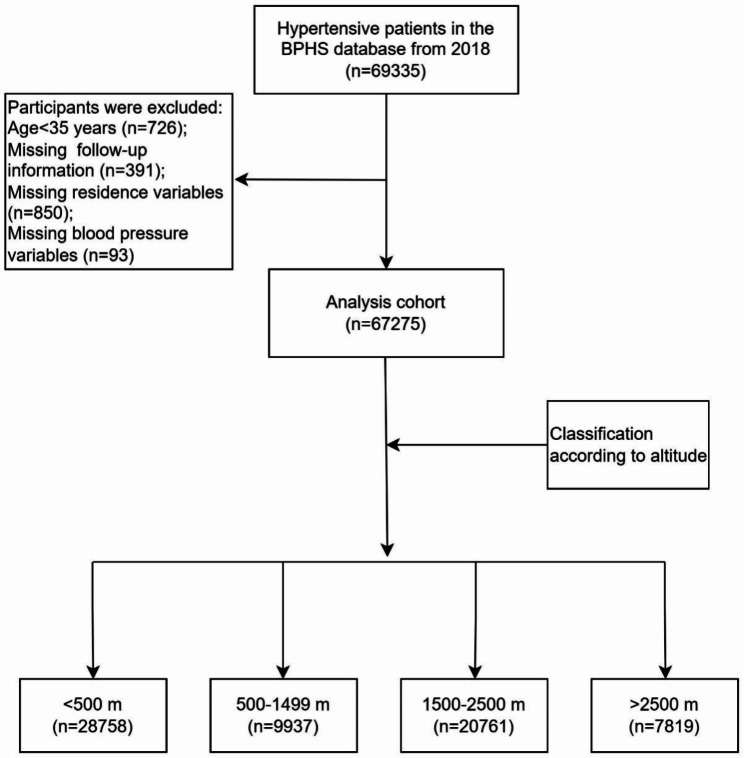
This cohort study encompassed 67,275 hypertensive patients aged ≥35 years who participated in China's Basic Public Health Service Program in 2018. Participants were categorized into four groups based on their residence altitude: <500 m, 500-1,499 m, 1,500-2,500 m, and > 2,500 m. The associations between residential altitude and the risks of all-cause and CVD mortality were analyzed using Cox proportional hazards regression models. The dose-response relationship was performed by the restricted cubic spline with multivariable adjusted models.
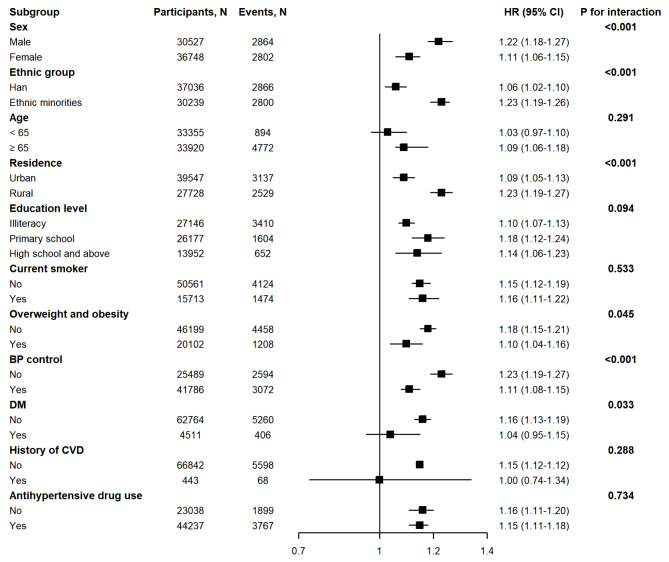
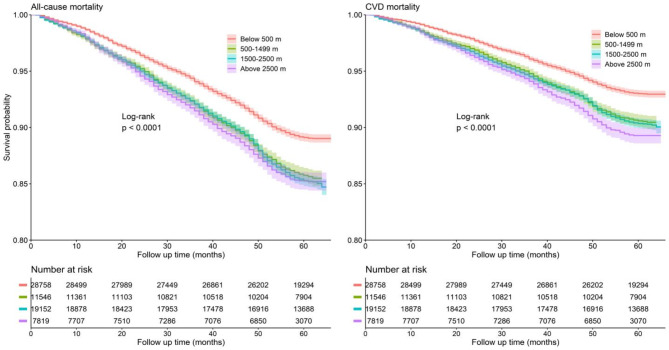
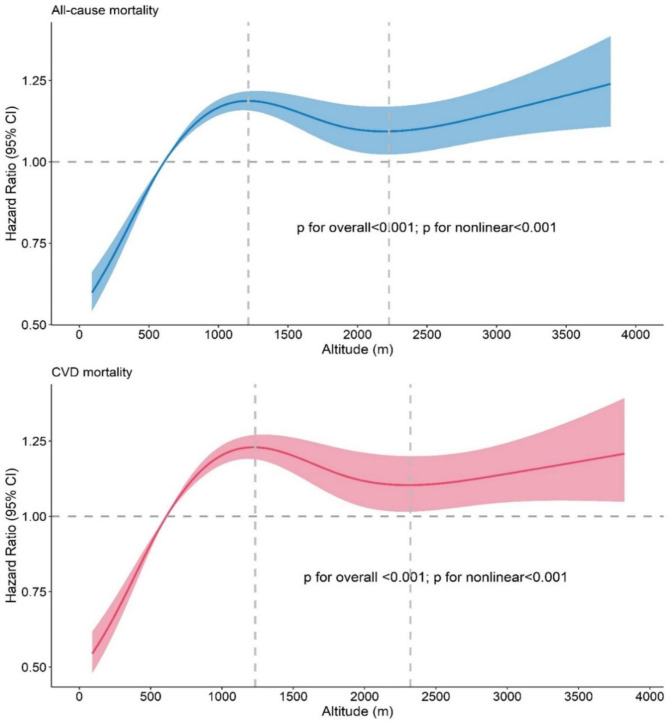
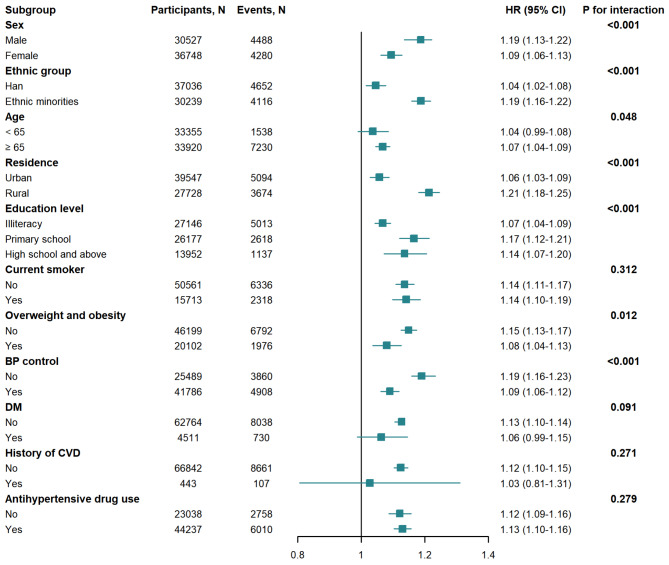
Among the 67,275 hypertensive patients included in the study (mean age of 63.9 years, with 45.3% male), 8,768 deaths were recorded, of which 5,666 were attributed to CVD. Following multivariate adjustment, when compared to the group residing at altitudes < 500 m, the groups living at altitudes of 500-1,499 m, 1500-2,500 m, and > 2,500 m exhibited significantly risks of all-cause mortality [HR = 1.45 (95% CI: 1.36-1.54), 1.35 (95% CI: 1.28-1.43), and 1.41 (95% CI: 1.28-1.54), respectively] and CVD mortality [HR = 1.47 (95% CI: 1.35-1.58), 1.42 (95% CI: 1.33-1.52), and 1.46 (95% CI: 1.31-1.62), respectively]. The restricted cubic spline curves revealed a nonlinear relationship between residential altitude and all-cause and CVD mortality. The risk of mortality was higher among participants with poorly controlled blood pressure, aged 65 years and above, and living in rural areas.
This study demonstrated a significant association between long-term residential high-altitude exposure and increased risks of all-cause and CVD mortality among hypertension patients. The implications of the findings call for a prioritization of public health resource allocation and early intervention efforts, especially for those living at high altitudes and in low-income areas where hypertension is prevalent.
现有证据不足以评估居住在不同海拔高度的高血压患者发生长期不良结局的风险。我们旨在研究居住海拔与高血压患者全因死亡和心血管疾病(CVD)死亡风险之间的关联。
这项队列研究纳入了2018年参加中国基本公共卫生服务项目的67275名年龄≥35岁的高血压患者。参与者根据居住海拔分为四组:<500米、500 - 1499米、1500 - 2500米和>2500米。使用Cox比例风险回归模型分析居住海拔与全因死亡和CVD死亡风险之间的关联。采用多变量调整模型的受限立方样条进行剂量反应关系分析。
在纳入研究的67275名高血压患者中(平均年龄63.9岁,男性占45.3%),记录到8768例死亡,其中5666例归因于CVD。多变量调整后,与居住在海拔<500米的组相比,居住在海拔500 - 1499米、1500 - 2500米和>2500米的组全因死亡风险显著增加[风险比(HR)分别为1.45(95%置信区间:1.36 - 1.54)、1.35(95%置信区间:1.28 - 1.43)和1.41(95%置信区间:1.28 - 1.54)],CVD死亡风险也显著增加[HR分别为1.47(95%置信区间:1.35 - 1.58)、1.42(95%置信区间:1.33 - 1.52)和1.46(95%置信区间:1.31 - 1.62)]。受限立方样条曲线显示居住海拔与全因死亡和CVD死亡之间存在非线性关系。血压控制不佳、年龄在65岁及以上以及居住在农村地区的参与者死亡风险更高。
本研究表明,高血压患者长期居住在高海拔地区与全因死亡和CVD死亡风险增加之间存在显著关联。研究结果的意义在于需要优先分配公共卫生资源并进行早期干预,特别是对于居住在高海拔地区和高血压流行的低收入地区的人群。