Racchetti Gabriella, Meldolesi Jacopo
San Raffaele Institute, Vita-Salute San Raffaele University, Milan 20132, Italy.
CNR Institute of Neuroscience at the Milano-Bicocca University, Vedano al Lambro, Milan 20854, Italy.
Extracell Vesicles Circ Nucl Acids. 2023 Mar 15;4(1):44-58. doi: 10.20517/evcna.2023.03. eCollection 2023.
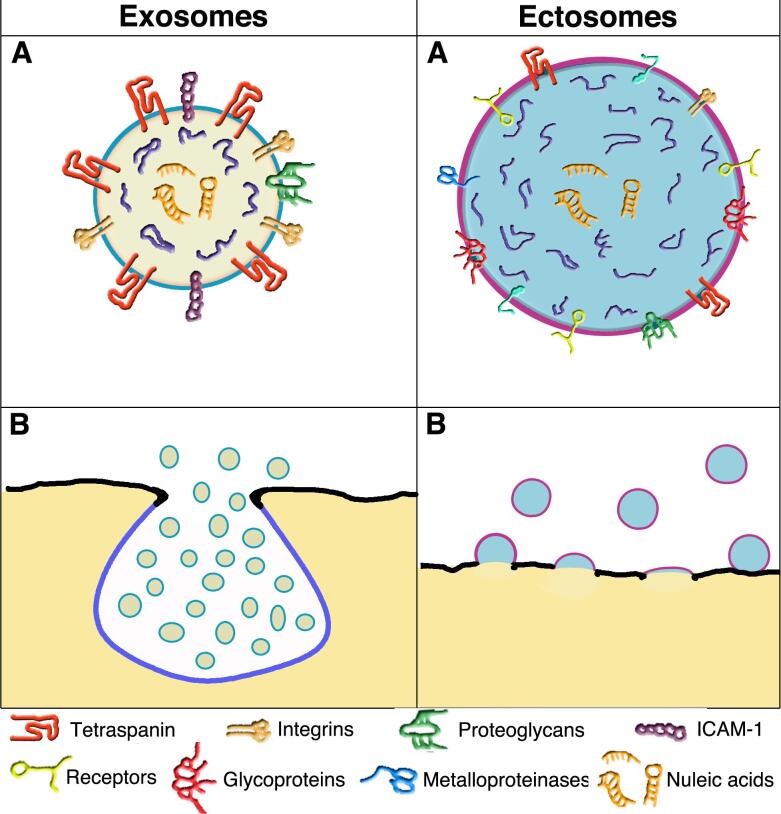
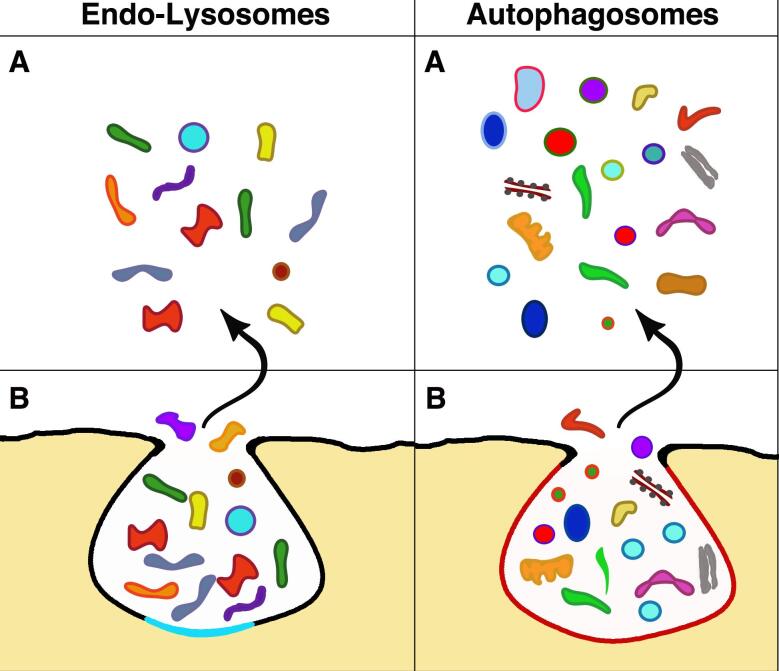
In all cells, generation and release of specific vesicles are the initial steps of back-and-forth intercellular communication. These processes are critical in normal physiology and pathophysiology. Vesicles have particular functions appropriate to their targets. When stimulated, they are released into the extracellular space. Four cytoplasmic membrane-bound structures generate their particular vesicles. Among these structures, multivesicular bodies (MVBs) can accumulate many small vesicles in their lumen; release occurs upon MVB exocytosis. Ectosomes are larger vesicles characterized by their responses and are generated directly and released independently from specific microdomains pre-established in the thickness of the plasma membrane. Most lysosomes do not generate vesicles. However, unique components of a minor form, the endo-lysosome, constitute the third class of structures that release a few vesicles by exocytosis with molecules and structures inducing changes in the extracellular environment. The autophagosome, the fourth structure, releases several heterogeneous vesicles by exocytosis with malformed bio-molecules, assembled structures, and damaged organelles. Interestingly, the frequent interaction of autophagosomes with MVBs and their exosomes contributes to the regulation and intensity of their action. The specificity and function of released vesicles depend on their membranes' and luminal cargoes' composition and dynamics. An ongoing investigation of the various vesicles reveals new properties regarding their generation, release, and resulting extracellular processes. The growth of information about structures and their vesicles progressively extends the knowledge base regarding cell communication and contributes to their clinical applications.
在所有细胞中,特定囊泡的生成和释放是细胞间双向通讯的起始步骤。这些过程在正常生理和病理生理中至关重要。囊泡具有与其靶标相适应的特定功能。受到刺激时,它们会释放到细胞外空间。有四种细胞质膜结合结构会产生其特定的囊泡。在这些结构中,多泡体(MVBs)的内腔可积累许多小囊泡;多泡体胞吐时发生释放。外泌体是较大的囊泡,其特征在于其反应,它们直接产生并从质膜厚度中预先建立的特定微结构域独立释放。大多数溶酶体不产生囊泡。然而,一种小形式的独特成分,即内溶酶体,构成了第三类结构,它们通过胞吐作用释放少量囊泡,囊泡中含有可诱导细胞外环境变化的分子和结构。自噬体,即第四种结构,通过与畸形生物分子、组装结构和受损细胞器一起胞吐作用释放几种异质囊泡。有趣的是,自噬体与多泡体及其外泌体的频繁相互作用有助于调节其作用并增强其作用强度。释放的囊泡的特异性和功能取决于其膜和内腔货物的组成及动态变化。对各种囊泡的持续研究揭示了有关其生成、释放及由此产生的细胞外过程的新特性。关于结构及其囊泡的信息不断增加,逐渐扩展了有关细胞通讯的知识库,并促进了它们在临床上的应用。