Acır İbrahim, Erdoğan Hacı Ali, Toka Ertuğrul, Yayla Vildan
Neurology Department, Bakırköy Dr. Sadi Konuk Training and Research Hospital, Istanbul, Turkey.
Clin Med Insights Oncol. 2024 Dec 17;18:11795549241308090. doi: 10.1177/11795549241308090. eCollection 2024.
The aim of this study is to examine the hematological and biochemical variables in patients diagnosed with cancer-related stroke who have different types of cancer and to evaluate the effects of these variables.
This retrospective study was conducted at a tertiary hospital stroke center and included 153 patients diagnosed with cancer-related stroke. Comprehensive etiological investigations were performed, and patients were classified according to the Trial of Org 101072 in Acute Stroke Treatment (TOAST) classification. Laboratory parameters including d-dimer, C-reactive protein (CRP), erythrocyte sedimentation rate (ESR), and fibrinogen levels were collected from blood samples taken at the time of stroke. Statistical analysis was performed using 1-way analysis of variance to assess differences in laboratory parameters across different cancer types.
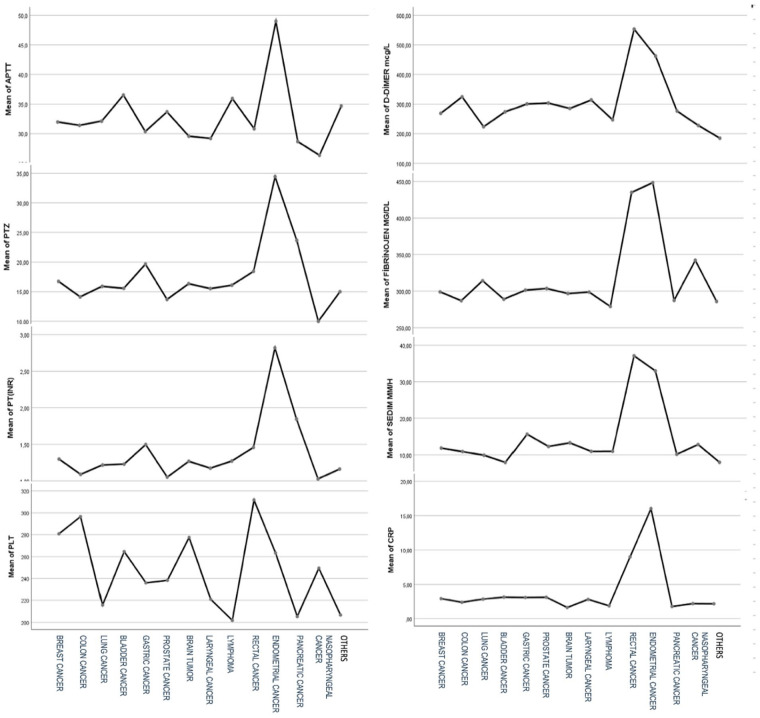
The study found significant variations in hematological and biochemical parameters among different cancer types. Specifically, glomerular filtration rate, activated partial thromboplastin time, prothrombin time, and international normalized ratio levels showed significant differences across cancer types ( < 0.05), indicating that these factors may play distinct roles in the pathophysiology of cancer-related strokes. d-dimer, CRP, and sedimentation levels were significantly elevated in certain cancer types such as rectal, endometrial, and pancreatic cancers ( < .01). These findings suggest a strong association between hypercoagulability and increased risk of stroke in these patients.
This retrospective study highlights the importance of considering cancer-specific factors in the management of stroke risk, particularly in cancers such as pancreatic and colon, which show a predisposition to earlier stroke occurrence. The elevated coagulation factors in these patients suggest the potential need for early preventive treatment with anticoagulants or thrombin inhibitors.
本研究旨在检查被诊断患有与癌症相关中风的不同癌症类型患者的血液学和生化指标,并评估这些指标的影响。
这项回顾性研究在一家三级医院的中风中心进行,纳入了153例被诊断患有与癌症相关中风的患者。进行了全面的病因调查,并根据急性中风治疗中组织纤溶酶原激活剂-10172试验(TOAST)分类对患者进行分类。从中风时采集的血样中收集包括D-二聚体、C反应蛋白(CRP)、红细胞沉降率(ESR)和纤维蛋白原水平在内的实验室参数。使用单因素方差分析进行统计分析,以评估不同癌症类型之间实验室参数的差异。
研究发现不同癌症类型之间血液学和生化参数存在显著差异。具体而言,肾小球滤过率、活化部分凝血活酶时间、凝血酶原时间和国际标准化比值水平在不同癌症类型之间存在显著差异(<0.05),表明这些因素可能在与癌症相关中风的病理生理学中发挥不同作用。在某些癌症类型如直肠癌、子宫内膜癌和胰腺癌中,D-二聚体、CRP和血沉水平显著升高(<0.01)。这些发现表明这些患者的高凝状态与中风风险增加之间存在密切关联。
这项回顾性研究强调了在中风风险管理中考虑癌症特异性因素的重要性,特别是在胰腺癌和结肠癌等癌症中,这些癌症易发生较早的中风。这些患者凝血因子升高表明可能需要早期使用抗凝剂或凝血酶抑制剂进行预防性治疗。