Pütz Jil, Jansen Simon, Reutimann Oliver, Rellstab Christian, Bordács Sándor, Neophytou Charalambos
Department of Forest and Soil Sciences, Institute of Silviculture, BOKU University, Peter-Jordan-Str. 82, AT-1190 Vienna, Austria.
Institute of Integrative Biology, ETH Zurich, CH-8092 Zurich, Switzerland.
Ann Bot. 2025 May 9;135(5):867-884. doi: 10.1093/aob/mcae216.
In Central Europe, the drought-tolerant downy oak (Quercus pubescens) is at the northern edge of its natural distribution range, often growing in small and spatially isolated populations. Here, we elucidate how the population genetic structure of Central European Q. pubescens was shaped by geographical barriers, genetic drift and introgression with the closely related sessile oak (Q. petraea).
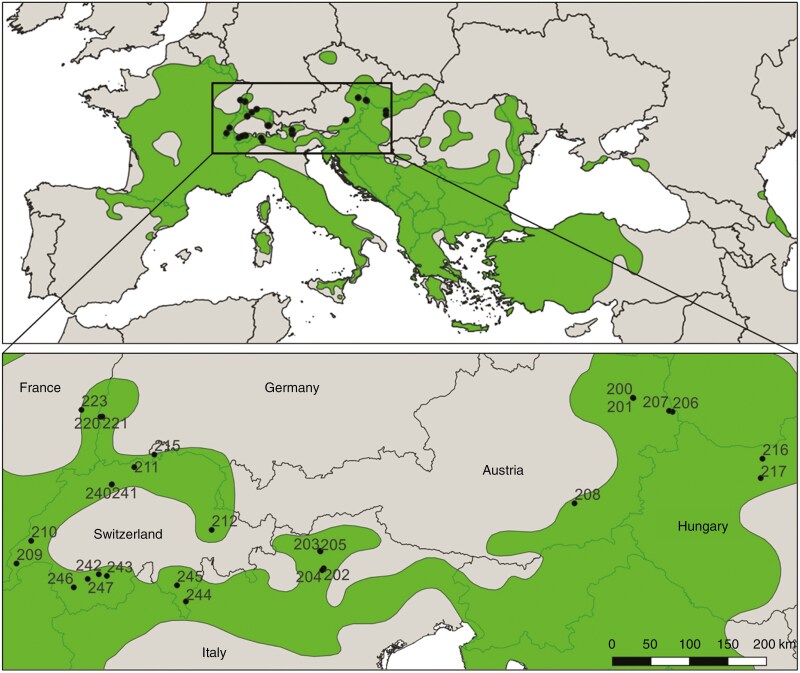
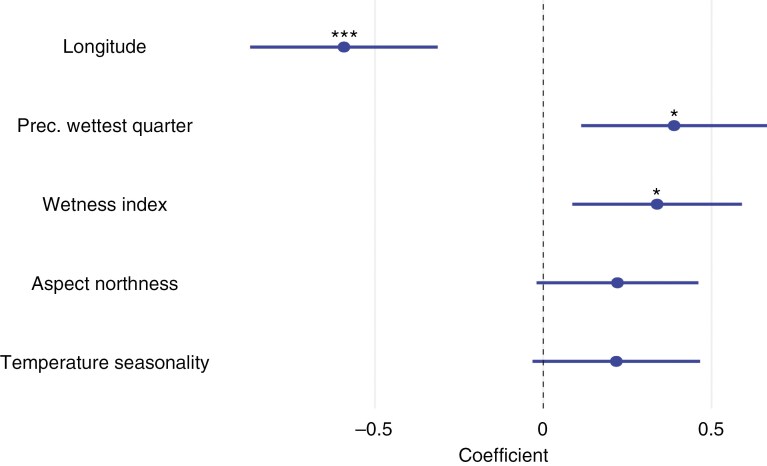
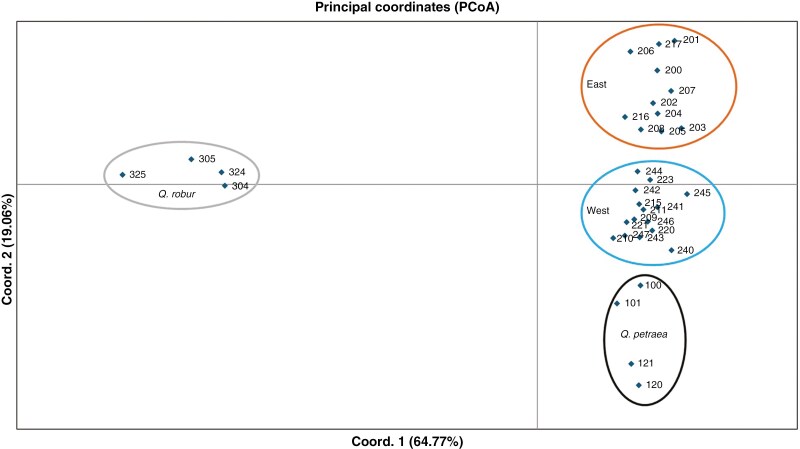
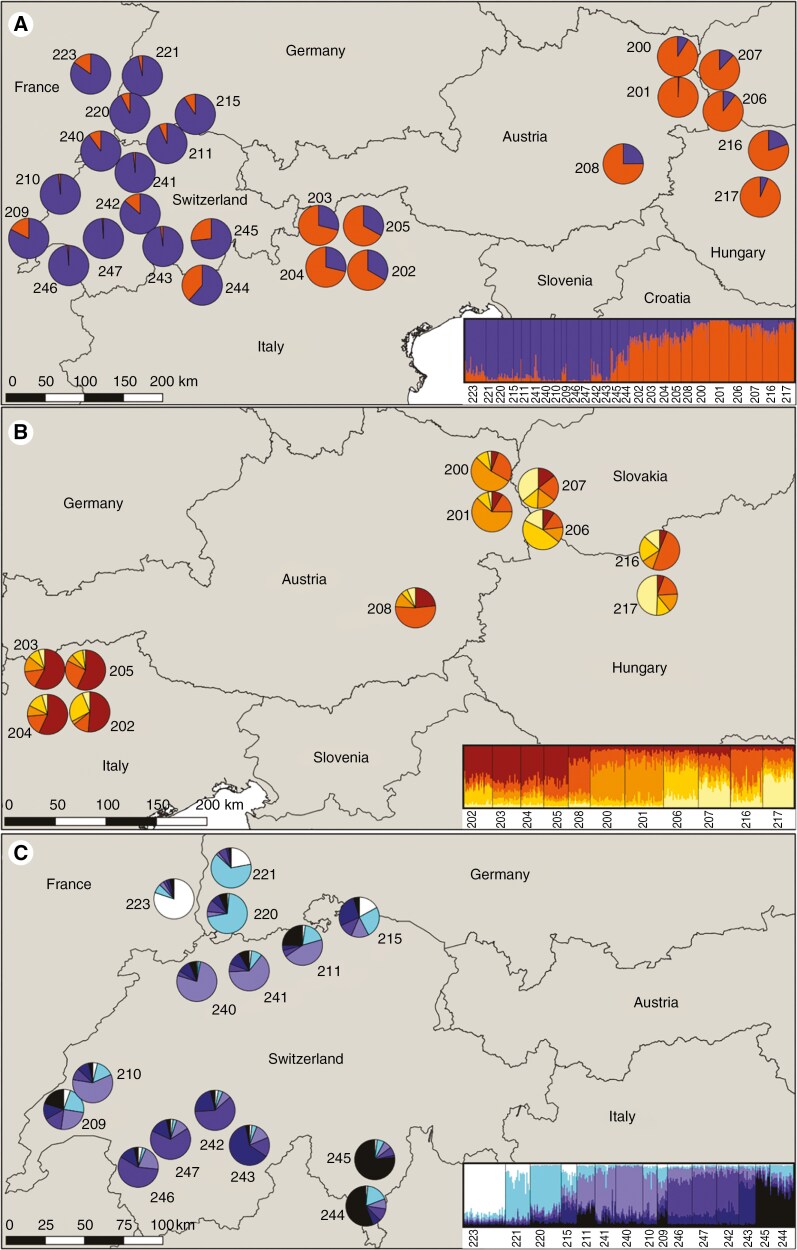
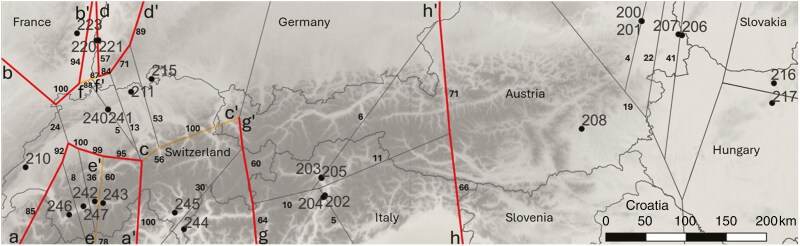
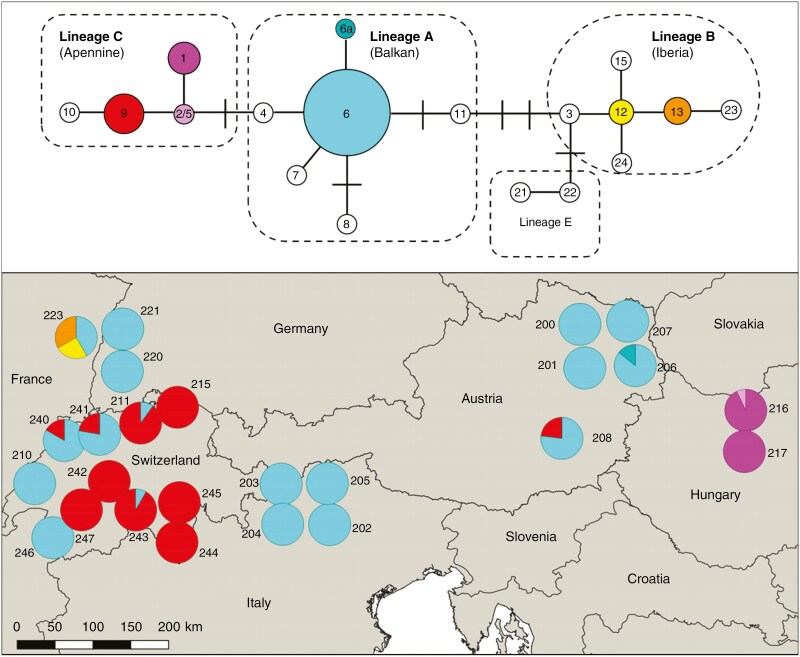
In total, 27 Q. pubescens populations from the northern margin of its natural distribution range were sampled. Based on 16 nuclear microsatellite markers (nSSRs), Bayesian clustering and distance-based analyses were performed to determine the intraspecific genetic structure and to identify genetic barriers. To identify drivers of introgression with Q. petraea, generalized linear models were applied to link levels of introgression with environmental conditions. To track post-glacial migration routes, the spatial distribution of haplotypes based on eight chloroplast microsatellite markers (cpSSRs) was investigated.
Based on nSSRs, the study populations of Q. pubescens were divided into a western and an eastern genetic cluster. Within these clusters, more pronounced genetic substructure was observed in the west, probably due to a rugged topography and limited gene flow. Introgression from Q. petraea was more prevalent at wetter and north-exposed sites and in the west. The identified cpSSR haplotypes followed known migration pathways.
Our results suggest two late-glacial refugia in or near the southwestern Alps and the southeastern Alps as potential sources for post-glacial migration. Although some genetic exchange is evident in northern Italy, south of the Alps, the two clusters remain distinct at a large scale. Landscape features and introgression with Q. petraea shaped the genetic substructure at a smaller scale. Our study provides a comprehensive overview of the genetic structure of Q. pubescens in Central Europe, relevant for conservation.
在中欧,耐旱的柔毛栎(Quercus pubescens)处于其自然分布范围的北缘,常生长在小规模且空间隔离的种群中。在此,我们阐明中欧柔毛栎的种群遗传结构是如何受到地理障碍、遗传漂变以及与近缘的无梗花栎(Quercus petraea)的基因渗入影响的。
总共对其自然分布范围北缘的27个柔毛栎种群进行了采样。基于16个核微卫星标记(nSSRs),进行了贝叶斯聚类分析和基于距离的分析,以确定种内遗传结构并识别遗传障碍。为了识别与无梗花栎基因渗入的驱动因素,应用广义线性模型将渗入水平与环境条件联系起来。为了追踪冰期后的迁移路线,研究了基于8个叶绿体微卫星标记(cpSSRs)的单倍型空间分布。
基于nSSRs,柔毛栎的研究种群被分为西部和东部遗传簇。在这些簇内,西部观察到更明显的遗传亚结构,可能是由于地形崎岖和基因流有限。来自无梗花栎的基因渗入在更湿润、朝北的地点以及西部更为普遍。所识别的cpSSR单倍型遵循已知的迁移路径。
我们的结果表明,在阿尔卑斯山脉西南部和东南部或其附近的两个末次冰期避难所是冰期后迁移的潜在来源。尽管在意大利北部阿尔卑斯山以南有一些明显的基因交流,但这两个簇在大尺度上仍然保持 distinct。景观特征和与无梗花栎的基因渗入在较小尺度上塑造了遗传亚结构。我们的研究提供了中欧柔毛栎遗传结构的全面概述,对保护具有重要意义。