Li Changying, Pang Guojin, Zhao Weihua, Liu Yingying, Huang Xiaoli, Chen Wei, Zhao Xinyan, Liu Tianhui, Wang Ping, Fan Xu, Gao Ming, Cong Min
Liver Research Center, Beijing Friendship Hospital, Capital Medical University, State Key Laboratory of Digestive Health and National Clinical Research Center of Digestive Diseases, Beijing, China.
Emergency Department, The First Affiliated Hospital of Tsinghua University, Beijing, China.
Hepatol Commun. 2024 Dec 20;9(1). doi: 10.1097/HC9.0000000000000604. eCollection 2025 Jan 1.
Hepcidin, a peptide hormone primarily produced by the liver, regulates iron metabolism by interacting with its receptor, ferroportin. Studies have demonstrated that hepcidin participates in the progression of liver fibrosis by regulating HSC activation, but its regulatory effect on hepatocytes remains largely unknown.
A carbon tetrachloride (CCl4)-induced liver fibrosis model was established in C57BL/6 wild-type (WT) and hepcidin knockout (Hamp-/-) mice. Liver injury and inflammation were assessed in WT and Hamp-/- mice at 24 and 48 hours following acute CCl4 exposure. In addition, transcriptomic sequencing of primary hepatocytes was performed to compare gene expression profiles between WT and Hamp-/- mice 24 hours after liver injury. The function of the identified molecule Eif2ak3/PERK (protein kinase R(PKR)-like endoplasmic reticulum kinase), was evaluated both in vitro and in vivo.
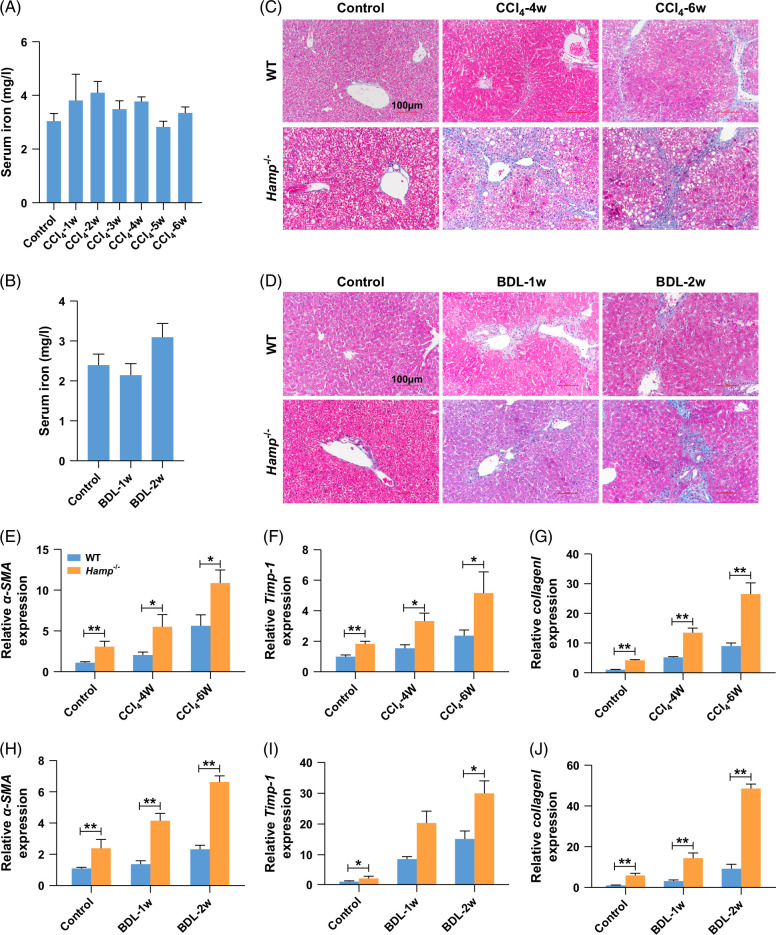
We found that serum hepcidin significantly increased during the progression of liver fibrosis induced by CCl4 and bile duct ligation. In addition, CCl4-treated Hamp-/- mice developed more severe liver injury, liver fibrosis, and hepatocyte apoptosis, with elevated Bax and decreased Bcl-2 expression, compared to the WT mice. Transcriptomic analysis of primary hepatocytes revealed that PERK was upregulated in Hamp-/- mice after CCl4 treatment, promoting apoptosis by regulating Bax and Bcl-2 expression. Subsequently, we demonstrated that hepcidin prevents hepatocyte apoptosis by inhibiting PERK both in vitro and in vivo.
Hepcidin inhibits hepatocyte apoptosis through suppression of the PERK pathway, highlighting its protective role in liver fibrosis and identifying a potential therapeutic target for the treatment of liver fibrosis.
铁调素是一种主要由肝脏产生的肽类激素,通过与其受体铁转运蛋白相互作用来调节铁代谢。研究表明,铁调素通过调节肝星状细胞(HSC)激活参与肝纤维化的进展,但其对肝细胞的调节作用在很大程度上仍不清楚。
在C57BL/6野生型(WT)和铁调素基因敲除(Hamp-/-)小鼠中建立四氯化碳(CCl4)诱导的肝纤维化模型。在急性CCl4暴露后24小时和48小时评估WT和Hamp-/-小鼠的肝损伤和炎症。此外,对原代肝细胞进行转录组测序,以比较肝损伤后24小时WT和Hamp-/-小鼠之间的基因表达谱。对鉴定出的分子真核翻译起始因子2α激酶3/蛋白激酶R(PKR)样内质网激酶(Eif2ak3/PERK)的功能进行体外和体内评估。
我们发现,在CCl4和胆管结扎诱导的肝纤维化进展过程中,血清铁调素显著增加。此外,与WT小鼠相比,CCl4处理的Hamp-/-小鼠出现更严重的肝损伤、肝纤维化和肝细胞凋亡,Bax表达升高,Bcl-2表达降低。原代肝细胞的转录组分析显示,CCl4处理后Hamp-/-小鼠中PERK上调,通过调节Bax和Bcl-2表达促进细胞凋亡。随后,我们证明铁调素在体外和体内均通过抑制PERK来预防肝细胞凋亡。
铁调素通过抑制PERK途径抑制肝细胞凋亡,突出了其在肝纤维化中的保护作用,并确定了治疗肝纤维化的潜在治疗靶点。