Song Qi, Singh Alex, McDonough John E, Adams Taylor S, Vos Robin, De Man Ruben, Myers Greg, Ceulemans Laurens J, Vanaudenaerde Bart M, Wuyts Wim A, Yan Xiting, Schupp Jonas, Hagood James S, Kaminski Naftali, Bar-Joseph Ziv
Computational Biology Department, School of Computer Science, Carnegie Mellon University, Pittsburgh, Pennsylvania, United States of America.
Faculty of Health Sciences, McMaster University, Ontario, Canada.
PLoS Comput Biol. 2024 Dec 19;20(12):e1012632. doi: 10.1371/journal.pcbi.1012632. eCollection 2024 Dec.
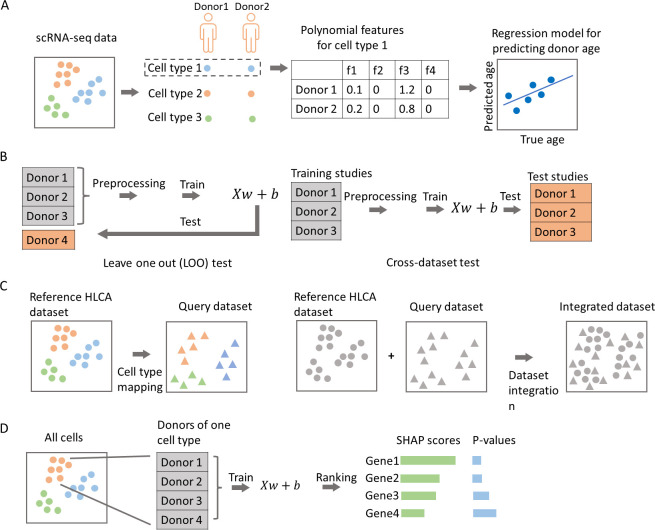
Age prediction based on single cell RNA-Sequencing data (scRNA-Seq) can provide information for patients' susceptibility to various diseases and conditions. In addition, such analysis can be used to identify aging related genes and pathways. To enable age prediction based on scRNA-Seq data, we developed PolyEN, a new regression model which learns continuous representation for expression over time. These representations are then used by PolyEN to integrate genes to predict an age. Existing and new lung aging data we profiled demonstrated PolyEN's improved performance over existing methods for age prediction. Our results identified lung epithelial cells as the most significant predictors for non-smokers while lung endothelial cells led to the best chronological age prediction results for smokers.
基于单细胞RNA测序数据(scRNA-Seq)的年龄预测可为患者对各种疾病和状况的易感性提供信息。此外,这种分析可用于识别与衰老相关的基因和途径。为了基于scRNA-Seq数据进行年龄预测,我们开发了PolyEN,这是一种新的回归模型,它学习随时间变化的表达的连续表示。然后,PolyEN使用这些表示来整合基因以预测年龄。我们分析的现有和新的肺衰老数据表明,PolyEN在年龄预测方面比现有方法具有更好的性能。我们的结果表明,肺上皮细胞是非吸烟者最重要的预测因子,而肺内皮细胞则为吸烟者带来了最佳的实际年龄预测结果。