Lee Donghun, Lee Gwangrog
Department of Biological Sciences, Korea Advanced Institute of Science and Technology, Daejeon 34141, Korea.
BMB Rep. 2025 Jan;58(1):17-23. doi: 10.5483/BMBRep.2024-0178.
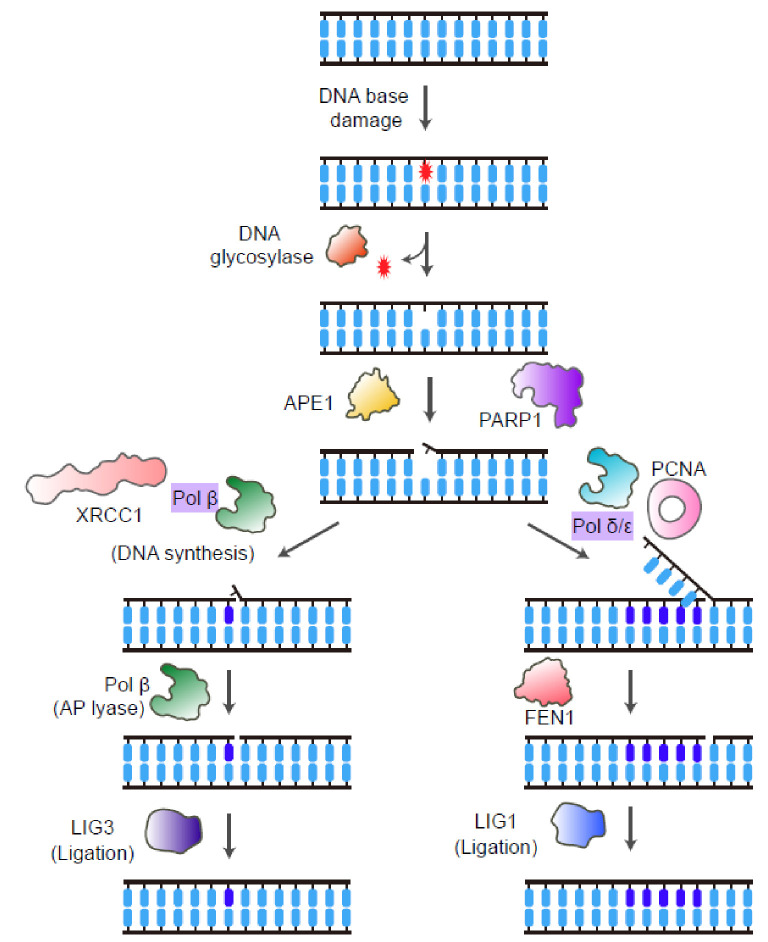
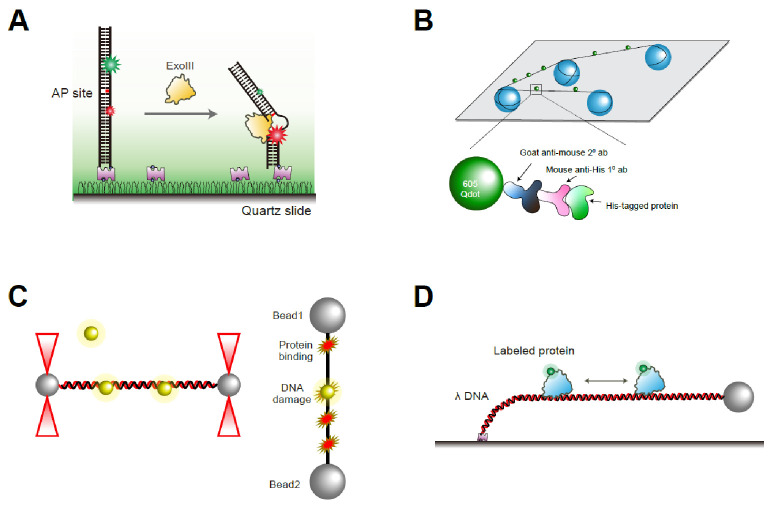
Base excision repair (BER) is an essential cellular mechanism that repairs small, non-helix-distorting base lesions in DNA, resulting from oxidative damage, alkylation, deamination, or hydrolysis. This review highlights recent advances in understanding the molecular mechanisms of BER enzymes through single-molecule studies. We discuss the roles of DNA glycosylases in lesion recognition and excision, with a focus on facilitated diffusion mechanisms such as sliding and hopping that enable efficient genome scanning. The dynamics of apurinic/apyrimidinic endonucleases, especially the coordination between APE1 and DNA polymerase β (Pol β), are explored to demonstrate their crucial roles in processing abasic sites. The review further explores the short-patch and long-patch BER pathways, emphasizing the activities of Pol β, XRCC1, PARP1, FEN1, and PCNA in supporting repair synthesis and ligation. Additionally, we highlight the emerging role of UV-DDB as a general damage sensor in BER, extending its recognized function beyond nucleotide excision repair. Single-molecule techniques have been instrumental in uncovering the complex interactions and mechanisms of BER proteins, offering unprecedented insights that could guide future therapeutic strategies for maintaining genomic stability. [BMB Reports 2025; 58(1): 17-23].
碱基切除修复(BER)是一种重要的细胞机制,可修复DNA中因氧化损伤、烷基化、脱氨基或水解导致的小的、不扭曲螺旋的碱基损伤。本综述重点介绍了通过单分子研究在理解BER酶分子机制方面的最新进展。我们讨论了DNA糖基化酶在损伤识别和切除中的作用,重点关注促进扩散机制,如滑动和跳跃,这些机制能够实现高效的基因组扫描。探索了脱嘌呤/脱嘧啶内切核酸酶的动力学,特别是APE1和DNA聚合酶β(Polβ)之间的协调作用,以证明它们在处理无碱基位点中的关键作用。本综述进一步探讨了短补丁和长补丁BER途径,强调了Polβ、XRCC1、PARP1、FEN1和PCNA在支持修复合成和连接中的活性。此外,我们强调了UV-DDB作为BER中一种通用损伤传感器的新作用,将其公认功能扩展到核苷酸切除修复之外。单分子技术有助于揭示BER蛋白的复杂相互作用和机制,提供了前所未有的见解,可为未来维持基因组稳定性的治疗策略提供指导。[《BMB报告》2025年;58(1): 17 - 23]