Whiston Aoife, Kidwell K M, O'Reilly S, Walsh C, Walsh J C, Glynn L, Robinson K, Hayes S
School of Allied Health, Ageing Research Centre, Health Research Institute, University of Limerick, Limerick, Ireland.
Department of Psychology, University of Limerick, Limerick, Ireland.
BMC Med Res Methodol. 2024 Dec 19;24(1):308. doi: 10.1186/s12874-024-02439-4.
Physical activity (PA) is often the cornerstone in risk-reduction interventions for the prevention and treatment of many chronic health conditions. PA interventions are inherently multi-dimensional and complex in nature. Thus, study designs used in the evaluation of PA interventions must be adaptive to intervention components and individual capacities. A Sequential Multiple Assignment Randomised Trial (SMART) is a factorial design in a sequential setting used to build effective adaptive interventions. SMARTs represent a relatively new design for PA intervention research. This systematic review aims to examine the state-of-the-art of SMARTs used to develop PA interventions, with a focus on study characteristics, design, and analyses.
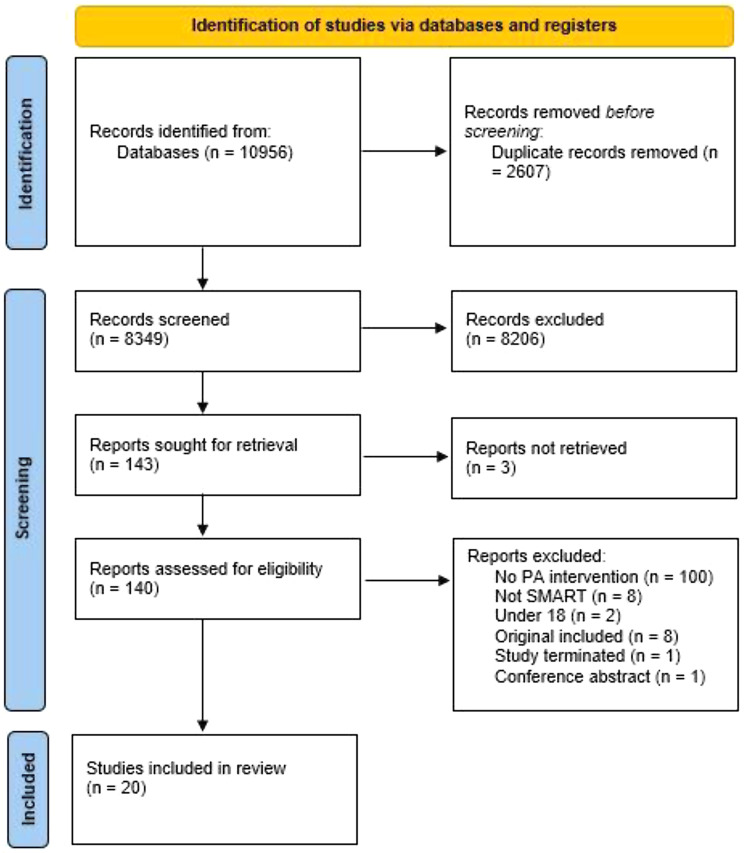
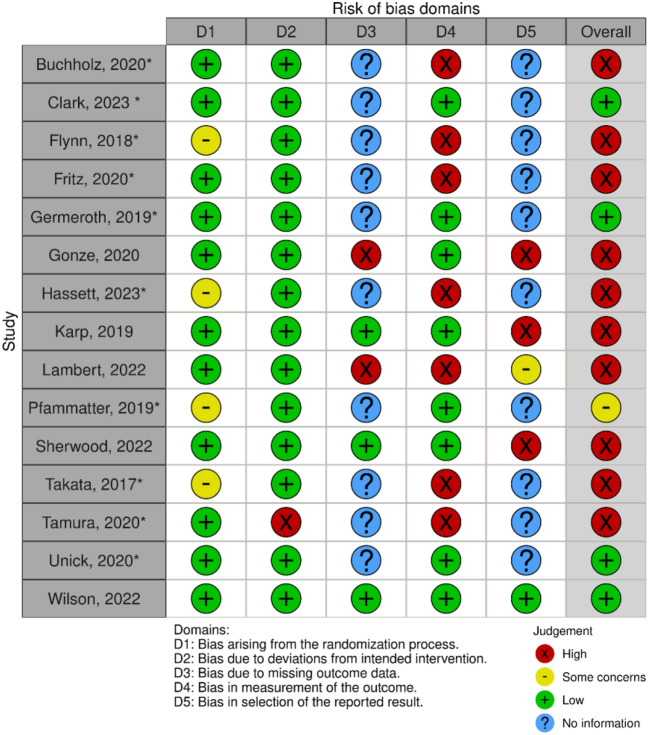
PubMed, Embase, PsychINFO, CENTRAL, and CinAHL were systematically searched through May 2023 for studies wherein PA SMARTs were conducted. Methodological quality was assessed using the Cochrane Risk of Bias 2 Tool.
Twenty studies across a variety of populations - e.g., obesity, chronic pain, and cardiovascular conditions, were included. All PA SMARTs involved two decision stages, with the majority including two initial treatment options. PA interventions most commonly consisted of individual aerobic exercise with strategies such as goal setting, wearable technology, and motivational interviewing also used to promote PA. Variation was observed across tailoring variables and timing of tailoring variables. Non-response strategies primarily involved augmenting and switching treatment options, and for responders to continue with initial treatment options. For analyses, most sample size estimations and outcome analyses accounted for the SMART aims specified. Techniques such as linear mixed models, weighted regressions, and Q-learning regression were frequently used. Risk of bias was high across the majority of included studies.
Individual-based aerobic exercise interventions supported by behaviour change techniques and wearable sensing technology may play a key role in the future development of SMARTs addressing PA intervention development. Clearer rationale for the selection of tailoring variables, timing of tailoring variables, and included measures is essential to advance PA SMART designs. Collaborative efforts from researchers, clinicians, and patients are needed in order to bridge the gap between adaptive research designs and personalised treatment pathways observed in clinical practice.
身体活动(PA)通常是预防和治疗多种慢性健康状况的风险降低干预措施的基石。PA干预本质上是多维度且复杂的。因此,用于评估PA干预的研究设计必须适应干预组成部分和个体能力。序贯多重分配随机试验(SMART)是一种序贯设置中的析因设计,用于构建有效的适应性干预措施。SMART是PA干预研究中一种相对较新的设计。本系统评价旨在研究用于开发PA干预措施的SMART的最新情况,重点关注研究特征、设计和分析。
通过系统检索PubMed、Embase、PsychINFO、CENTRAL和CINAHL直至2023年5月,查找进行PA SMART研究的文献。使用Cochrane偏倚风险2工具评估方法学质量。
纳入了20项针对各种人群的研究,如肥胖、慢性疼痛和心血管疾病患者。所有PA SMART都涉及两个决策阶段,大多数包括两种初始治疗方案。PA干预最常见的是个体有氧运动,还使用目标设定、可穿戴技术和动机访谈等策略来促进PA。在定制变量和定制变量的时机方面存在差异。无反应策略主要包括增加和切换治疗方案,对于有反应者则继续采用初始治疗方案。在分析方面,大多数样本量估计和结果分析都考虑了指定的SMART目标。线性混合模型、加权回归和Q学习回归等技术经常被使用。大多数纳入研究的偏倚风险较高。
由行为改变技术和可穿戴传感技术支持的基于个体的有氧运动干预可能在解决PA干预开发的SMART的未来发展中发挥关键作用。选择定制变量、定制变量的时机和纳入的测量指标时,更明确的理论依据对于推进PA SMART设计至关重要。研究人员、临床医生和患者需要共同努力,以弥合适应性研究设计与临床实践中观察到的个性化治疗途径之间的差距。