Wojdała Anna L, Vanbrabant Jeroen, Bayoumy Sherif, Antwi-Berko Daniel, Bastard Nathalie Le, van der Flier Wiesje M, Jeromin Andreas, Lambrechts Charlotte, Van Loo Maxime, Vandijck Manu, Stoops Erik, Verberk Inge M W, Teunissen Charlotte E
Neurochemistry Laboratory, Department of Laboratory Medicine, Amsterdam UMC, Vrije Universiteit Amsterdam, Amsterdam Neuroscience, Amsterdam, The Netherlands.
ADx NeuroSciences NV, Ghent, Belgium.
Alzheimers Res Ther. 2024 Dec 19;16(1):266. doi: 10.1186/s13195-024-01630-5.
Among the Alzheimer's disease (AD) biomarkers measured in blood, phosphorylated forms of tau (p-tau) have been shown to exhibit a particularly high diagnostic potential. Here, we performed a comprehensive method comparison study, followed by evaluation of the diagnostic performance of eight recent plasma p-tau immunoassays targeting different tau phosphorylation sites, different tau fragments, and that are measured by two distinct platforms.
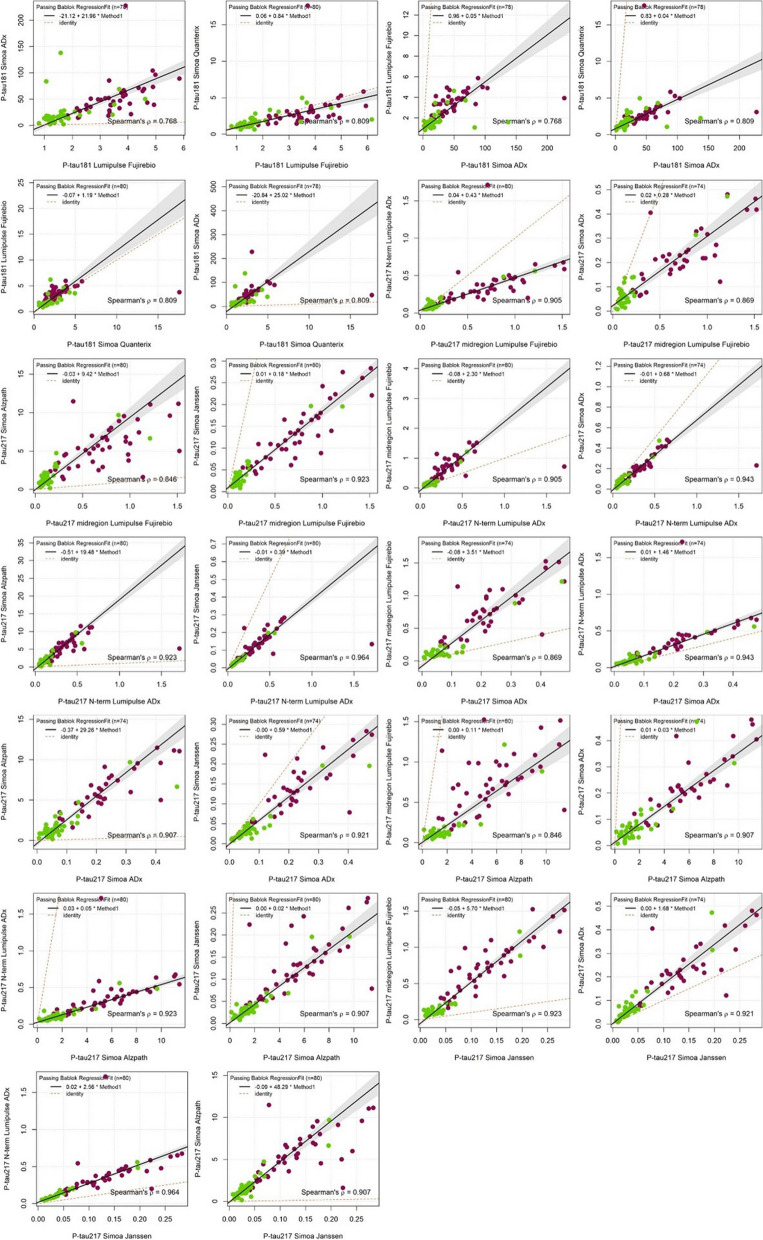
We enrolled a cohort of 40 patients with AD at the stage of dementia (AD-dem) characterized by positive CSF A + T + profile, and a control group of 40 cognitively healthy participants (Control), to conduct a comprehensive method comparison for three plasma p-tau181 and five plasma p-tau217 assays run on the Simoa HD-X™ or Lumipulse G600II/G1200 platforms. Design of the compared assays differed in regard to: (1) tau phosphorylation site targeted by the capture antibody (T181 or T217), and (2) epitope of the pan-tau detector antibody (N-terminal or mid-region). For each of the assays we determined precision and analytical sensitivity parameters and used Passing-Bablok regression and Bland-Altman plots for pairwise comparison of p-tau181 or p-tau217 assays. Subsequently, we evaluated the diagnostic accuracy of all the assays for discrimination between AD-dem and Control groups.
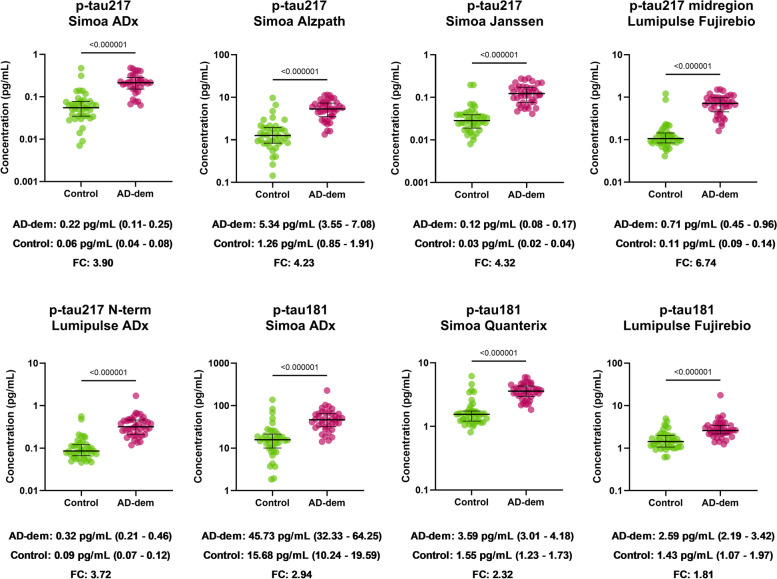
We found a strong, positive correlation between all the measurements. Fixed and/or proportional bias was observed for each of compared p-tau181 assay pairs or p-tau217 assay pairs. While both plasma p-tau181 and p-tau217 levels were significantly increased in AD-dem vs. Control groups as measured by all assays, higher median concentration AD-dem/Control fold change and AUC values were observed for p-tau217 (assays range: fold change 3.72-6.74, AUC 0.916-0.956) compared with p-tau181 (assays range 1.81-2.94, AUC 0.829-0.909), independently of the platform used. No significant differences were observed between diagnostic performance of p-tau181 assays or p-tau217 assays targeting tau N-terminus or mid-region.
Although all plasma p-tau measurements enabled discrimination between clinical groups, p-tau217 assays showed the highest robustness, independently of the pan-tau detector antibody targeting N-terminal or mid-region, and independently of the platform used. Considering the observed method disagreement in measured absolute concentrations, we stress the need for development of certified reference material, harmonizing measurements across different platforms.
在血液中检测的阿尔茨海默病(AD)生物标志物中,磷酸化形式的tau(p-tau)已显示出特别高的诊断潜力。在此,我们进行了一项全面的方法比较研究,随后评估了最近针对不同tau磷酸化位点、不同tau片段且通过两种不同平台测量的八种血浆p-tau免疫测定法的诊断性能。
我们招募了一组40例处于痴呆阶段的AD患者(AD-dem),其脑脊液A + T + 谱呈阳性,以及一组40名认知健康参与者作为对照组(Control),对在Simoa HD-X™或Lumipulse G600II/G1200平台上运行的三种血浆p-tau181和五种血浆p-tau217测定法进行全面的方法比较。所比较测定法的设计在以下方面有所不同:(1)捕获抗体靶向的tau磷酸化位点(T181或T217),以及(2)泛tau检测抗体的表位(N端或中间区域)。对于每种测定法,我们确定了精密度和分析灵敏度参数,并使用Passing-Bablok回归和Bland-Altman图对p-tau181或p-tau217测定法进行成对比较。随后,我们评估了所有测定法区分AD-dem组和对照组的诊断准确性。
我们发现所有测量值之间存在强正相关。在比较的每个p-tau181测定法对或p-tau217测定法对中均观察到固定和/或比例偏差。虽然通过所有测定法测得的AD-dem组与对照组相比,血浆p-tau181和p-tau217水平均显著升高,但与p-tau181(测定法范围:倍数变化1.81 - 2.94,AUC 0.829 - 0.909)相比,p-tau217的中位数浓度AD-dem/对照组倍数变化和AUC值更高(测定法范围:倍数变化3.72 - 6.74,AUC 0.916 - 0.956),与所使用的平台无关。靶向tau N端或中间区域的p-tau181测定法或p-tau217测定法的诊断性能之间未观察到显著差异。
尽管所有血浆p-tau测量均能够区分临床组,但p-tau217测定法显示出最高的稳健性,与靶向N端或中间区域的泛tau检测抗体无关,也与所使用的平台无关。考虑到在测量的绝对浓度中观察到的方法差异,我们强调需要开发经过认证的参考物质,以统一不同平台的测量。