Endrias Eshetu Elfios, Geta Temesgen, Desalegn Bemnet, Ataro Bizuayehu Atinafu, Israel Eskinder, Kebede Christian, Belayneh Melesse, Ahmed Beker, Moloro Abdulkerim Hassen, Nigussie Getachew
School of Nursing, College of Health Science and Medicine, Wolaita Sodo University, Wolaita Sodo, Ethiopia.
School of Public Health, College of Health Science and Medicine, Wolaita Sodo University, Wolaita Sodo, Ethiopia.
BMC Health Serv Res. 2024 Dec 19;24(1):1625. doi: 10.1186/s12913-024-12111-8.
Hypertension is a significant public health challenge, particularly in low- and middle-income countries, where its management is often inadequate. Understanding patients' experiences and perspectives is crucial for improving hypertension care. Despite a growing body of literature on hypertension in Ethiopia, most studies focus on quantitative data, leaving a significant gap in qualitative insights into patient experiences and perspectives. This study uniquely contributes to the field by exploring the lived experiences of patients in Southern Ethiopia, providing context-specific evidence to inform patient-centered hypertension management strategies.
This qualitative study aimed to explore the experiences and perspectives of patients with hypertension regarding their management and care at a comprehensive hospital in Southern Ethiopia.
A phenomenological approach was employed to capture the experiences and perspectives of participants. In-depth interviews were conducted with 14 patients with hypertension, selected through purposive sampling. The interviews were audio-recorded, transcribed verbatim, and analyzed using OpenCode version 4.02 software to facilitate systematic coding and thematic analysis. Then, key themes and subthemes were identified from the data related to patient experiences and perspectives providing a relevant framework for understanding the complexities of hypertension management from the patients' perspectives.
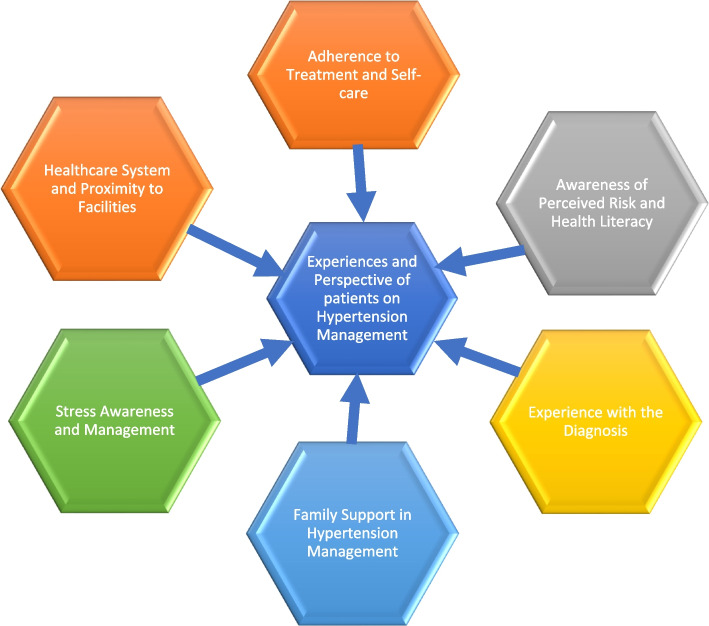
The six key themes emerged, depicting participants' challenges, coping strategies, and interactions with the healthcare system. The themes identified are: adherence to treatment and self-care, awareness of perceived risk and health literacy, experience with the diagnosis, family support in hypertension management, stress awareness and management, and healthcare system and proximity to facilities. Participants noted obstacles to adherence, including long waiting times, forgetting medications, and stress related to their condition. CONCLUSION AND RECOMMENDATION: The findings highlight the need for specific patient-centered strategies that address the challenges faced by hypertensive patients in Southern Ethiopia, such as reducing wait times, enhancing family involvement in care, increasing adherence, and addressing stress. Strengthening healthcare services is essential for sustainable hypertension management.
高血压是一项重大的公共卫生挑战,在低收入和中等收入国家尤为如此,这些国家的高血压管理往往不足。了解患者的经历和观点对于改善高血压护理至关重要。尽管埃塞俄比亚关于高血压的文献越来越多,但大多数研究都集中在定量数据上,在对患者经历和观点的定性见解方面存在重大差距。本研究通过探索埃塞俄比亚南部患者的生活经历,为以患者为中心的高血压管理策略提供特定背景的证据,为该领域做出了独特贡献。
这项定性研究旨在探讨埃塞俄比亚南部一家综合医院高血压患者在管理和护理方面的经历和观点。
采用现象学方法来捕捉参与者的经历和观点。通过目的抽样选取了14名高血压患者进行深入访谈。访谈进行了录音,逐字转录,并使用OpenCode 4.02软件进行分析,以促进系统编码和主题分析。然后,从与患者经历和观点相关的数据中确定关键主题和子主题,为从患者角度理解高血压管理的复杂性提供相关框架。
出现了六个关键主题,描述了参与者的挑战、应对策略以及与医疗系统的互动。确定的主题包括:坚持治疗和自我护理、对感知风险的认识和健康素养、诊断经历、高血压管理中的家庭支持、压力意识和管理以及医疗系统和设施的可及性。参与者指出了坚持治疗的障碍,包括等待时间长、忘记服药以及与病情相关的压力。
研究结果强调需要制定以患者为中心的具体策略,以应对埃塞俄比亚南部高血压患者面临的挑战,如减少等待时间、加强家庭参与护理、提高依从性以及应对压力。加强医疗服务对于可持续的高血压管理至关重要。