Martínez-Dubarbie Francisco, Guerra-Ruiz Armando, López-García Sara, Lage Carmen, Fernández-Matarrubia Marta, Pozueta-Cantudo Ana, García-Martínez María, Corrales-Pardo Andrea, Bravo María, López-Hoyos Marcos, Irure-Ventura Juan, de Lucas Enrique Marco, Drake-Pérez Marta, García-Unzueta María Teresa, Sánchez-Juan Pascual, Rodríguez-Rodríguez Eloy
Neurology Service, Marqués de Valdecilla University Hospital, Santander, Cantabria, 39008, Spain.
Institute for Research Marqués de Valdecilla (IDIVAL), Santander, Cantabria, 39011, Spain.
Alzheimers Res Ther. 2024 Dec 20;16(1):268. doi: 10.1186/s13195-024-01642-1.
The advent of Alzheimer's disease-modifying drugs requires accurate biological diagnosis to identify candidates for these therapies. So far, the most promising single plasma biomarker is phosphorylated tau at threonine 217 (p-tau217). To understand its biological features, it is essential to know its longitudinal trajectory and factors influencing it in cognitively unimpaired subjects with no brain pathology.
We analyzed longitudinal plasma p-tau217 values (mean follow-up time = 768.3 days) in a cohort of 209 healthy volunteers. We have studied factors associated with plasma p-tau217 changes by using different linear mixed-effects models.
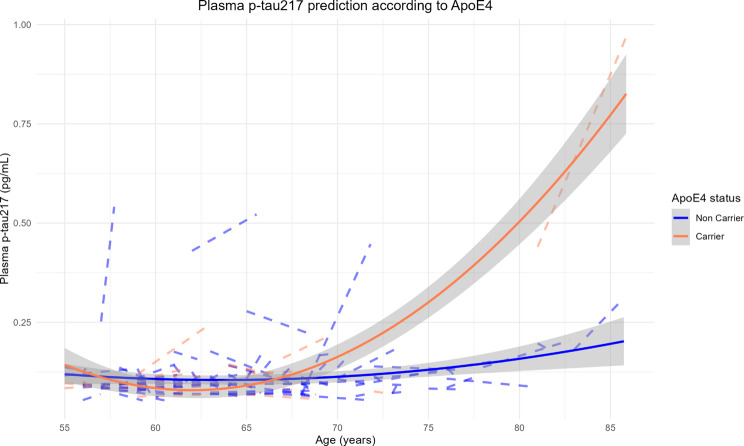
In amyloid-negative cognitively healthy subjects (n = 151) carriers of ApoE ε4 allele had significantly higher p-tau217 values than non-carriers (0.85 pg/mL; p-value < 0.001) and also a greater rate of change (0.01 pg/mL/year; p-value < 0.001). In the overall sample, including subjects with amyloid and tau pathology we have seen that amyloid positive subjects had higher predicted baseline plasma p-tau217 values than amyloid negative subjects (0.16 pg/mL; p-value < 0.001) and a greater rate of change (0.00004 pg/mL/day; p-value < 0.001). Subjects considered tau positive also showed a greater rate of change of p-tau217 with respect to tau negative (0.00005 pg/mL/day; p-value < 0.001). A + T + N + participants showed a higher baseline p-tau217 levels than A-T-N- subjects (0.2 pg/mL; p-value < 0.001) and also a greater rate of change (0.00006 pg/mL/day; p-value = 0.002). ApoE ε4 carriers had a greater rate of change than non-carriers (0.00003 pg/mL/day; p-value = 0.03).
In amyloid-negative cognitively unimpaired subjects, ApoE4 status influenced both baseline levels and rate of change of plasma p-tau217. Other factors such as age, sex or glomerular filtration rate have not shown significant influence on plasma p-tau217 levels in this group.
阿尔茨海默病修饰药物的出现需要准确的生物学诊断来确定这些疗法的候选者。到目前为止,最有前景的单一血浆生物标志物是苏氨酸217位点的磷酸化tau蛋白(p-tau217)。为了解其生物学特征,了解其在无脑部病理的认知未受损受试者中的纵向轨迹及其影响因素至关重要。
我们分析了209名健康志愿者队列中的血浆p-tau217纵向值(平均随访时间 = 768.3天)。我们使用不同的线性混合效应模型研究了与血浆p-tau217变化相关的因素。
在淀粉样蛋白阴性的认知健康受试者(n = 151)中,载脂蛋白E ε4等位基因携带者的p-tau217值显著高于非携带者(0.85 pg/mL;p值<0.001),且变化率也更高(0.01 pg/mL/年;p值<0.001)。在包括有淀粉样蛋白和tau病理的受试者的总体样本中,我们发现淀粉样蛋白阳性受试者的预测基线血浆p-tau217值高于淀粉样蛋白阴性受试者(0.16 pg/mL;p值<0.001),且变化率更高(0.00004 pg/mL/天;p值<0.001)。被认为tau阳性的受试者相对于tau阴性受试者也显示出更高的p-tau217变化率(0.00005 pg/mL/天;p值<0.001)。A+T+N+参与者的基线p-tau217水平高于A-T-N-受试者(0.2 pg/mL;p值<0.001),且变化率也更高(0.00006 pg/mL/天;p值 = 0.002)。载脂蛋白E ε4携带者的变化率高于非携带者(0.00003 pg/mL/天;p值 = 0.03)。
在淀粉样蛋白阴性的认知未受损受试者中,ApoE4状态影响血浆p-tau217的基线水平和变化率。在该组中,年龄、性别或肾小球滤过率等其他因素对血浆p-tau217水平未显示出显著影响。