Clinical Memory Research Unit, Department of Clinical Sciences, Lund University, Malmö, Sweden.
Department of Neurology, Skåne University Hospital, Lund, Sweden.
Brain. 2020 Dec 1;143(12):3805-3815. doi: 10.1093/brain/awaa327.
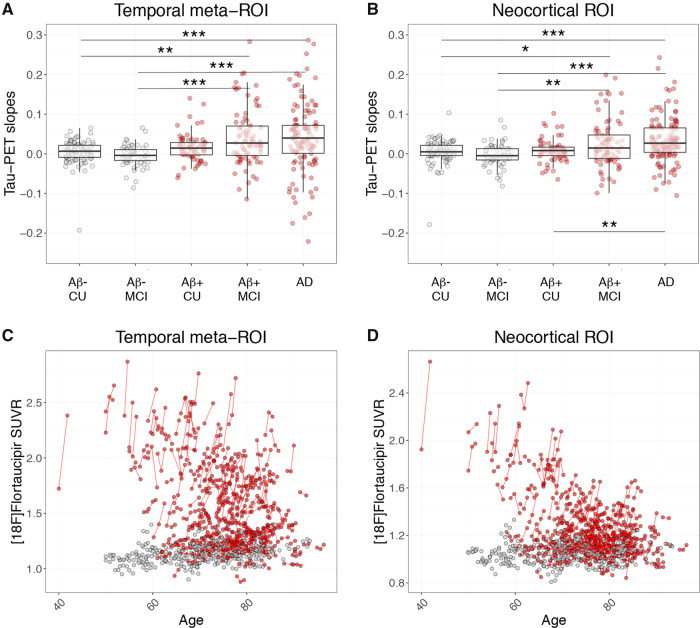
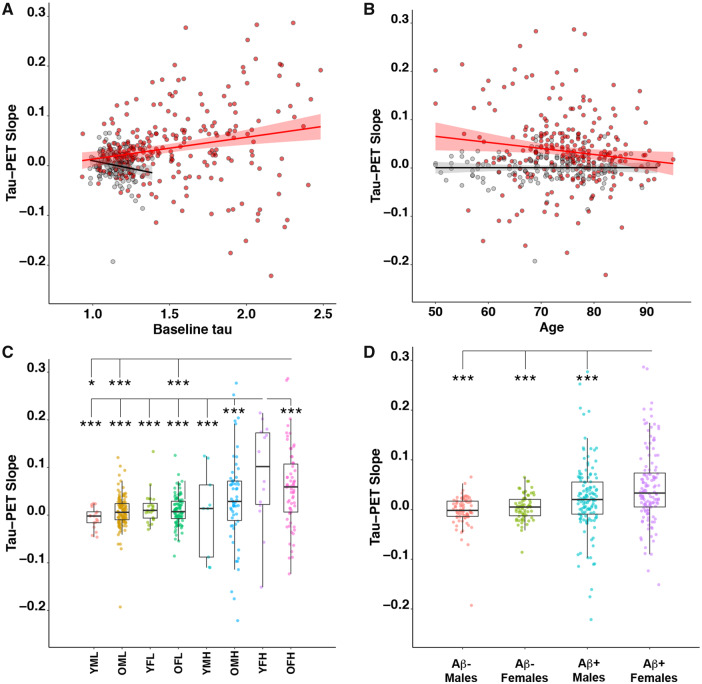
The development of tau-PET allows paired helical filament tau pathology to be visualized in vivo. Increased knowledge about conditions affecting the rate of tau accumulation could guide the development of therapies halting the progression of Alzheimer's disease. However, the factors modifying the rate of tau accumulation over time in Alzheimer's disease are still largely unknown. Large-scale longitudinal cohort studies, adjusting for baseline tau load, are needed to establish such risk factors. In the present longitudinal study, 419 participants from four cohorts in the USA (Avid 05e, n = 157; Expedition-3, n = 82; ADNI, n = 123) and Sweden (BioFINDER, n = 57) were scanned repeatedly with tau-PET. The study participants were cognitively unimpaired (n = 153), or patients with mild cognitive impairment (n = 139) or Alzheimer's disease dementia (n = 127). Participants underwent two to four tau-PET (18F-flortaucipir) scans with a mean (± standard deviation) of 537 (±163) days between the first and last scan. The change in tau-PET signal was estimated in temporal meta- and neocortical regions of interest. Subject specific tau-PET slopes were predicted simultaneously by age, sex, amyloid status (determined by amyloid-β PET), APOE ε4 genotype, study cohort, diagnosis and baseline tau load. We found that accelerated increase in tau-PET signal was observed in amyloid-β-positive mild cognitive impairment (3.0 ± 5.3%) and Alzheimer's disease dementia (2.9 ± 5.7%), respectively, when compared to either amyloid-β-negative cognitively unimpaired (0.4 ± 2.7%), amyloid-β-negative mild cognitive impairment (-0.4 ± 2.3%) or amyloid-β-positive cognitively unimpaired (1.2 ± 2.8%). Tau-PET uptake was accelerated in females (temporal region of interest: t = 2.86, P = 0.005; neocortical region of interest: t = 2.90, P = 0.004), younger individuals (temporal region of interest: t = -2.49, P = 0.013), and individuals with higher baseline tau-PET signal (temporal region of interest: t = 3.83, P < 0.001; neocortical region of interest: t = 5.01, P < 0.001). Tau-PET slopes decreased with age in amyloid-β-positive subjects, but were stable by age in amyloid-β-negative subjects (age × amyloid-β status interaction: t = -2.39, P = 0.018). There were no effects of study cohort or APOE ε4 positivity. In a similar analysis on longitudinal amyloid-β-PET (in ADNI subjects only, n = 639), we found significant associations between the rate of amyloid-β accumulation and APOE ε4 positivity, older age and baseline amyloid-β positivity, but no effect of sex. In conclusion, in this longitudinal PET study comprising four cohorts, we found that the tau accumulation rate is greater in females and younger amyloid-β-positive individuals, while amyloid-β accumulation is greater in APOE ε4 carriers and older individuals. These findings are important considerations for the design of clinical trials, and might improve our understanding of factors associated with faster tau aggregation and spread.
tau-PET 的发展使得配对螺旋丝 tau 病理学能够在体内可视化。增加对影响 tau 积累速度的条件的了解,可以指导开发阻止阿尔茨海默病进展的治疗方法。然而,在阿尔茨海默病中,tau 随时间积累的速度的影响因素在很大程度上仍然未知。需要进行大规模的纵向队列研究,对 tau 负荷进行基线调整,以确定这些风险因素。在本纵向研究中,来自美国(Avid 05e,n=157;Expedition-3,n=82;ADNI,n=123)和瑞典(BioFINDER,n=57)的四个队列的 419 名参与者进行了重复 tau-PET 扫描。研究参与者认知正常(n=153)或患有轻度认知障碍(n=139)或阿尔茨海默病痴呆(n=127)。参与者接受了 2 到 4 次 tau-PET(18F-flortaucipir)扫描,第一次和最后一次扫描之间的平均(±标准偏差)为 537(±163)天。在时间性和新皮质感兴趣区域估计 tau-PET 信号的变化。个体特异性 tau-PET 斜率同时由年龄、性别、淀粉样蛋白状态(由淀粉样蛋白-β PET 确定)、APOE ε4 基因型、研究队列、诊断和基线 tau 负荷预测。我们发现,与淀粉样蛋白-β 阴性认知正常(0.4±2.7%)、淀粉样蛋白-β 阴性轻度认知障碍(-0.4±2.3%)或淀粉样蛋白-β 阳性认知正常(1.2±2.8%)相比,淀粉样蛋白-β 阳性轻度认知障碍(3.0±5.3%)和阿尔茨海默病痴呆(2.9±5.7%)中 tau-PET 信号的增加速度更快。tau-PET 摄取在女性中加速(时间区域感兴趣:t=2.86,P=0.005;新皮质区域感兴趣:t=2.90,P=0.004)、在年轻个体中加速(时间区域感兴趣:t=-2.49,P=0.013)、以及在基线 tau-PET 信号较高的个体中加速(时间区域感兴趣:t=3.83,P<0.001;新皮质区域感兴趣:t=5.01,P<0.001)。在淀粉样蛋白-β 阳性受试者中,tau-PET 斜率随年龄而降低,但在淀粉样蛋白-β 阴性受试者中则随年龄而稳定(年龄×淀粉样蛋白-β 状态交互作用:t=-2.39,P=0.018)。研究队列或 APOE ε4 阳性无影响。在 ADNI 受试者(n=639)的纵向淀粉样蛋白-β-PET 相似分析中,我们发现淀粉样蛋白-β 积累率与 APOE ε4 阳性、年龄较大和基线淀粉样蛋白-β 阳性有关,但与性别无关。总之,在这项包括四个队列的纵向 PET 研究中,我们发现女性和年轻的淀粉样蛋白-β 阳性个体 tau 积累速度更快,而淀粉样蛋白-β 积累速度则与 APOE ε4 携带者和年龄较大的个体有关。这些发现对于临床试验的设计非常重要,可能会增进我们对与更快的 tau 聚集和传播相关的因素的理解。