Bernstein David N, Ilchuk Alexy, Shoji Monica M, Harper Carl M, Rozental Tamara D
Beth Israel Deaconess Medical Center, Harvard Medical School, Boston, MA.
Harvard Combined Orthopaedic Residency Program, Massachusetts General Hospital, Boston, MA.
J Hand Surg Glob Online. 2024 Sep 18;6(6):882-887. doi: 10.1016/j.jhsg.2024.08.009. eCollection 2024 Nov.
The use of a person's hands is crucial to their ability to succeed at work. Hand pathologies can impact work success by increasing absenteeism (ie, not being able to go to work) and presenteeism (ie, being able to work but in a reduced capacity). In this study, we quantified employed patients' presenteeism and absenteeism following carpal tunnel release or surgical fixation of a distal radius fracture (DRF).
In this prospective cohort study, 91 patients (carpal tunnel syndrome [CTS]: n = 62; DRF: n = 29) from June 2022 to December 2023 were included. Baseline patient characteristics and patient-reported outcome measures (PROMs) were collected. Presenteeism and absenteeism were calculated using the World Health Organization's Health and Work Performance Questionnaire. Questionnaires were sought before surgery and at 3 and 6 months after surgery. Clinical improvement was determined using minimal clinically important difference (MCID) cutoff range estimates. The employee value of lost work was calculated as a percentage of the average patient in each group before surgery and at 6 months after surgery.
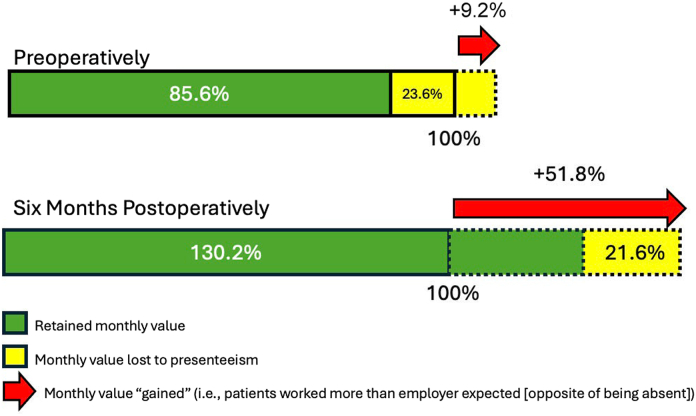
The average change in PROMs scores from before to after surgery at 6 months surpassed the low-end MCID estimates for all functional and pain-related PROMs. For patients undergoing surgery for CTS and DRF, retained employee value rose from 85.6% to 130.2% (ie, worked more than expected) and 52.7% to 56.9%, respectively.
Patients undergoing surgery for CTS or DRF have clinically appreciable improvement in functional and pain symptoms by 6 months after surgery. However, by 6 months after surgery, carpal tunnel release results in greater than complete employee value recovery, compared with surgical fixation of DRFs in which greater than 40% of the employee value remains lost after surgery. These findings can assist with preoperative expectation setting.
TYPE OF STUDY/LEVEL OF EVIDENCE: Prognostic II.
手部的使用对个人工作成功的能力至关重要。手部疾病会通过增加旷工率(即无法上班)和出勤但工作能力下降(即出勤主义)来影响工作成效。在本研究中,我们对接受腕管松解术或桡骨远端骨折(DRF)手术固定的在职患者的出勤主义和旷工情况进行了量化。
在这项前瞻性队列研究中,纳入了2022年6月至2023年12月的91例患者(腕管综合征[CTS]:n = 62;DRF:n = 29)。收集了患者的基线特征和患者报告的结局指标(PROMs)。使用世界卫生组织的健康与工作绩效问卷计算出勤主义和旷工情况。在手术前以及手术后3个月和6个月进行问卷调查。使用最小临床重要差异(MCID)临界值范围估计来确定临床改善情况。将损失工作的员工价值计算为每组手术前和手术后6个月平均患者的百分比。
所有功能和疼痛相关的PROMs在术后6个月时,从术前到术后的平均得分变化超过了低端MCID估计值。对于接受CTS和DRF手术的患者,保留的员工价值分别从85.6%升至130.2%(即工作超出预期)和从52.7%升至56.9%。
接受CTS或DRF手术的患者在术后6个月时,功能和疼痛症状在临床上有明显改善。然而,术后6个月时,与DRF手术固定相比,腕管松解术导致员工价值完全恢复且有所超出,DRF手术固定术后超过40%的员工价值仍有损失。这些发现有助于术前预期的设定。
研究类型/证据水平:预后性研究II级