Brown Frankie F, Oliver Rebecca, Eddy Rachel, Causer Adam J, Emery Annabelle, Collier-Bain Harrison D, Dutton David, Crowe Josephine, Augustine Daniel, Graby John, Rees Daniel, Rothschild-Rodriguez Daniela, Peacock Oliver J, Moore Sally, Murray James, Turner James E, Campbell John P
Department for Health, University of Bath, Bath, United Kingdom.
School of Applied Sciences, Edinburgh Napier University, Edinburgh, United Kingdom.
Front Oncol. 2024 Dec 5;14:1472551. doi: 10.3389/fonc.2024.1472551. eCollection 2024.
Chronic lymphocytic leukaemia (CLL) typically presents with asymptomatic, early-stage disease that is monitored until disease progression ('treatment-naïve' CLL). The objective of this pilot study was to assess the feasibility and preliminary safety of an exercise program in treatment-naïve CLL. We also sought to preliminarily assess the impact of the exercise program on disease activity, as it has been proposed that exercise training may reduce disease outgrowth in treatment-naïve CLL.
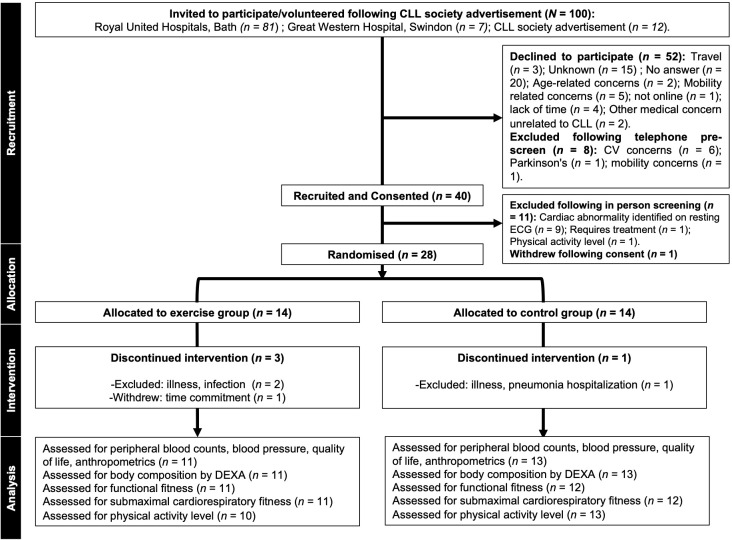
A total of 40 treatment-naïve CLL patients were recruited into this randomised-controlled pilot study, and after screening, n = 28 were randomised into a 16-week, home-based, partially supervised, personalised, progressive exercise intervention ( = 14: mean ± SD: age = 62 ± 12 years) or 16 weeks of usual care, control group ( = 14: mean ± SD: age = 61 ± 10 years). The primary outcome measures were safety (number and severity of adverse events) and feasibility (uptake, retention, and adherence to the trial). Disease activity (CD5/CD19 CLL cells clonally restricted to kappa or lambda) and other immune cell phenotypes, with a principal focus on T cells, were measured by flow cytometry. Other secondary outcomes included DEXA-derived body composition, cardiorespiratory and functional fitness, resting cardiovascular measures.
Trial uptake was 40%, and the overall retention rate was 86%, with 79% of the exercise group and 93% of the control group completing the trial. Adherence to the exercise intervention was 92 ± 8%. One serious adverse event was reported unrelated to the trial, and one adverse event related to the trial was reported. The exercise intervention elicited a 2% increase in DEXA-derived lean mass in the exercise group compared with a 0.4% decrease in the control group ( = 0.01). No between-group differences were observed over time for whole-body mass, BMI, bone mineral density, body fat, blood pressure resting heart rate, or measures of cardiorespiratory or functional fitness (all > 0.05). No between-group differences were observed over time for clonal CLL cells and CD4 or CD8 T-cell subsets (all > 0.05).
The exercise training program used in this study was feasible in people with treatment-naïve CLL who passed pre-trial screening, and we preliminarily conclude that the exercise training program was safe and also resulted in an increase in lean mass.
https://doi.org/10.1186/ISRCTN55166064, identifier ISRCTN 55166064.
慢性淋巴细胞白血病(CLL)通常表现为无症状的早期疾病,在疾病进展之前进行监测(“初治”CLL)。这项试点研究的目的是评估一项运动计划在初治CLL患者中的可行性和初步安全性。我们还试图初步评估该运动计划对疾病活动的影响,因为有研究提出运动训练可能会减少初治CLL患者的疾病进展。
共有40例初治CLL患者被纳入这项随机对照试点研究,经过筛选后,n = 28例患者被随机分为16周的居家、部分监督、个性化、渐进式运动干预组(n = 14:均值±标准差:年龄 = 62 ± 12岁)或16周的常规护理对照组(n = 14:均值±标准差:年龄 = 61 ± 10岁)。主要结局指标为安全性(不良事件的数量和严重程度)和可行性(试验的纳入、保留和依从性)。通过流式细胞术测量疾病活动(克隆性限制在κ或λ的CD5/CD19 CLL细胞)和其他免疫细胞表型,主要关注T细胞。其他次要结局包括双能X线吸收法(DEXA)测定的身体成分、心肺功能和身体机能、静息心血管指标。
试验纳入率为40%,总体保留率为86%,运动组79%和对照组93%的患者完成了试验。运动干预的依从性为92 ± 8%。报告了1例与试验无关的严重不良事件和1例与试验相关的不良事件。与对照组减少0.4%相比,运动干预使运动组DEXA测定的瘦体重增加了2%(P = 0.01)。随着时间推移,全身质量、体重指数(BMI)、骨矿物质密度、体脂、血压、静息心率或心肺功能或身体机能指标在组间均未观察到差异(均P > 0.05)。随着时间推移,克隆性CLL细胞以及CD4或CD8 T细胞亚群在组间也未观察到差异(均P > 0.05)。
本研究中使用的运动训练计划对于通过试验前筛选的初治CLL患者是可行的,我们初步得出结论,该运动训练计划是安全的,并且还能使瘦体重增加。