Kong Danqing, Ping Nana, Zhu Qian, Zhang Xiao, Li Junhong, Zou Rui, Wu Depei, Jin Zhengming, Qu Changju
National Clinical Research Center for Hematologic Diseases, Jiangsu Institute of Hematology, The First Affiliated Hospital of Soochow University, Suzhou, China.
Institute of Blood and Marrow Transplantation, Collaborative Innovation Center of Hematology, Suzhou University, Suzhou, China.
Front Oncol. 2024 Dec 5;14:1491100. doi: 10.3389/fonc.2024.1491100. eCollection 2024.
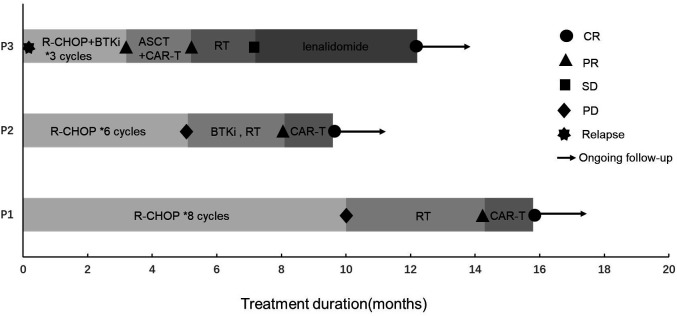
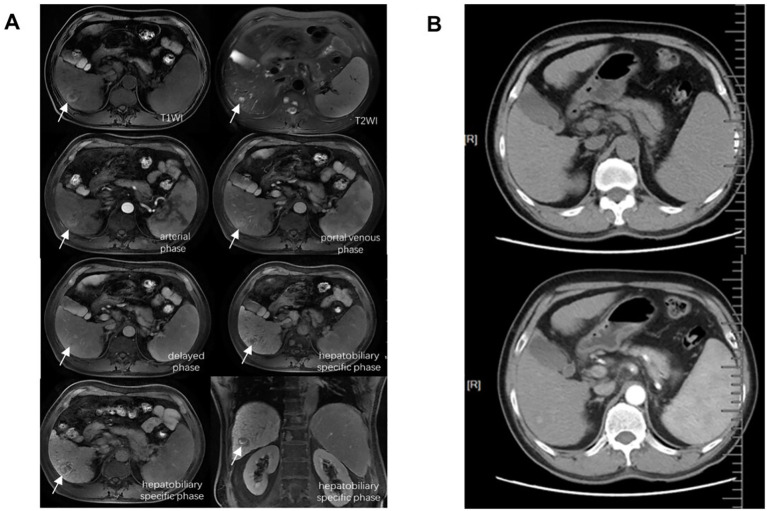
Chimeric antigen receptor T-cell (CAR-T) therapy has demonstrated both efficacy and safety in relapsed/refractory diffuse large B-cell lymphoma (DLBCL) patients infected with hepatitis B virus (HBV). However, its applicability in individuals with liver cirrhosis remains largely unexplored due to the potential for unpredictable complications. Here, we report three cases (P1, P2, and P3) of relapsed/refractory DLBCL with HBV-related cirrhosis treated with CAR-T cell infusion. P1 and P2 received CAR-T cell infusion following a conditioning regimen of fludarabine and cyclophosphamide (FC) for lymphodepletion, while P3 received the SEAM (semustine, etoposide, cytarabine, and melphalan) regimen and autologous stem cell transplantation bridging CAR-T cell infusion. P1 and P2 achieved rapid complete remission (CR), whereas P3 initially exhibited stable disease a month after CAR-T infusion and subsequently achieved CR after local radiation salvage therapy and lenalidomide maintenance. With a median follow-up of 42 months after CAR-T, the progression-free survival rate was 100%. Notably, during follow-up, these patients experienced complications associated with cirrhosis, including endoscopic variceal bleeding, HBV reactivation, or the diagnosis of hepatic malignancy. Our findings suggest that CAR-T therapy is applicable and effective for the treatment of DLBCL patients with HBV-related cirrhosis, albeit necessitating monitoring for potential hepatic complications.
嵌合抗原受体T细胞(CAR-T)疗法已在感染乙型肝炎病毒(HBV)的复发/难治性弥漫性大B细胞淋巴瘤(DLBCL)患者中显示出疗效和安全性。然而,由于可能出现不可预测的并发症,其在肝硬化患者中的适用性在很大程度上仍未得到探索。在此,我们报告3例接受CAR-T细胞输注治疗的复发/难治性DLBCL合并HBV相关肝硬化的病例(P1、P2和P3)。P1和P2在接受氟达拉滨和环磷酰胺(FC)预处理方案进行淋巴细胞清除后接受CAR-T细胞输注,而P3接受了SEAM(司莫司汀、依托泊苷、阿糖胞苷和美法仑)方案以及桥接CAR-T细胞输注的自体干细胞移植。P1和P2迅速实现完全缓解(CR),而P3在CAR-T输注后1个月最初表现为病情稳定,随后在局部挽救性放疗和来那度胺维持治疗后实现CR。CAR-T治疗后中位随访42个月,无进展生存率为100%。值得注意的是,在随访期间,这些患者出现了与肝硬化相关的并发症,包括内镜下静脉曲张出血、HBV再激活或肝恶性肿瘤的诊断。我们的研究结果表明,CAR-T疗法适用于治疗合并HBV相关肝硬化的DLBCL患者且有效,尽管需要监测潜在的肝脏并发症。