Mi Ranran Z, Yang Ellie Fan, Tahk Alexander, Tarfa Adati, Cotter Lynne M, Lu Linqi, Yang Sijia, Gustafson David H, Westergaard Ryan, Shah Dhavan
Department of Communication, Media and Journalism, Kean University, Union, NJ, United States.
School of Communication, Illinois State University, Normal, IL, United States.
J Med Internet Res. 2024 Dec 20;26:e57774. doi: 10.2196/57774.
Despite the increasing popularity of mobile health (mHealth) technologies, little is known about which types of mHealth system engagement might affect the maintenance of antiretroviral therapy among people with HIV and substance use disorders.
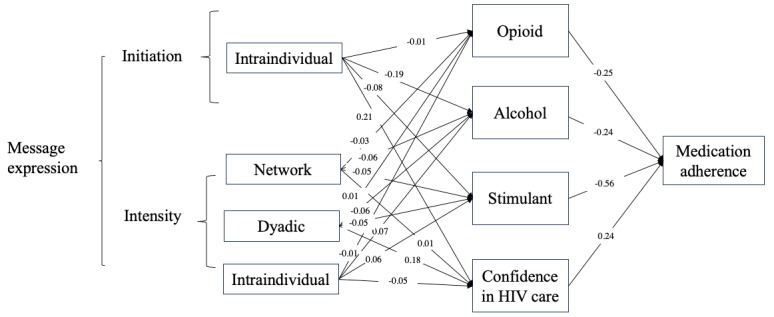
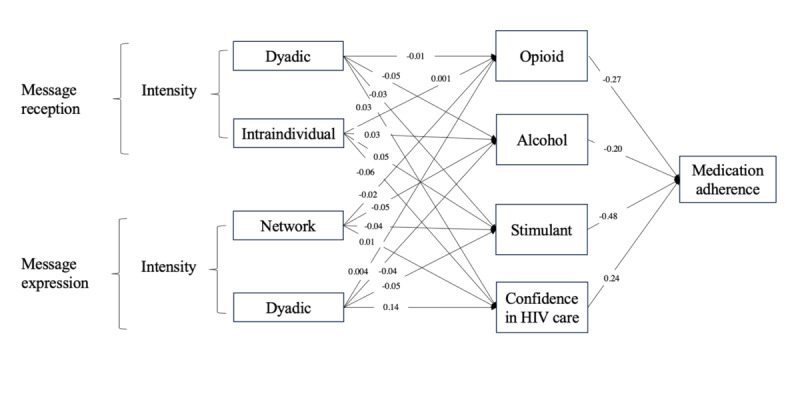
This study aimed to use longitudinal and detailed system logs and weekly survey data to test a mediation model, where mHealth engagement indicators were treated as predictors, substance use and confidence in HIV management were treated as joint mediators, and antiretroviral therapy adherence was treated as the outcome. We further distinguished the initiation and intensity of system engagement by mode (expression vs reception) and by communication levels (intraindividual vs dyadic vs network).
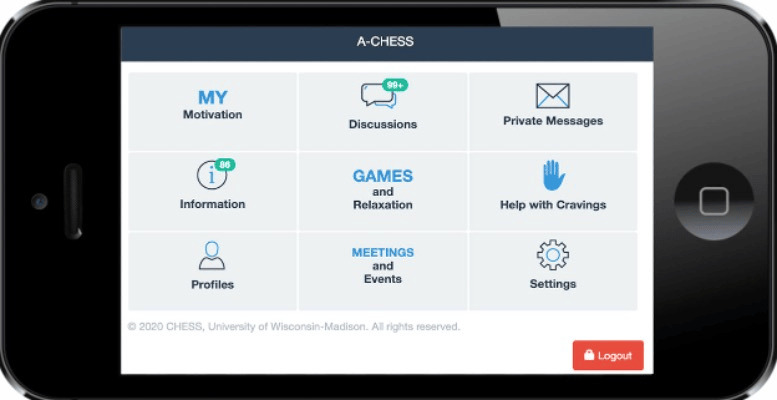
Tailored for people with HIV living with substance use disorders, the mHealth app was distributed among 208 participants aged >18 years from 2 US health clinics. Supervised by medical professionals, participants received weekly surveys through the app to report their health status and medication adherence data. System use was passively collected through the app, operationalized as transformed click-level data, aggregated weekly, and connected to survey responses with a 7-day lagged window. Using the weekly check-in record provided by participants as the unit of analysis (N=681), linear regression and structure equation models with cluster-robust SEs were used for analyses, controlling within-person autocorrelation and group-level error correlations. Racial groups were examined as moderators in the structure equation models.
We found that (1) intensity, not initiation, of system use; (2) dyadic message expression and reception; and (3) network expression positively predicted medication adherence through joint mediators (substance use and confidence in HIV management). However, intraindividual reception (ie, rereading saved entries for personal motivation) negatively predicts medication adherence through joint mediators. We also found Black participants have distinct usage patterns, suggesting the need to tailor mHealth interventions for this subgroup.
These findings highlight the importance of considering the intensity of system engagement, rather than initiation alone, when designing mHealth interventions for people with HIV and tailoring these systems to Black communities.
尽管移动健康(mHealth)技术越来越受欢迎,但对于哪些类型的移动健康系统参与可能会影响艾滋病毒感染者和物质使用障碍患者的抗逆转录病毒治疗维持情况,人们知之甚少。
本研究旨在使用纵向和详细的系统日志以及每周的调查数据来测试一个中介模型,其中移动健康参与指标被视为预测因素,物质使用和对艾滋病毒管理的信心被视为联合中介,抗逆转录病毒治疗依从性被视为结果。我们还通过模式(表达与接收)和沟通水平(个体内与二元与网络)区分了系统参与的启动和强度。
针对患有物质使用障碍的艾滋病毒感染者量身定制的移动健康应用程序,分发给来自美国2家健康诊所的208名年龄大于18岁的参与者。在医学专业人员的监督下,参与者通过该应用程序每周接受调查,以报告他们的健康状况和药物依从性数据。系统使用情况通过该应用程序被动收集,作为转换后的点击级数据进行操作,每周汇总,并与调查回复以7天的滞后窗口进行关联。以参与者提供的每周签到记录作为分析单位(N = 681),使用具有聚类稳健标准误的线性回归和结构方程模型进行分析,控制个体内自相关和组级误差相关性。在结构方程模型中,将种族群体作为调节因素进行检验。
我们发现:(1)系统使用的强度而非启动;(2)二元消息表达和接收;以及(3)网络表达通过联合中介(物质使用和对艾滋病毒管理的信心)对药物依从性有正向预测作用。然而,个体内接收(即重新阅读保存的条目以获取个人动力)通过联合中介对药物依从性有负向预测作用。我们还发现黑人参与者有不同的使用模式,这表明需要为该亚组量身定制移动健康干预措施。
这些发现突出了在为艾滋病毒感染者设计移动健康干预措施以及为黑人社区量身定制这些系统时,考虑系统参与强度而非仅启动情况的重要性。