di Gaeta Ettore, Olivieri Michela, Savi Annarita, Magnani Patrizia, Canevari Carla, Gusmini Simone, Palumbo Diego, Guazzarotti Giorgia, Augello Luigi, Calabrese Francesca, Steidler Stephanie, Cipriani Federica, Rimini Margherita, Casadei-Gardini Andrea, Aldrighetti Luca, Chiti Arturo, De Cobelli Francesco
Department of Radiology, IRCCS Ospedale San Raffaele, Milan, Italy.
Department of Nuclear Medicine, IRCCS Ospedale San Raffaele, Milan, Italy.
Radiol Med. 2025 Apr;130(4):474-485. doi: 10.1007/s11547-024-01946-0. Epub 2024 Dec 20.
Personalized treatment schemes are being systematically applied to ensure best treatment outcome in oncologic patients. This is true also for personalized dosimetry in transarterial radioembolization (TARE) in hepatocellular carcinoma (HCC) patients. Precise and detailed volumetric and functional data derived from radiological and nuclear imaging methods are essential for personalized dosimetry. We sought to evaluate accuracy of dual-phase cone-beam CT (CBCT) in comparison to pre-treatment contrast-enhanced CT (CECT), and Tc-macroaggregated albumin-SPECT/CT ([Tc]MAA SPECT/CT) to predict and assess the efficacy of TARE based on post-treatment Y PET/CT.
Thirty consecutive patients with HCC treated with TARE were included. Intraprocedural dual-phase CBCT acquisition protocol was developed to distinguish tumor volume in the early arterial phase and perfused volume of non-affected liver in the late arterial phase. Volumetric data obtained from pre-treatment CECT, dual-phase CBCT and [Tc]MAA SPECT/CT were compared to post-treatment Y PET/CT considered the standard reference. Treatment simulations for final calculated dose from the different imaging derived volumes were then compared to post-treatment Y PET/CT.
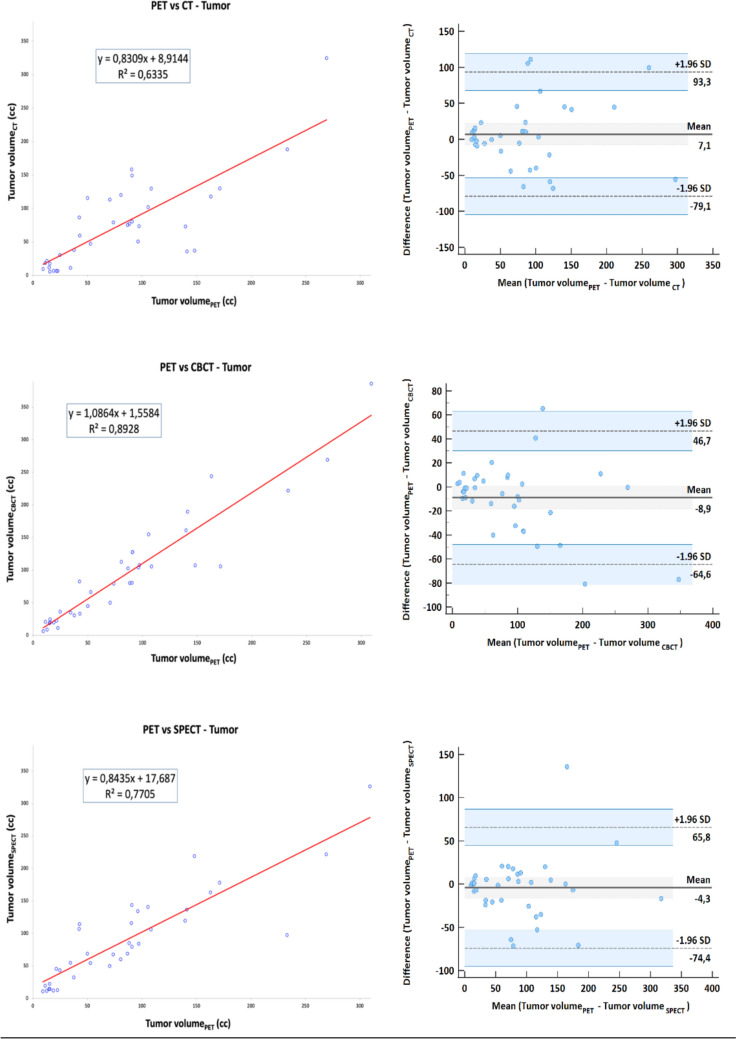
CBCT resulted as the most accurate method in predicting tumor- (R 0.88) and perfused volumes (R 0.82). Dosimetry prediction planning performed on derived volumes from the different methods did not show significant difference (p < 0.05), yet highest concordance with Y PET/CT data was observed with dual-phase CBCT.
Our study shows that dual-phase CBCT acquisition is a novel alternative method for correctly and safely administering more accurate and defined doses during TARE.
gov ID: NCT03981497.
个性化治疗方案正在系统应用,以确保肿瘤患者获得最佳治疗效果。这在肝细胞癌(HCC)患者经动脉放射性栓塞(TARE)的个性化剂量测定中也是如此。从放射学和核成像方法获得的精确而详细的体积和功能数据对于个性化剂量测定至关重要。我们试图评估双期锥形束CT(CBCT)与治疗前对比增强CT(CECT)以及锝标记大聚合白蛋白单光子发射计算机断层扫描/计算机断层扫描([Tc]MAA SPECT/CT)相比的准确性,以基于治疗后Y正电子发射断层扫描/计算机断层扫描(PET/CT)预测和评估TARE的疗效。
纳入30例连续接受TARE治疗的HCC患者。制定了术中双期CBCT采集方案,以区分动脉早期的肿瘤体积和动脉晚期未受影响肝脏的灌注体积。将从治疗前CECT、双期CBCT和[Tc]MAA SPECT/CT获得的体积数据与被视为标准参考的治疗后Y PET/CT进行比较。然后将根据不同成像得出的体积最终计算剂量的治疗模拟结果与治疗后Y PET/CT进行比较。
CBCT是预测肿瘤体积(R = 0.88)和灌注体积(R = 0.82)最准确的方法。对不同方法得出的体积进行的剂量测定预测规划未显示出显著差异(p < 0.05),但双期CBCT与Y PET/CT数据的一致性最高。
我们的研究表明,双期CBCT采集是一种新颖的替代方法,可在TARE期间正确、安全地给予更准确和明确的剂量。
美国国立医学图书馆临床试验注册中心标识符:NCT03981497。