Xi Ya-Zhi, Li Zhen-Ping, Zhou Qing-He
Department of Anesthesiology and Pain Medicine, the Affiliated Hospital of Jiaxing University, No.1882, South of the Second Ring Road, Jiaxing City, Zhejiang Province, 314000, China.
BMC Med Educ. 2024 Dec 21;24(1):1515. doi: 10.1186/s12909-024-06568-8.
Radial artery cannulation can be challenging, particularly for inexperienced providers. This study aimed to compare the success rates of resident physicians performing radial artery cannulation with mild sedation and analgesia versus without.
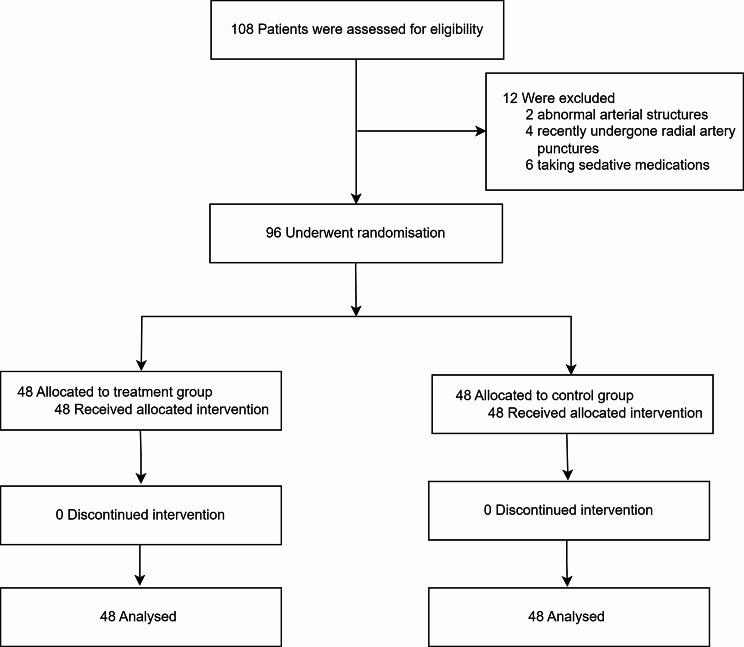
This study was a prospective, single-center, double-blind randomized controlled trial. Twelve anesthesiology residents performed radial artery insertions on 96 patients. The procedures were conducted with either mild sedation and analgesia (treatment group) or an equivalent volume of 0.9%Nacl (control group), in a random order. The primary outcome was the success rate of radial artery cannulation within 10 min for each group. Secondary outcomes included the first-attempt success rate, visual analogue scale (VAS) scores, and self-reported patient discomfort scores (0 corresponding to "no anxious", 1 corresponding to "mildly anxious", 2 corresponding to "moderately anxious" and 3 corresponding to "very anxious").
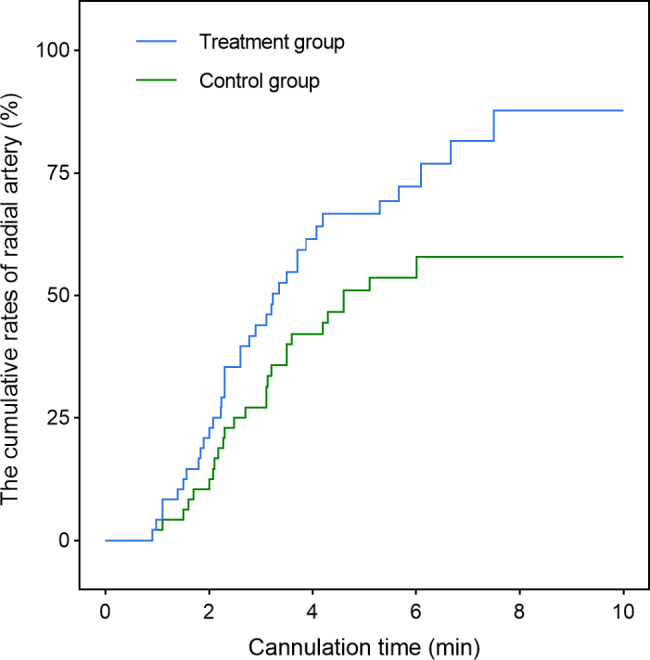
The success rate of radial artery cannulation within 10 min was 75.0% (36/48) in the treatment group and 54.2% (26/48) in the control group, respectively (difference 20.8%; P = 0.033, OR: 1.38, 95%CI: 1.02-1.88). The first-attempt success rate was 68.8% (33/48) in the treatment group, compared to 52.1% (25/48) in the control group (difference 16.7%; P = 0.095, OR: 1.32, 95%CI: 0.95-1.84). The VAS scores and self-reported patient discomfort scores were significantly lower in the treatment group than in the control group (2.0 [2.0, 2.0] vs. 3.0 [2.0, 4.0], P = 0.005; 1.0 [0.0, 2.0] vs. 2.0 [2.0, 2.0], P<0.001, respectively).
The success rate of radial artery cannulation within 10 min significantly increased for anesthesiology residents with the use of mild sedation and analgesia. Additionally, these medications resulted in a notable reduction in procedure-related pain and patient discomfort.
The study was registered at ClinicalTrials.gov (NCT05863455), with Qing-he Zhou as the principal investigator, on May 16, 2023.
桡动脉置管可能具有挑战性,尤其是对于经验不足的医护人员而言。本研究旨在比较住院医师在使用轻度镇静镇痛与不使用的情况下进行桡动脉置管的成功率。
本研究为一项前瞻性、单中心、双盲随机对照试验。12名麻醉科住院医师对96例患者进行桡动脉穿刺置管。操作按随机顺序分为使用轻度镇静镇痛(治疗组)或等量0.9%氯化钠溶液(对照组)。主要结局是每组在10分钟内桡动脉置管的成功率。次要结局包括首次尝试成功率、视觉模拟评分(VAS)以及患者自我报告的不适评分(0对应“无焦虑”,1对应“轻度焦虑”,2对应“中度焦虑”,3对应“非常焦虑”)。
治疗组10分钟内桡动脉置管成功率为75.0%(36/48),对照组为54.2%(26/48)(差异20.8%;P = 0.033,OR:1.38,95%CI:1.02 - 1.88)。治疗组首次尝试成功率为68.8%(33/48),对照组为52.1%(25/48)(差异16.7%;P = 0.095,OR:1.32,95%CI:0.95 - 1.84)。治疗组的VAS评分和患者自我报告的不适评分显著低于对照组(分别为2.0 [2.0, 2.0] 对比3.0 [2.0, 4.0],P = 0.005;1.0 [0.0, 2.0] 对比2.0 [2.0, 2.0],P < 0.001)。
对于麻醉科住院医师,使用轻度镇静镇痛可显著提高10分钟内桡动脉置管的成功率。此外,这些药物可显著减轻与操作相关的疼痛和患者不适。
本研究于2023年5月16日在ClinicalTrials.gov(NCT05863455)注册,主要研究者为周清河。