Nuwematsiko Rebecca, Kiwanuka Noah, Wafula Solomon T, Nakafeero Mary, Nakanjako Lydia, Luzze Henry, Turyahabwe Stavia, Sekandi Juliet N, Atuyambe Lynn, Buregyeya Esther
School of Public Health, Department of Disease Control and Environmental Health, Makerere University, Kampala, Uganda.
School of Public Health, Department of Epidemiology and Biostatistics, Makerere University, Kampala, Uganda.
BMC Health Serv Res. 2024 Dec 23;24(1):1638. doi: 10.1186/s12913-024-12115-4.
Loss to follow-up (LTFU) of patients with presumed tuberculosis (TB) before completing the diagnostic process (pre-diagnosis LTFU) and before initiating treatment for those diagnosed (pre-treatment LTFU) is a challenge in the realization of the End TB Strategy. We assessed the proportion of pre-diagnosis and pre-treatment LTFU and associated factors among patients with presumed TB and those diagnosed in the selected health facilities.
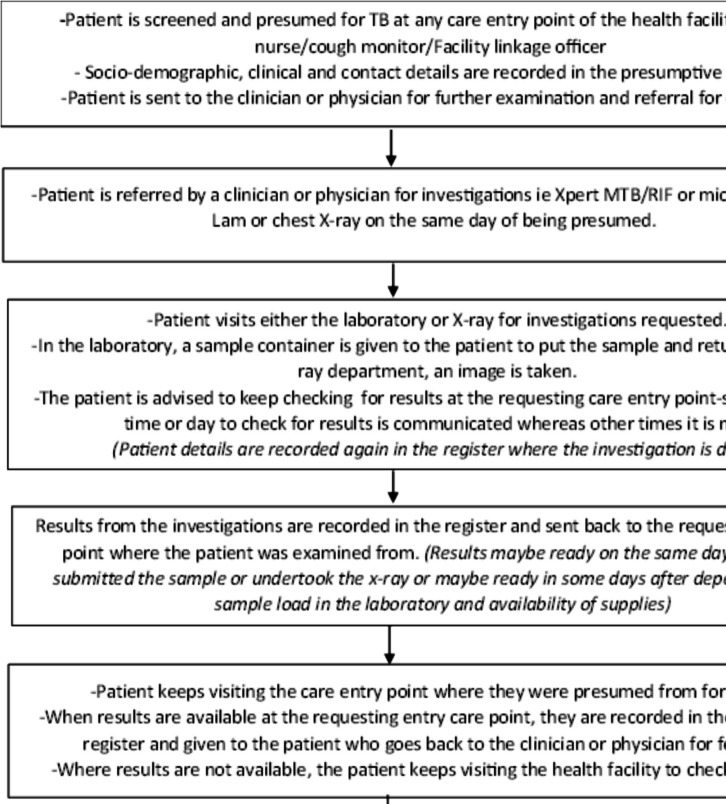
This was a retrospective cohort study involving a review of routinely collected data from presumptive, laboratory and TB treatment registers from January 2019 to December 2022. The study was conducted in three general hospitals and one lower-level health center IV in Central Uganda. We defined pre-diagnosis LTFU as failure to test for TB and obtain results within 30 days from the date of being presumed and pre-treatment LTFU as failure to initiate TB treatment within 14 days from the date of diagnosis. Modified Poisson regression was used to estimate prevalence ratios (PRs) and 95% confidence intervals (CIs) of factors associated with pre-diagnosis and pre-treatment LTFU.
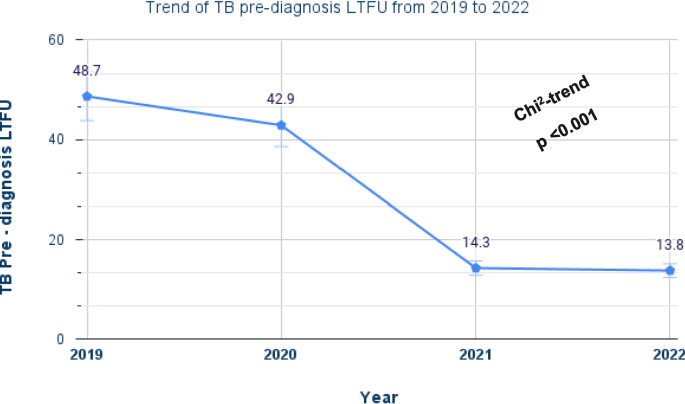
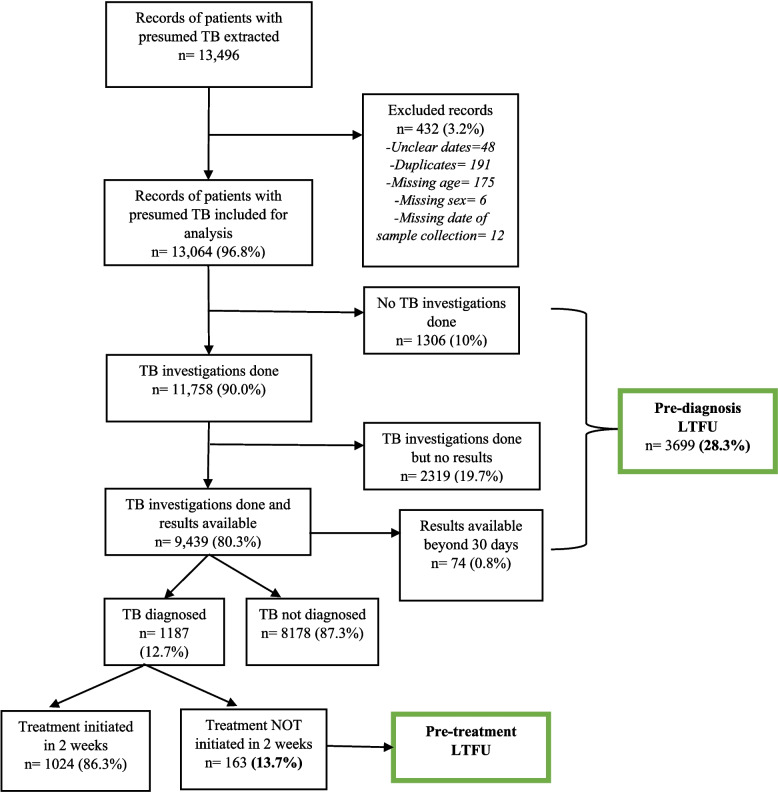
Of the 13,064 patients with presumed TB, 39.9% were aged 25 to 44 years, and 57.1% were females. Almost a third, 28.3% (3,699/13.064) experienced pre-diagnosis LTFU and 13.7% (163/1187) did not initiate treatment within 14 days from being diagnosed. Pre-diagnosis LTFU was more likely to occur among patients aged 0-14 years (adj PR 1.1, 95% CI: 1.06,1.24), females (adj.PR=1.06, 95% CI: 1.01, 1.12) and those with no record of place of residence (adj. PR=2.7, 95% CI: 2.54, 2.93). In addition, patients with no record of phone contact were more likely to be LTFU, (adj. PR=1.1, 95% CI: 1.05, 1.17). Pre-treatment LTFU was also more likely among patients with no record of place of residence (adj PR 7.1, 95% CI: 5.13,9.85) and those with no record of phone contact (adj PR 2.2, 95% CI: 1.63,2.86). Patients presumed from the HIV clinics were 40% less likely to experience pre-treatment LTFU compared to those in the outpatient departments (adj PR 0.6, 95% CI: 0.41,0.88).
High proportions of pre-diagnosis and pre-treatment LTFU were observed in this study. This calls for urgent interventions at these time points in the TB care cascade to be able to realise the End TB Strategy.
疑似结核病患者在完成诊断过程之前(诊断前失访)以及确诊患者在开始治疗之前(治疗前失访)的失访情况,是实现终止结核病战略面临的一项挑战。我们评估了选定医疗机构中疑似结核病患者和确诊患者的诊断前失访及治疗前失访比例及其相关因素。
这是一项回顾性队列研究,涉及对2019年1月至2022年12月从疑似、实验室及结核病治疗登记册中常规收集的数据进行审查。该研究在乌干达中部的三家综合医院和一家四级基层医疗中心开展。我们将诊断前失访定义为从被判定为疑似结核病之日起30天内未进行结核病检测及未获得检测结果,将治疗前失访定义为从确诊之日起14天内未开始结核病治疗。采用修正泊松回归来估计与诊断前及治疗前失访相关因素的患病率比(PRs)和95%置信区间(CIs)。
在13064例疑似结核病患者中,39.9%的患者年龄在25至44岁之间,57.1%为女性。近三分之一(28.3%,3699/13064)的患者经历了诊断前失访,13.7%(163/1187)的患者在确诊后14天内未开始治疗。0至14岁的患者(调整PR为1.1,95%CI:1.06,1.24)、女性(调整PR = 1.06,95%CI:1.01,1.12)以及无居住地址记录的患者(调整PR = 2.7,95%CI:2.54,2.93)更有可能出现诊断前失访。此外,无电话联系方式记录的患者更有可能失访(调整PR = 1.1,95%CI:1.05,1.17)。无居住地址记录的患者(调整PR为7.1,95%CI:5.13,9.85)和无电话联系方式记录的患者(调整PR为2.2,95%CI:范围1.63,2.86)也更有可能出现治疗前失访。与门诊部的患者相比,来自艾滋病毒诊所的疑似患者出现治疗前失访的可能性降低40%(调整PR为0.6,95%CI:0.41,0.88)。
本研究中观察到诊断前和治疗前失访的比例较高。这就需要在结核病治疗流程的这些时间点采取紧急干预措施,以便能够实现终止结核病战略。