Gunarathna Isuru, Spear Joseph D, Carter Tamar E
Department of Biology, College of Arts and Sciences, Baylor University, Waco, TX, USA.
Parasit Vectors. 2024 Dec 23;17(1):530. doi: 10.1186/s13071-024-06604-y.
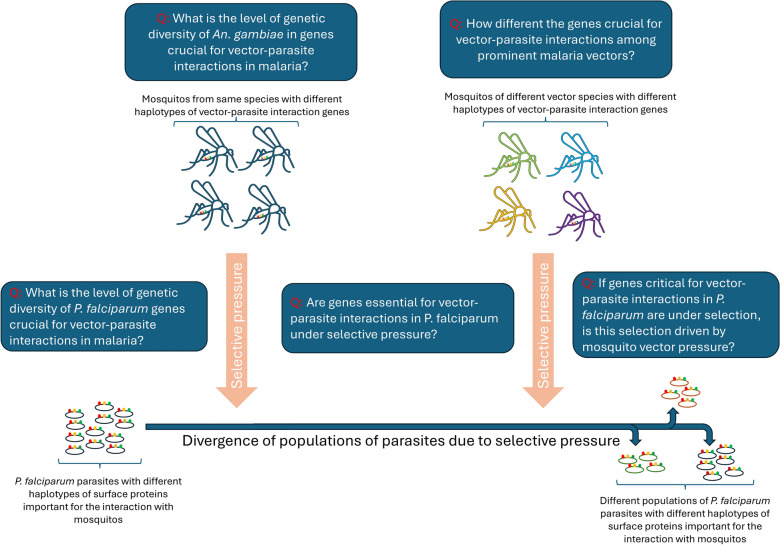
The high burden of malaria in Africa is largely due to the presence of competent and adapted Anopheles vector species. With invasive Anopheles stephensi implicated in malaria outbreaks in Africa, understanding the genomic basis of vector-parasite compatibility is essential for assessing the risk of future outbreaks due to this mosquito. Vector compatibility with P. falciparum arises from ancient coevolution and involves genes such as Pfs47 in P. falciparum and P47Rec in Anopheles. Questions remain about whether sub-continental vector variation is a selective pressure on current Plasmodium populations.
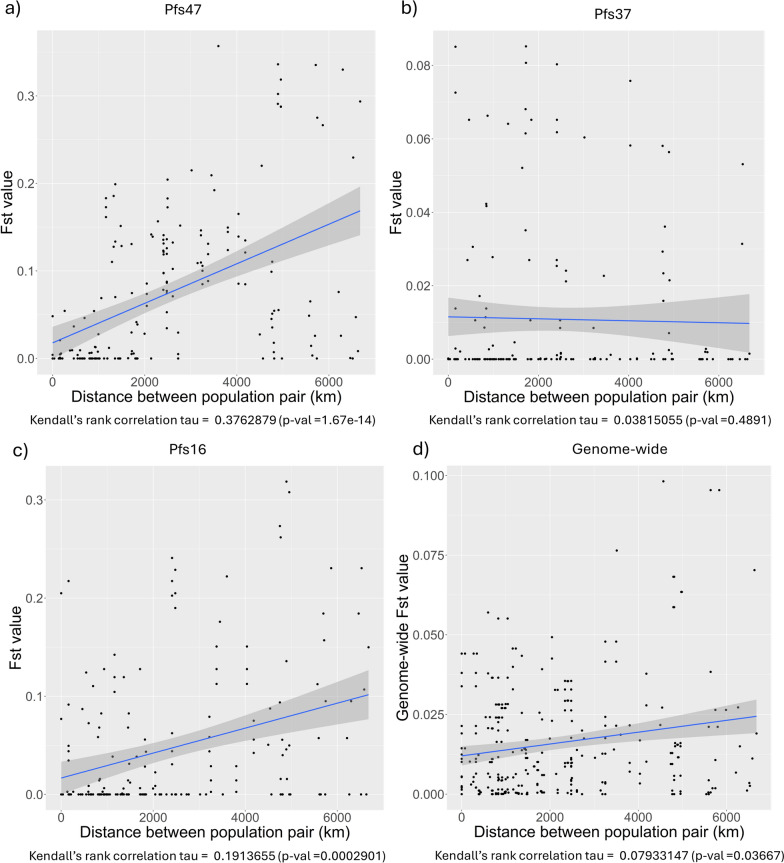
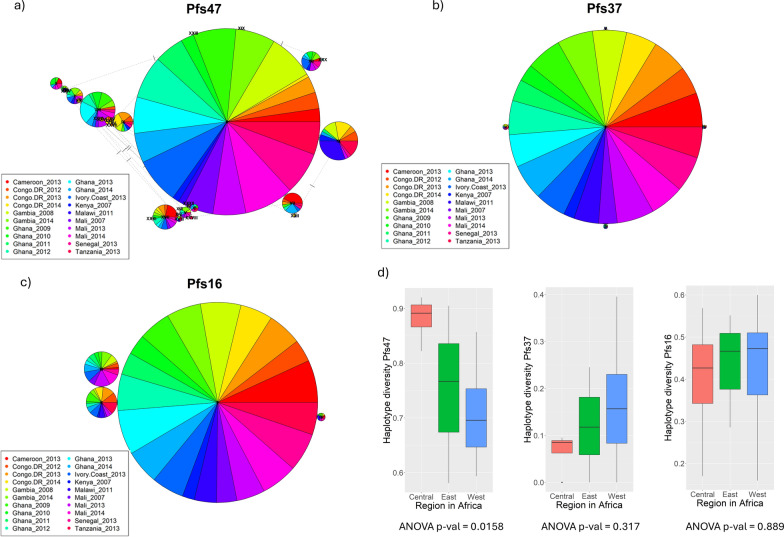
We analyzed the genetic diversity in parasite-vector interaction genes in P. falciparum and An. gambiae from 9 and 15 countries in Africa, respectively. Specifically, we looked for evidence of malaria vector-mediated selection within three P. falciparum genes (Pfs47, Pfs16, Pfs37) and conducted association analyses with occurrence probabilities of prominent malaria vectors.
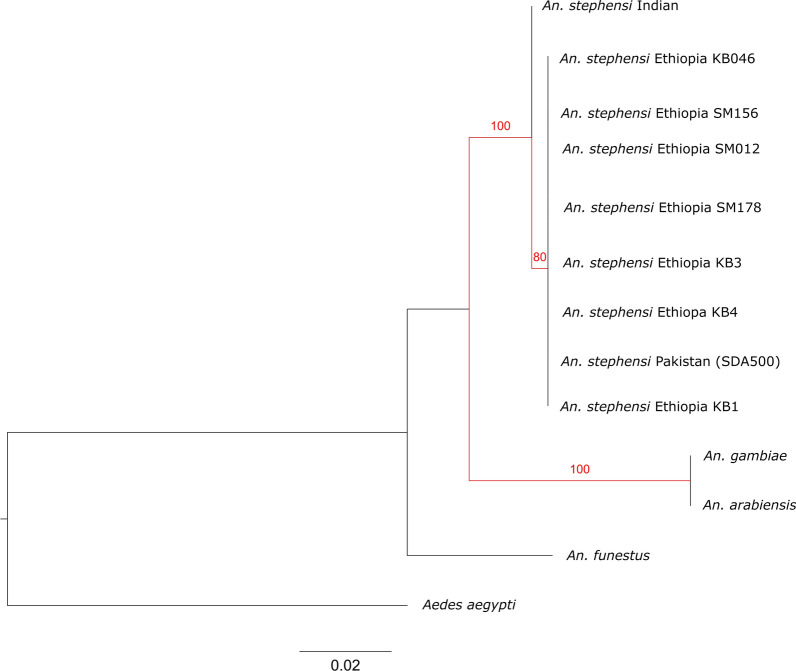
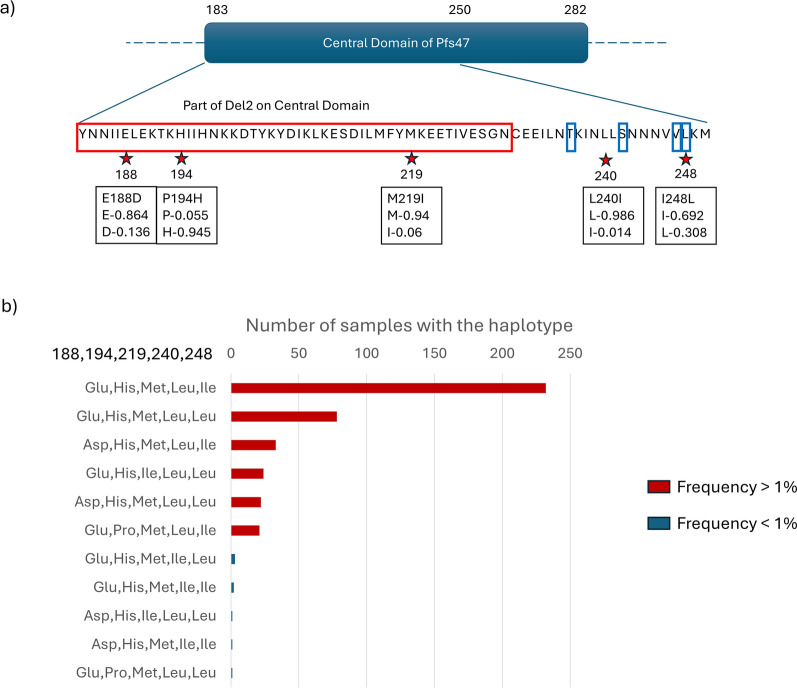
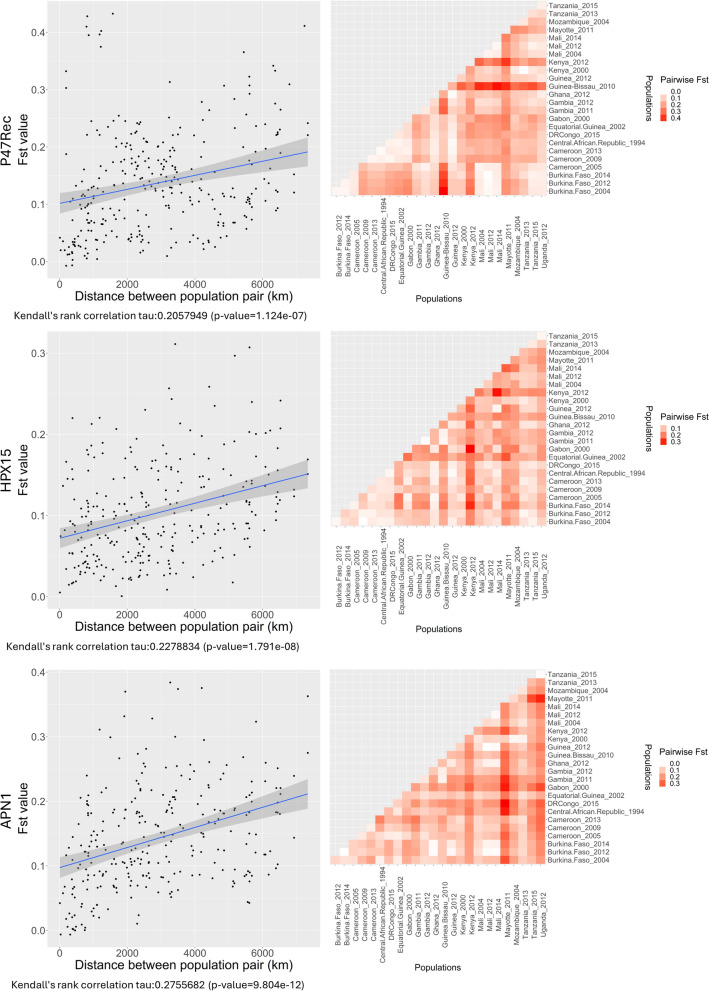
Higher protein haplotype diversities of Pfs47 and Pfs16 were associated with the probability of occurrence of An. arabiensis and An. funestus together. Only Pfs16 carried a signature of positive selection consistently (average Tajima's D = -2.96), which was associated with the probability of occurrence of An. funestus. These findings support vector-mediated selection on the basis of vector species diversity that may be occurring within Africa. We also employed phylogenetic analyses of An. gambiae interaction genes (P47Rec, APN1, HPX15) to identify significant subspecies diversity as a prerequisite to vector-population-mediated selection. Anopheles gambiae HPX15 revealed significant within-species differentiation (multiple branches bootstrap > 70) compared with absence of variation in P47Rec, suggesting that further investigation into subspecies-mediated selection on the basis of HPX15 is needed. Finally, we observed five amino acid changes at P47Rec in invasive An. stephensi compared with dominant African Anopheles species, calling for further investigation of the impact these distinct P47Rec variants might have on local African P. falciparum Pfs47 diversity.
Overall, these findings suggest that vector variation within Africa could influence P. falciparum diversity and lay a genomic framework for future investigation of invasive An. stephensi's impact on African malaria.
非洲疟疾负担沉重,很大程度上是由于存在适宜且适应性强的按蚊病媒物种。随着侵袭性斯氏按蚊在非洲疟疾疫情中被牵连,了解病媒与寄生虫相容性的基因组基础对于评估由这种蚊子引发未来疫情的风险至关重要。病媒与恶性疟原虫的相容性源于古老的共同进化,涉及恶性疟原虫中的Pfs47和按蚊中的P47Rec等基因。关于次大陆病媒变异是否对当前疟原虫种群构成选择压力,仍存在疑问。
我们分别分析了来自非洲9个和15个国家的恶性疟原虫和冈比亚按蚊中寄生虫 - 病媒相互作用基因的遗传多样性。具体而言,我们在三个恶性疟原虫基因(Pfs47、Pfs16、Pfs37)中寻找疟疾病媒介导选择的证据,并与主要疟疾病媒的出现概率进行关联分析。
Pfs47和Pfs16较高的蛋白质单倍型多样性与阿拉伯按蚊和嗜人按蚊共同出现的概率相关。只有Pfs16始终带有正选择的特征(平均 Tajima's D = -2.96),这与嗜人按蚊的出现概率相关。这些发现支持基于非洲可能正在发生的病媒物种多样性的病媒介导选择。我们还对冈比亚按蚊相互作用基因(P47Rec、APN1、HPX15)进行了系统发育分析,以确定显著的亚种多样性是病媒种群介导选择的先决条件。与P47Rec缺乏变异相比,冈比亚按蚊HPX15显示出显著的种内分化(多个分支自展值>70),这表明需要进一步研究基于HPX15的亚种介导选择。最后,我们观察到侵袭性斯氏按蚊与非洲主要按蚊物种相比,P47Rec有五个氨基酸变化,这需要进一步研究这些不同的P47Rec变体可能对非洲当地恶性疟原虫Pfs47多样性产生的影响。
总体而言,这些发现表明非洲内部的病媒变异可能影响恶性疟原虫的多样性,并为未来研究侵袭性斯氏按蚊对非洲疟疾的影响奠定了基因组框架。