Keleta Yacob, Ramelow Julian, Cui Liwang, Li Jun
Department of Biological Sciences, Florida International University, Miami, FL, 33199, USA.
Herbert Wertheim College of Medicine, Florida International University, Miami, FL, 33199, USA.
NPJ Vaccines. 2021 Nov 29;6(1):140. doi: 10.1038/s41541-021-00401-9.
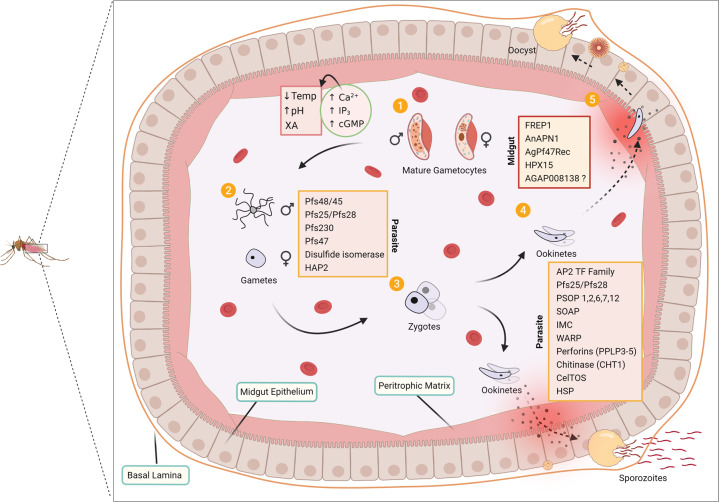
Despite considerable effort, malaria remains a major public health burden. Malaria is caused by five Plasmodium species and is transmitted to humans via the female Anopheles mosquito. The development of malaria vaccines against the liver and blood stages has been challenging. Therefore, malaria elimination strategies advocate integrated measures, including transmission-blocking approaches. Designing an effective transmission-blocking strategy relies on a sophisticated understanding of the molecular mechanisms governing the interactions between the mosquito midgut molecules and the malaria parasite. Here we review recent advances in the biology of malaria transmission, focusing on molecular interactions between Plasmodium and Anopheles mosquito midgut proteins. We provide an overview of parasite and mosquito proteins that are either targets for drugs currently in clinical trials or candidates of promising transmission-blocking vaccines.
尽管付出了巨大努力,疟疾仍然是一项重大的公共卫生负担。疟疾由五种疟原虫引起,通过雌性按蚊传播给人类。开发针对肝脏和血液阶段的疟疾疫苗一直具有挑战性。因此,疟疾消除策略主张采取综合措施,包括传播阻断方法。设计有效的传播阻断策略依赖于对控制蚊子中肠分子与疟原虫之间相互作用的分子机制的深入理解。在此,我们综述了疟疾传播生物学的最新进展,重点关注疟原虫与按蚊中肠蛋白之间的分子相互作用。我们概述了目前处于临床试验阶段的药物靶点或有前景的传播阻断疫苗候选物的寄生虫和蚊子蛋白。