Marquez-Lara Alejandro, Padget William, Wall Eric J, Parikh Shital N
Atrium Health Wake Forest Baptist, Winston-Salem, North Carolina, USA.
Beaumont Hospital, Farmington Hills, Michigan, USA.
Orthop J Sports Med. 2024 Dec 20;12(12):23259671241299838. doi: 10.1177/23259671241299838. eCollection 2024 Dec.
Postoperative knee arthrofibrosis after arthroscopic ligament reconstruction is a serious complication. Among adolescents, risk factors for postoperative arthrofibrosis are not well characterized and the effectiveness of early manipulation under anesthesia (MUA) is not well established.
To identify risk factors for arthrofibrosis after arthroscopic knee ligament reconstruction in adolescent patients and to evaluate the safety and effectiveness of early MUA.
Case-control study; Level of evidence, 3.
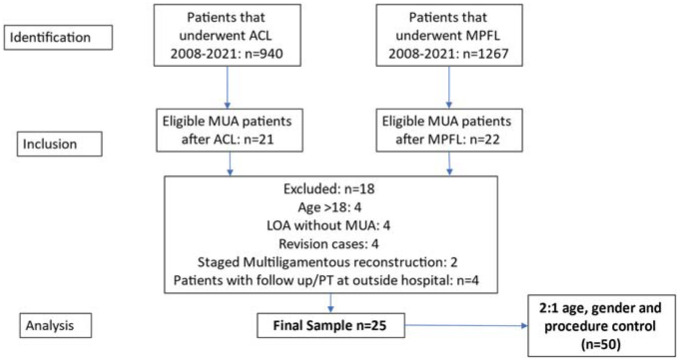
The charts of all adolescent patients (<19 years of age) who underwent early MUA (<3 months) for knee stiffness after anterior cruciate ligament (ACL) or medial patellofemoral ligament (MPFL) reconstructions between 2008 and 2021 were retrospectively reviewed. Patients were matched 2:1 with patients without MUA from the same study period. The primary outcome was the final range of motion (ROM) after MUA. Logistic regression analysis was performed to identify predictors of MUA.
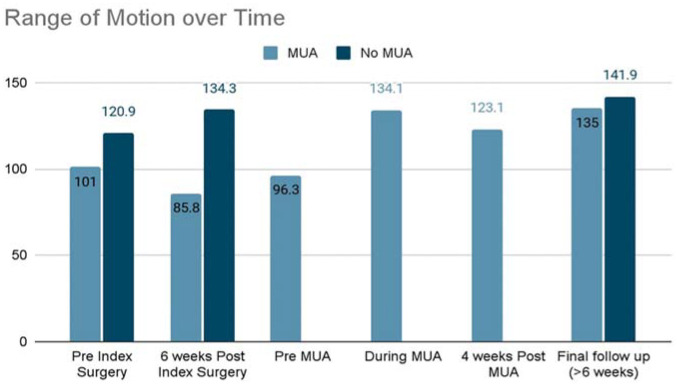
A total of 25 patients (10 with ACL reconstruction and 15 with MPFL reconstruction) with a mean age of 14.8 ± 2.6 years were included for analysis. Overall, 44% were skeletally immature. Patients underwent MUA at a mean of 63.3 ± 19.5 days after the index surgery. The mean ROM improved significantly from 96.3°± 20.5° to 135°± 9.7° after MUA after a median follow-up of 8.1 months (interquartile range, 5.4-15.0 months). There were no complications associated with MUA, but 2 patients (8.0%) had MUA treatment failure. There were no differences in body mass index, type and frequency of associated procedures, or patellar height on lateral radiographs between the cohorts. The MUA cohort had statistically significant increased operative time, decreased preoperative motion, decreased ROM at 6 weeks postoperatively, and increased pain at 6 weeks postoperatively when compared with the non-MUA cohort. Regression analysis demonstrated that ROM at 6 weeks (OR: 0.83, 95% CI, 0.69-0.98, = .034) was significantly associated with the need for MUA.
The findings of this study suggest that early (<3 months) MUA is safe and effective in treating knee arthrofibrosis in adolescent patients. MUA is a treatment alternative for patients with restricted ROM at 6 weeks that may help them recover full ROM.
关节镜下韧带重建术后膝关节关节纤维性强直是一种严重的并发症。在青少年中,术后关节纤维性强直的危险因素尚未得到充分描述,早期麻醉下手法治疗(MUA)的有效性也未得到充分证实。
确定青少年患者关节镜下膝关节韧带重建术后关节纤维性强直的危险因素,并评估早期MUA的安全性和有效性。
病例对照研究;证据等级,3级。
回顾性分析2008年至2021年间所有因前交叉韧带(ACL)或髌股内侧韧带(MPFL)重建术后膝关节僵硬而接受早期MUA(<3个月)的青少年患者(<19岁)的病历。将这些患者与同一研究期间未接受MUA的患者按2:1进行匹配。主要结局是MUA后的最终活动范围(ROM)。进行逻辑回归分析以确定MUA的预测因素。
共纳入25例患者(10例ACL重建,15例MPFL重建)进行分析,平均年龄为14.8±2.6岁。总体而言,44%的患者骨骼未成熟。患者在初次手术后平均63.3±19.5天接受MUA。中位随访8.1个月(四分位间距,5.4 - 15.0个月)后,MUA后平均ROM从96.3°±20.5°显著改善至135°±9.7°。未发生与MUA相关的并发症,但有2例患者(8.0%)MUA治疗失败。两组患者的体重指数、相关手术的类型和频率或外侧X线片上的髌腱长度无差异。与未接受MUA的队列相比,接受MUA的队列手术时间显著延长,术前活动度降低,术后6周ROM降低,术后6周疼痛增加。回归分析表明,术后6周的ROM(比值比:0.83,95%置信区间,0.69 - 0.98,P = 0.034)与是否需要MUA显著相关。
本研究结果表明,早期(<3个月)MUA治疗青少年患者膝关节关节纤维性强直是安全有效的。对于术后6周ROM受限的患者,MUA是一种治疗选择,可能有助于他们恢复完全的ROM。