Buhiliga Yosra F, Alkhars Hussam F, Alqahtani Maha, AlAlwan Abdullah, Alkhars Ali F
Plastic and Reconstructive Surgery, Dammam Medical Complex, Dammam, SAU.
Surgery, King Faisal University, Al Hofuf, SAU.
Cureus. 2024 Dec 18;16(12):e75939. doi: 10.7759/cureus.75939. eCollection 2024 Dec.
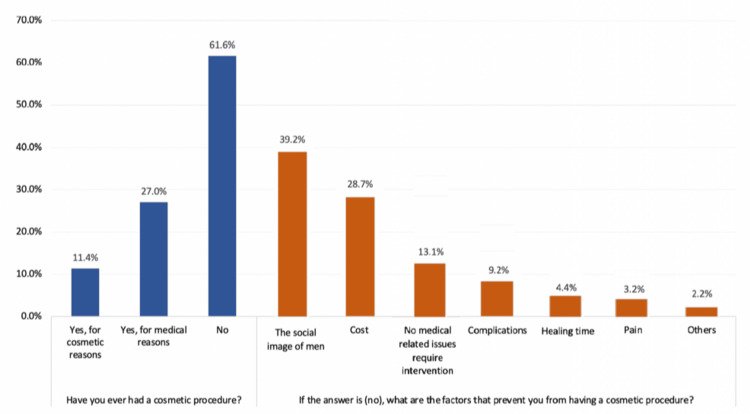
Background Cosmetic procedures have become increasingly popular worldwide; however, male participation remains relatively low, especially in conservative societies like Saudi Arabia. This study explores the awareness, attitudes, and experiences of men concerning aesthetic procedures in Saudi Arabia, with a focus on sociodemographic factors and sources of information. This study aimed to assess male awareness, attitudes, and experiences with aesthetic procedures in Saudi Arabia and identify factors influencing their engagement with these interventions. Methodology A cross-sectional study was conducted involving 818 male participants from various regions in Saudi Arabia. Data on sociodemographic profiles, awareness levels, and attitudes toward cosmetic procedures were collected using a structured questionnaire. Descriptive statistics, chi-square tests, and logistic regression models were used for data analysis performed using SPSS version 26 (IBM Corp., Armonk, NY, USA). Results The study found that 504 (61.6%) participants had never undergone a cosmetic procedure. The most common reasons for not undergoing such procedures included the social image of men (198, 39.2%), cost (145, 28.7%), and no health issues requiring aesthetic intervention (66, 13.1%). Awareness of cosmetic procedures was relatively low, with 223 (27.3%) participants rating their awareness as "low" and 101 (12.3%) as "very low." Social media (333, 40.7%), physicians (211, 25.8%), and television (144, 17.6%) were the primary sources of information. Significant factors influencing attitudes included age, education level, employment status, and marital status, all of which had a significant p-value below 0.05. Conclusions Awareness and acceptance of cosmetic procedures among Saudi males are increasing, influenced by various cultural, societal, and personal factors. This study highlights the need for targeted campaigns and education to promote understanding and acceptance. Further research is needed to examine how these attitudes evolve and their implications for the cosmetic industry and healthcare providers.
背景 美容手术在全球范围内越来越受欢迎;然而,男性的参与度仍然相对较低,尤其是在沙特阿拉伯这样的保守社会。本研究探讨了沙特阿拉伯男性对美容手术的认知、态度和经历,重点关注社会人口统计学因素和信息来源。本研究旨在评估沙特阿拉伯男性对美容手术的认知、态度和经历,并确定影响他们接受这些干预措施的因素。方法 进行了一项横断面研究,涉及来自沙特阿拉伯不同地区的818名男性参与者。使用结构化问卷收集有关社会人口统计学特征、认知水平和对美容手术态度的数据。描述性统计、卡方检验和逻辑回归模型用于使用SPSS 26版(美国纽约州阿蒙克市IBM公司)进行的数据分析。结果 研究发现,504名(61.6%)参与者从未接受过美容手术。不接受此类手术的最常见原因包括男性的社会形象(198人,39.2%)、费用(145人,28.7%)以及没有需要美容干预的健康问题(66人,13.1%)。对美容手术的认知相对较低,223名(27.3%)参与者将他们的认知评为“低”,101名(12.3%)评为“非常低”。社交媒体(333人,40.7%)、医生(211人,25.8%)和电视(144人,17.6%)是主要信息来源。影响态度的重要因素包括年龄、教育水平、就业状况和婚姻状况,所有这些因素的p值均显著低于0.05。结论 受各种文化、社会和个人因素的影响,沙特男性对美容手术的认知和接受度正在提高。本研究强调需要开展有针对性的宣传活动和教育,以促进理解和接受。需要进一步研究来考察这些态度如何演变以及它们对美容行业和医疗保健提供者的影响。