Zhao Jianli, Yu Yunfang, Ren Wei, Ding Linxiaoxiao, Chen Yongjian, Yuan Peng, Yue Jian, Yang Yaping, Zou Guorong, Chen Tao, Chai Jie, Zhang Li, Wu Wenjing, Zeng Yinduo, Gui Xiujuan, Cai Yangyang, Luo Simin, Yuan Zhongyu, Zhang Kang, Yao Herui, Wang Ying
Guangdong Provincial Key Laboratory of Malignant Tumor Epigenetics and Gene Regulation Department of Medical Oncology Breast Tumor Centre Phase I Clinical Trial Centre, Clinical Research Design Division, Clinical Research Center Sun Yat-sen Memorial Hospital Sun Yat-sen University Guangzhou Guangdong China.
Faculty of Medicine Macau University of Science and Technology Taipa Macao PR China.
MedComm (2020). 2024 Dec 20;6(1):e70031. doi: 10.1002/mco2.70031. eCollection 2025 Jan.
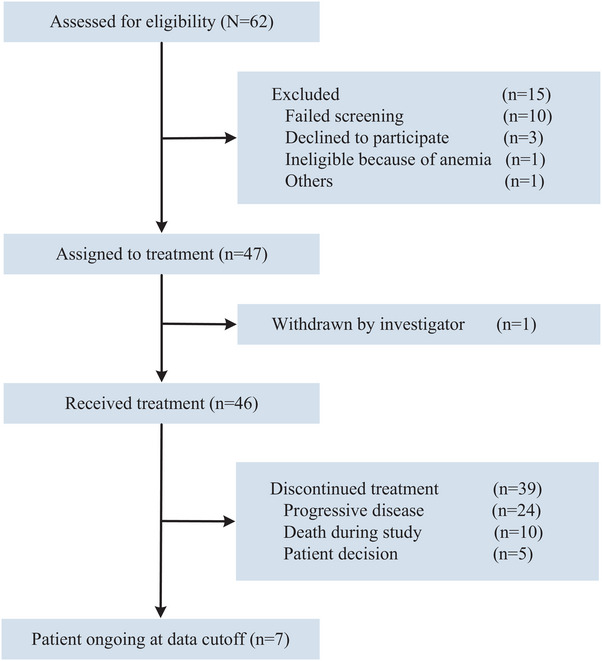
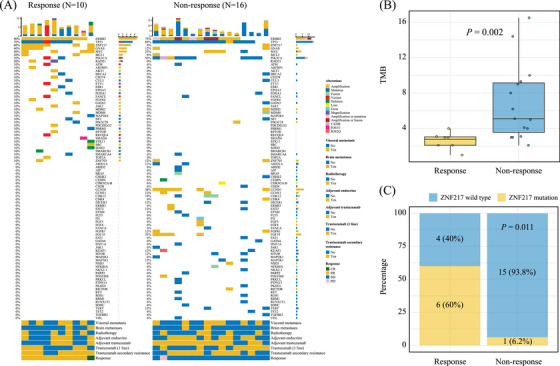
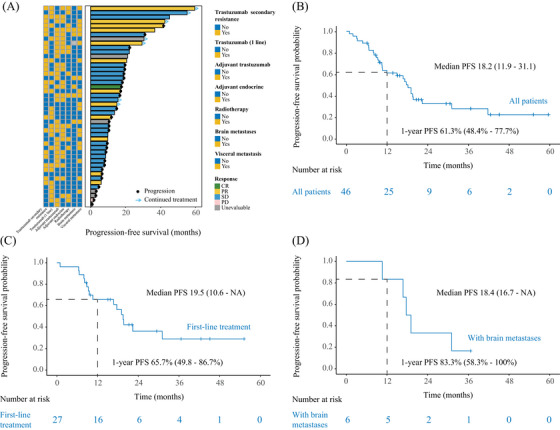
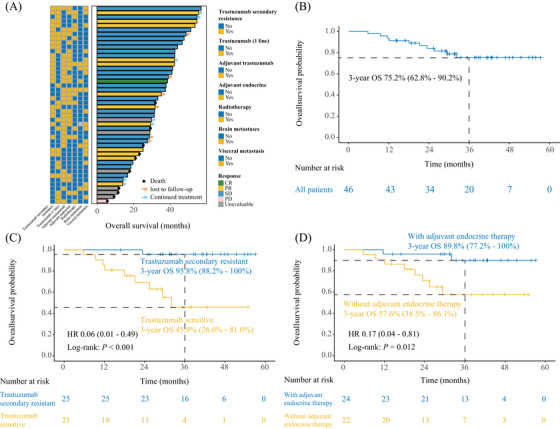
This multicenter, single-arm, phase II clinical trial (NCT04034589) evaluated the efficacy and safety of pyrotinib combined with fulvestrant in patients with HR-positive/HER2-positive metastatic breast cancer who had experienced trastuzumab treatment failure. A total of 46 patients were enrolled, receiving pyrotinib orally once daily and fulvestrant intramuscularly on days 1 and 15 of cycle 1, followed by monthly doses on day 1. The primary endpoint was progression-free survival (PFS), while secondary endpoints included overall survival (OS), objective response rate (ORR), disease control rate (DCR), and safety. The median PFS was 18.2 months (95% CI, 11.9-31.1) overall, 19.5 months (95% CI, 10.6-NA) for those receiving the combination as first-line therapy, and 18.4 months (95% CI, 16.7-NA) for patients with brain metastases. Median OS was not reached, with a 3-year OS rate of 75.2% (95% CI, 62.8-90.2%). The ORR was 32.5%, and the DCR was 97.5%. Responses were observed in patients with low tumor mutation burden and mutation. Importantly, no grade 4 or higher treatment-related adverse events or deaths were reported, indicating a favorable safety profile. In conclusion, the combination of pyrotinib and fulvestrant demonstrated promising antitumor activity and acceptable safety in HR-positive/HER2-positive metastatic breast cancer patients.
这项多中心、单臂、II期临床试验(NCT04034589)评估了吡咯替尼联合氟维司群在经历曲妥珠单抗治疗失败的HR阳性/HER2阳性转移性乳腺癌患者中的疗效和安全性。共纳入46例患者,每日口服一次吡咯替尼,第1周期的第1天和第15天肌肉注射氟维司群,随后在第1天每月给药一次。主要终点是无进展生存期(PFS),次要终点包括总生存期(OS)、客观缓解率(ORR)、疾病控制率(DCR)和安全性。总体中位PFS为18.2个月(95%CI,11.9 - 31.1),接受联合治疗作为一线治疗的患者为19.5个月(95%CI,10.6 - NA),脑转移患者为18.4个月(95%CI,16.7 - NA)。中位OS未达到,3年总生存率为75.2%(95%CI, 62.8 - 90.2%)。ORR为32.5%,DCR为97.5%。在肿瘤突变负荷低和有[此处原文可能缺失具体突变信息]突变的患者中观察到缓解。重要的是,未报告4级或更高等级的治疗相关不良事件或死亡,表明安全性良好。总之,吡咯替尼和氟维司群联合治疗在HR阳性/HER2阳性转移性乳腺癌患者中显示出有前景的抗肿瘤活性和可接受的安全性。