Gu Joyce H, Samarneh Mark
Medicine, Lake Erie College of Osteopathic Medicine, Greensburg, USA.
Internal Medicine/Nephrology, St. John's Riverside Hospital, Yonkers, USA.
Cureus. 2024 Nov 22;16(11):e74245. doi: 10.7759/cureus.74245. eCollection 2024 Nov.
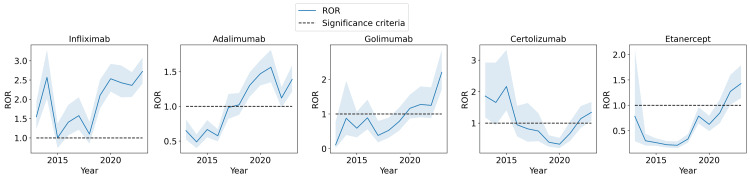
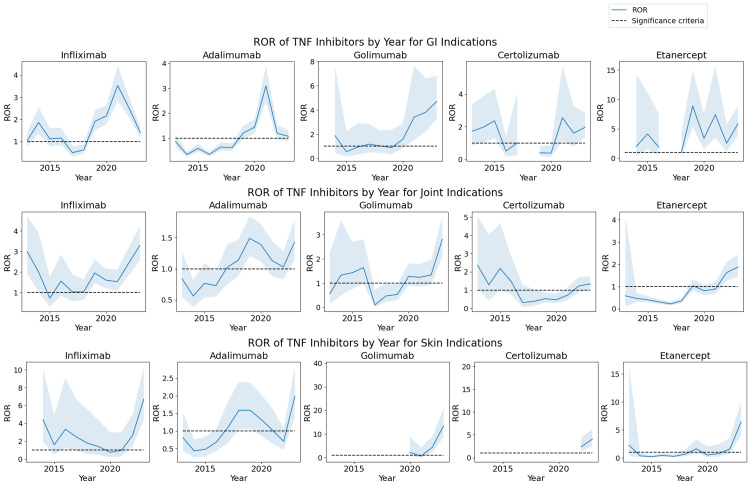
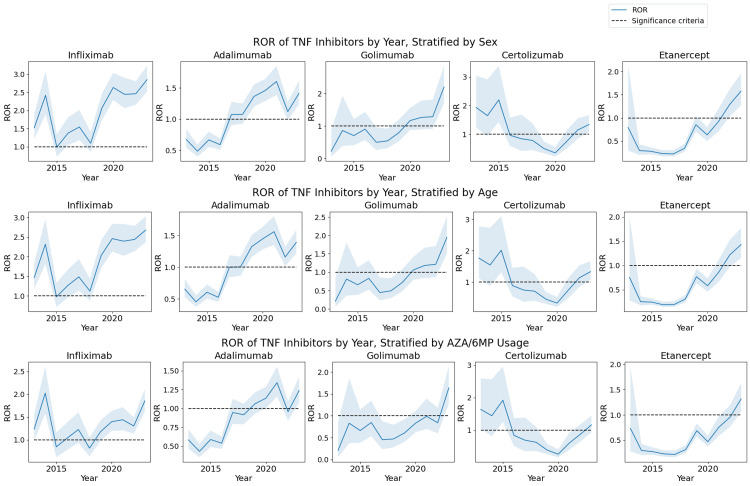
Tumor necrosis factor (TNF) inhibitors are a class of pharmacologic agents used to treat a wide range of immunologic diseases. We present a systematic study of the pancreatitis risk with TNF inhibitor use through a retrospective case-control design disproportionality analysis of the U.S. Food and Drug Administration Adverse Event Reporting System (FAERS) database, with data ranging from the fourth quarter of 2012 (2012 Q4) to the second quarter of 2024 (2024 Q2). Our analysis reveals an increasing trend in the pancreatitis risk with TNF inhibitors when stratified by year, with all of the TNF inhibitors studied exhibiting significant association with pancreatitis in the year 2023. Furthermore, these results hold even when controlling for sex, age, concurrent use of azathioprine, and the indication for treatment. Our findings flag the necessity for a careful investigation and monitoring of pancreatitis risk in patients undergoing TNF inhibitor therapy, especially in recent years.
肿瘤坏死因子(TNF)抑制剂是一类用于治疗多种免疫性疾病的药物。我们通过对美国食品药品监督管理局不良事件报告系统(FAERS)数据库进行回顾性病例对照设计不均衡分析,对使用TNF抑制剂的胰腺炎风险进行了系统研究,数据范围从2012年第四季度(2012 Q4)至2024年第二季度(2024 Q2)。我们的分析显示,按年份分层时,使用TNF抑制剂的胰腺炎风险呈上升趋势,在2023年,所有研究的TNF抑制剂都与胰腺炎存在显著关联。此外,即使在控制性别、年龄、硫唑嘌呤的同时使用情况以及治疗指征后,这些结果仍然成立。我们的研究结果表明,有必要对接受TNF抑制剂治疗的患者,尤其是近年来的患者,仔细调查和监测胰腺炎风险。