Kaleem Bushra, Shahab Sadaf, Shamsi Tahir Sultan
Department of Clinical Research, National Institute of Blood Disease and Bone Marrow Transplantation, Karachi, Pakistan.
Department of Clinical Haematology, National Institute of Blood Disease and Bone Marrow Transplantation, Karachi, Pakistan.
Adv Lab Med. 2024 Sep 16;5(4):412-417. doi: 10.1515/almed-2024-0069. eCollection 2024 Dec.
kinase domain mutations are an important cause of resistance to tyrosine kinase inhibitors (TKIs) in chronic myeloid leukaemia (CML) of which T315I is the most treatment-resilient. This study aimed to observe the frequency of T315I and its impact on disease prognosis in terms of progression and survival.
Patients with a response which categorized them into warning zone/or who failed to respond to their TKI treatment completely as per the European LeukemiaNet (ELN) were labeled as non-responders. They were assessed for T315I mutation using amplification refractory mutation system-polymerase chain reaction (ARMS-PCR) and validated via sequencing. Patients were then longitudinally followed for 96 months for the prognostic impact of the mutation.
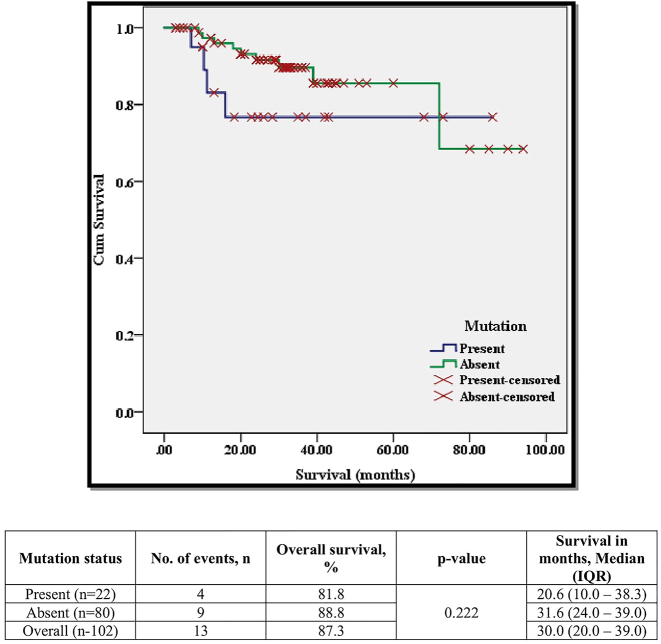
Of the 102 non-responders, T315I mutation was detected in 21.6 % of patients with a female preponderance. Almost 59 % of mutation-harbouring patients were labelled as low Sokal risk at baseline. The disease progression into the blastic phase was reported in 58.8 % of mutation-harbouring patients. Overall survival (study period: 96 months) was 81.8 % in patients harbouring T315I mutation. Patients in the blastic phase had significant odds of harbouring T315I mutation.
Sub-optimal response or failure to TKI treatment indicates the development of resistance due to the presence of T315I mutation or other mutation(s). Early identification will help redirect the patient's treatment.
激酶结构域突变是慢性髓性白血病(CML)对酪氨酸激酶抑制剂(TKIs)耐药的重要原因,其中T315I是最具治疗抵抗性的。本研究旨在观察T315I的频率及其对疾病进展和生存预后的影响。
根据欧洲白血病网络(ELN)标准,将反应处于警告区或对TKI治疗未完全反应的患者标记为无反应者。使用扩增阻滞突变系统-聚合酶链反应(ARMS-PCR)评估他们的T315I突变情况,并通过测序进行验证。然后对患者进行96个月的纵向随访,以观察该突变对预后的影响。
在102例无反应者中,21.6%的患者检测到T315I突变,女性占多数。近59%携带突变的患者在基线时被标记为低索卡尔风险。58.8%携带突变的患者疾病进展至急变期。携带T315I突变患者的总生存率(研究期:96个月)为81.8%。处于急变期的患者携带T315I突变的几率显著增加。
TKI治疗反应欠佳或失败表明由于存在T315I突变或其他突变而产生耐药。早期识别有助于调整患者的治疗方案。