Kaumbekova Samal, Sakaguchi Naoya, Shah Dhawal, Umezawa Masakazu
Department of Medical and Robotic Engineering Design, Faculty of Advanced Engineering, Tokyo University of Science, 6-3-1 Niijuku, Katsushika, Tokyo 125-8585, Japan.
Chemical and Materials Engineering, School of Engineering and Digital Sciences, Nazarbayev University, Kabanbay Batyr 53, Astana 010000, Kazakhstan.
ACS Omega. 2024 Dec 3;9(50):49283-49292. doi: 10.1021/acsomega.4c06409. eCollection 2024 Dec 17.
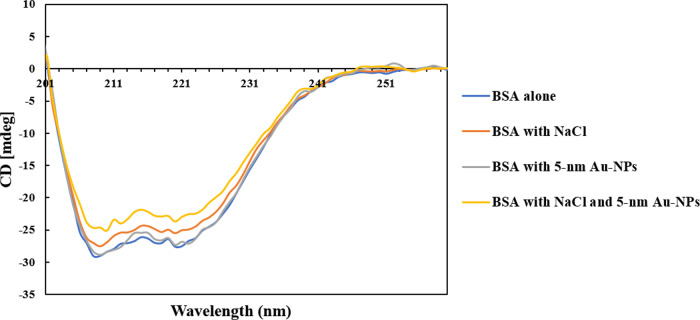
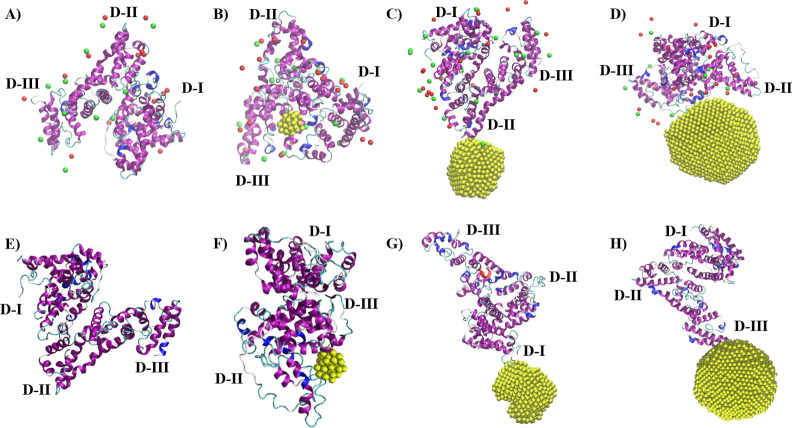
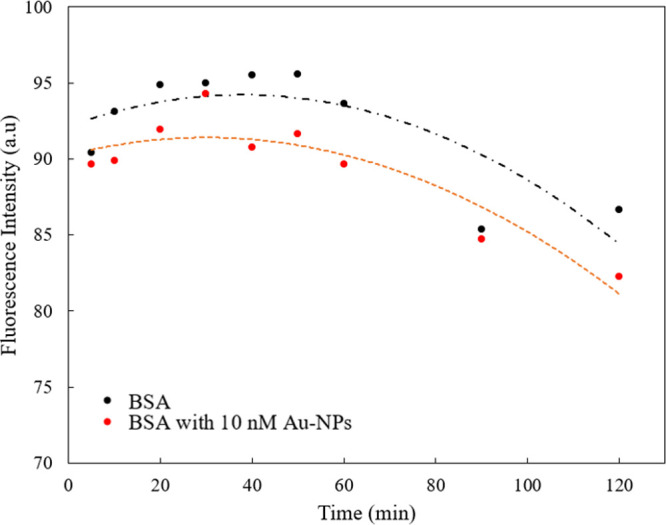
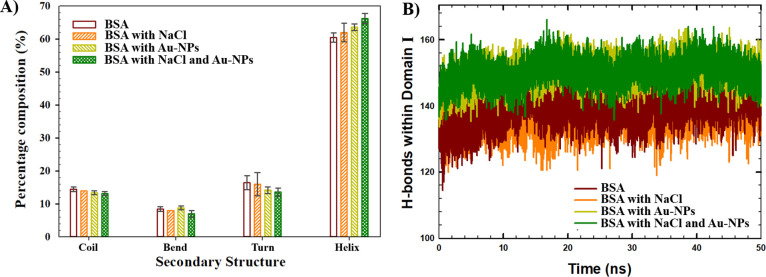
With the development of nanotechnology, there is growing interest in using nanoparticles (NPs) for biomedical applications, such as diagnostics, drug delivery, imaging, and nanomedicine. The protein's structural stability plays a pivotal role in its functionality, and any alteration in this structure can have significant implications, including disease progression. Herein, we performed a combined experimental and computational study of the effect of gold NPs with a diameter of 5 nm (5 nm Au-NPs) on the structural stability of bovine serum albumin (BSA) protein in the absence and presence of NaCl salt. Circular dichroism spectroscopy showed a loss in the secondary structure of BSA due to the synergistic effect of Au-NPs and NaCl, and Thioflavin T fluorescence assays showed suppressed β-sheet formation in the presence of Au-NPs in PBS, emphasizing the intricate interplay between NPs and physiological conditions. Additionally, molecular dynamics (MD) simulations revealed that 5 nm Au-NP induced changes in the secondary structure of the BSA monomer in the presence of NaCl, highlighting the initial binding mechanism between BSA and Au-NP. Furthermore, MD simulations explored the effect of smaller Au-NP (3 nm) and nanocluster (Au-NC with the size of 1 nm) on the binding sites of the BSA monomer. Although the formation of stable BSA-Au conjugates was revealed in the presence of NPs of different sizes, no specific protein binding sites were observed. Moreover, due to its small size, 1 nm Au-NC decreased helical content and hydrogen bonds in the BSA monomer, promoting protein unfolding more significantly. In summary, this combined experimental and computational study provides comprehensive insights into the interactions among Au nanosized substances, BSA, and physiological conditions that are essential for developing tailored nanomaterials with enhanced biocompatibility and efficacy.
随着纳米技术的发展,人们越来越关注将纳米颗粒(NPs)用于生物医学应用,如诊断、药物递送、成像和纳米医学。蛋白质的结构稳定性对其功能起着关键作用,这种结构的任何改变都可能产生重大影响,包括疾病进展。在此,我们进行了一项结合实验和计算的研究,考察了直径为5纳米的金纳米颗粒(5 nm Au-NPs)在有无NaCl盐存在的情况下对牛血清白蛋白(BSA)蛋白质结构稳定性的影响。圆二色光谱显示,由于Au-NPs和NaCl的协同作用,BSA的二级结构丧失,硫黄素T荧光测定表明,在PBS中存在Au-NPs时,β-折叠的形成受到抑制,强调了纳米颗粒与生理条件之间复杂的相互作用。此外,分子动力学(MD)模拟表明,在存在NaCl的情况下,5 nm Au-NP会诱导BSA单体二级结构的变化,突出了BSA与Au-NP之间的初始结合机制。此外,MD模拟还探讨了较小的Au-NP(3 nm)和纳米团簇(尺寸为1 nm的Au-NC)对BSA单体结合位点的影响。尽管在不同尺寸的纳米颗粒存在下揭示了稳定的BSA-Au缀合物的形成,但未观察到特定的蛋白质结合位点。此外,由于其尺寸小,1 nm Au-NC降低了BSA单体中的螺旋含量和氢键,更显著地促进了蛋白质的展开。总之,这项结合实验和计算的研究为金纳米物质、BSA和生理条件之间的相互作用提供了全面的见解,这些对于开发具有增强生物相容性和功效的定制纳米材料至关重要。