Mangoura Safwat A, Abdel-Raheem Mahmoud H, Eltyb Hanan A, Molla Mohammed S, Hussein Abeer M R
Department of Pharmacology and Toxicology, Faculty of Pharmacy, Badr University in Cairo (BUC), Badr, Cairo, Egypt.
Department of Medical Pharmacology, Faculty of Medicine, Assiut University, Assiut, 71515, Egypt.
Cancer Chemother Pharmacol. 2024 Dec 23;95(1):12. doi: 10.1007/s00280-024-04723-y.
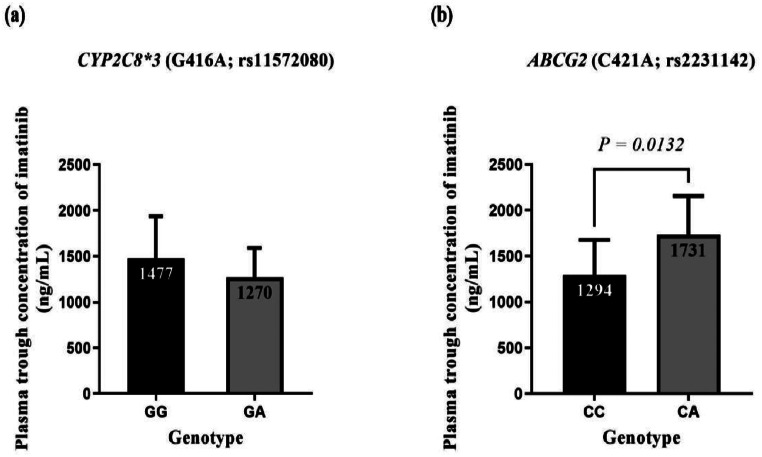
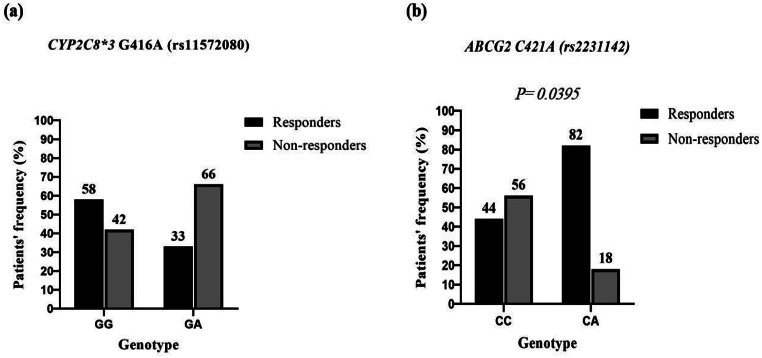
The treatment landscape for chronic myeloid leukemia (CML) has been revolutionized by the introduction of imatinib, a tyrosine kinase inhibitor, which has transformed the disease from a fatal condition into a manageable chronic illness for a substantial number of patients. Despite this, some individuals do not respond adequately to the treatment, and others may experience disease progression even with continued therapy. This study examined how CYP2C8*3 (G416A; rs11572080) and ABCG2 C421A (rs2231142) single nucleotide polymorphisms (SNPs) affect the plasma trough concentration and therapeutic response of imatinib in Egyptian CML patients.
The study included fifty patients with chronic-phase CML, who were categorized into two groups: responders (n = 26) and non-responders (n = 24), according to their BCR-ABL1 transcription levels after 12 months of imatinib treatment. Genotyping of the CYP2C8*3 and ABCG2 C421A polymorphisms was performed using polymerase chain reaction-restriction fragment length polymorphism (PCR-RFLP), while plasma trough concentrations were determined through high-performance liquid chromatography with ultraviolet-diode array detection (HPLC-UV/DAD).
Patients with the CA genotype of ABCG2 C421A showed significantly higher mean plasma trough concentrations of imatinib (CA: 1731 ± 424.7 ng/mL; CC: 1294 ± 381.3 ng/mL; p = 0.0132) and demonstrated a better molecular response compared to those with the CC genotype (p = 0.0395).
The ABCG2 C421A polymorphism significantly influenced imatinib plasma trough concentrations and molecular responses in Egyptian chronic-phase CML patients. Genotyping of this polymorphism in these patients could assist in optimizing imatinib therapy, predicting more favorable treatment outcomes, and enabling the development of more personalized treatment plans.
伊马替尼(一种酪氨酸激酶抑制剂)的引入彻底改变了慢性髓性白血病(CML)的治疗格局,它已将这种疾病从一种致命疾病转变为许多患者可控制的慢性病。尽管如此,一些患者对治疗反应不佳,而另一些患者即使持续治疗也可能出现疾病进展。本研究探讨了CYP2C8*3(G416A;rs11572080)和ABCG2 C421A(rs2231142)单核苷酸多态性(SNP)如何影响埃及CML患者中伊马替尼的血浆谷浓度和治疗反应。
该研究纳入了50例慢性期CML患者,根据伊马替尼治疗12个月后的BCR-ABL1转录水平将其分为两组:反应者(n = 26)和无反应者(n = 24)。使用聚合酶链反应-限制性片段长度多态性(PCR-RFLP)对CYP2C8*3和ABCG2 C421A多态性进行基因分型,同时通过高效液相色谱-紫外二极管阵列检测(HPLC-UV/DAD)测定血浆谷浓度。
ABCG2 C421A的CA基因型患者显示出伊马替尼的平均血浆谷浓度显著更高(CA:1731±424.7 ng/mL;CC:1294±381.3 ng/mL;p = 0.0132),并且与CC基因型患者相比表现出更好的分子反应(p = 0.0395)。
ABCG2 C421A多态性显著影响埃及慢性期CML患者中伊马替尼的血浆谷浓度和分子反应。对这些患者进行该多态性的基因分型有助于优化伊马替尼治疗、预测更有利的治疗结果并制定更个性化的治疗方案。