Bello Mozidat Olamide, Wadid Mark, Malode Aishwarya, Patel Vahin, Shah Anuj, Vyas Ankit, Ahmad Hassaan Ali, Tarun Tushar, Dani Sourbha, Ahmad Javaria, Zarwan Corrine, Ganatra Sarju
Cardio-Oncology Program, Division of Cardiovascular Medicine, Department of Medicine, Lahey Hospital and Medical Center, 41 Mall Road, Burlington, MA, 01805, USA.
Department of Vascular Medicine, Ochsner Clinic Foundation, New Orleans, LA, USA.
Cardiol Ther. 2025 Mar;14(1):1-15. doi: 10.1007/s40119-024-00394-1. Epub 2024 Dec 23.
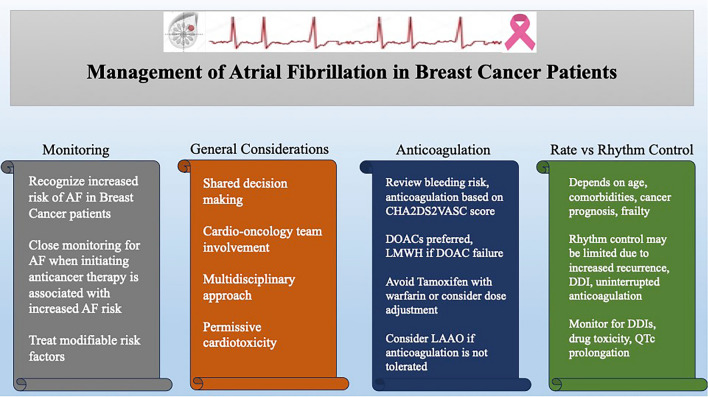
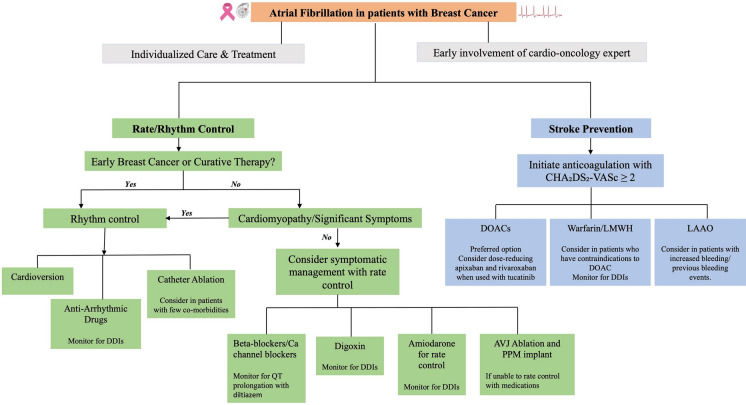
In addition to traditional risk factors, patients with breast cancer are at an increased risk of atrial fibrillation due to cancer itself and certain cancer therapies. Atrial fibrillation in these patients adds to their morbidity and mortality. The precise mechanisms leading to the increased atrial fibrillation in patients with breast cancer are not well understood. The main goal of atrial fibrillation management in this population is to facilitate uninterrupted cancer treatment while addressing the arrhythmia and other cardiovascular sequelae of cancer treatment. Rhythm control is often challenging to implement in patients with breast cancer during active antineoplastic therapy because of the need for uninterrupted anticoagulation, potential drug-drug interactions between cancer treatments and antiarrhythmic medications, and the increased likelihood of atrial fibrillation recurrence. Prevention of thromboembolism and anticoagulation can also be challenging in patients with breast cancer as a result of the increased risk of cancer-related procoagulant state and coagulopathies. The integration of a cardio-oncology team and a multidisciplinary approach are crucial for better outcomes. The therapeutic interventions should be tailored toward individual patients' profiles through a shared decision-making approach. The precise mechanisms leading to the increased atrial fibrillation in patients with breast cancer are not well understood, highlighting the gaps in our knowledge. More research is required to reduce these gaps, refine risk stratification, and optimize treatment strategies in these patients.
除了传统风险因素外,乳腺癌患者由于癌症本身及某些癌症治疗而发生心房颤动的风险增加。这些患者发生心房颤动会增加其发病率和死亡率。导致乳腺癌患者心房颤动增加的确切机制尚不完全清楚。该人群心房颤动管理的主要目标是在处理心律失常及癌症治疗的其他心血管后遗症的同时,促进癌症治疗的不间断进行。在积极的抗肿瘤治疗期间,对乳腺癌患者实施节律控制往往具有挑战性,因为需要不间断抗凝、癌症治疗与抗心律失常药物之间可能存在药物相互作用,以及心房颤动复发的可能性增加。由于癌症相关促凝状态和凝血障碍风险增加,乳腺癌患者预防血栓栓塞和抗凝也可能具有挑战性。心脏肿瘤学团队的整合和多学科方法对于取得更好的治疗效果至关重要。应通过共同决策方法,根据个体患者的情况制定治疗干预措施。导致乳腺癌患者心房颤动增加的确切机制尚不完全清楚,这凸显了我们知识上的差距。需要更多研究来缩小这些差距、完善风险分层并优化这些患者的治疗策略。