Maciocia Nicola, Wade Brandon, Maciocia Paul
Department of Haematology, University College London Cancer Institute, London, United Kingdom.
Blood Adv. 2025 Feb 25;9(4):913-923. doi: 10.1182/bloodadvances.2023012263.
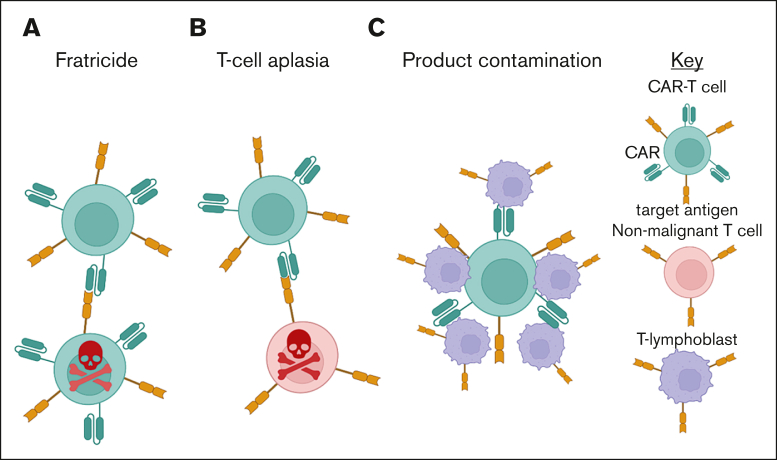
Chimeric antigen receptor T-cell (CAR-T) therapy has proven successful for B-cell lymphomas and leukemias. This success has inspired the development of CAR-T for T-cell malignancies. T-cell lymphomas and T-cell acute lymphoblastic leukemia (T-ALL) are highly heterogenous diseases but are united by poor prognosis in the relapsed/refractory setting and the lack of any novel, targeted therapies. CAR-T therapy is a promising solution for these diseases but carries a number of challenges, principally that target antigens are typically shared between malignant and normal T cells. This can cause issues with fratricide and T-cell aplasia. In this review we discuss the current state of CAR-T treatment for T-ALL and T-cell lymphomas, highlighting recent novel clinical data for T-cell malignancies and discuss lessons that can be learned for future research in this area.
嵌合抗原受体T细胞(CAR-T)疗法已被证明对B细胞淋巴瘤和白血病有效。这一成功激发了针对T细胞恶性肿瘤的CAR-T疗法的开发。T细胞淋巴瘤和T细胞急性淋巴细胞白血病(T-ALL)是高度异质性疾病,但在复发/难治情况下预后不良以及缺乏任何新型靶向疗法是它们的共同特征。CAR-T疗法是治疗这些疾病的一种有前景的解决方案,但也带来了一些挑战,主要是靶抗原通常在恶性T细胞和正常T细胞之间共享。这可能导致自相残杀和T细胞发育不全的问题。在这篇综述中,我们讨论了CAR-T治疗T-ALL和T细胞淋巴瘤的现状,强调了T细胞恶性肿瘤的最新临床数据,并讨论了该领域未来研究可借鉴的经验教训。