Quispialaya Kely Monica, Therriault Joseph, Aliaga Antonio, Benedet Andrea L, Ashton Nicholas J, Karikari Thomas, Cassa Macedo Arthur, Rahmouni Nesrine, Tissot Cécile, Fernandez Arias Jaime, Wang Yi-Ting Tina, Trudel Lydia, Hosseini Seyyed Ali, Matsudaira Takashi, Chan Tevy, Pascoal Tharick, Gilfix Brian, Vitali Paolo, Zimmer Eduardo R, Provost Karine, Soucy Jean-Paul, Gauthier Serge, Zetterberg Henrik, Jean-Claude Bertrand J, Blennow Kaj, Rosa-Neto Pedro
Translational Neuroimaging Laboratory, The McGill University Research Centre for Studies in Aging, McConnell Brain Imaging Centre, Montreal Neurological Institute, McGill University, Montreal, Quebec, Canada.
Department of Experimental Medicine, McGill University.
Neurology. 2025 Jan 28;104(2):e210211. doi: 10.1212/WNL.0000000000210211. Epub 2024 Dec 23.
To compare the diagnostic performance of an immunoassay for plasma concentrations of phosphorylated tau (p-tau) 217 with visual assessments of fluorine-18 fluorodeoxyglucose [F]FDG-PET in individuals who meet appropriate use criteria for Alzheimer dementia (AD) biomarker assessments.
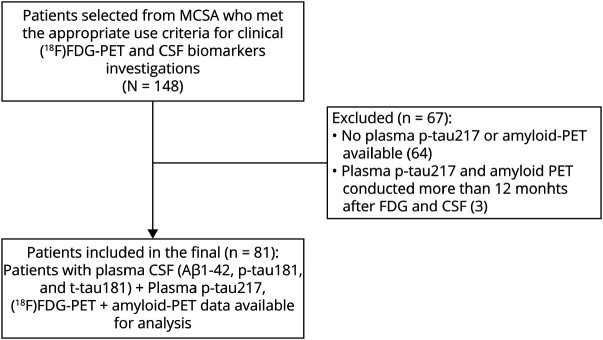
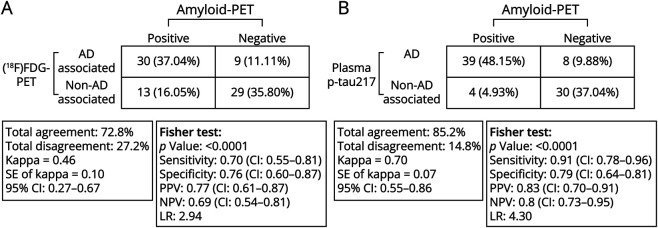
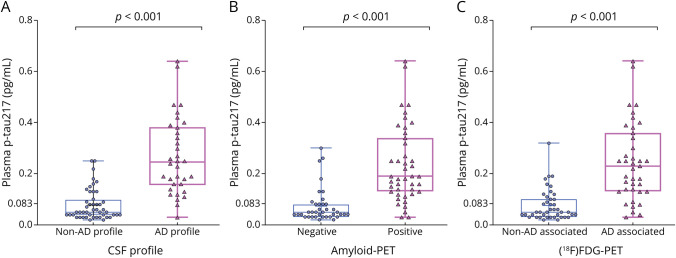
We performed a retrospective analysis of individuals with early-onset (age <65 years at onset) and/or atypical dementia (features other than memory at onset), who were evaluated at a tertiary care memory clinic. All participants underwent measurements of CSF biomarkers (Aβ42, p-tau181, and total tau levels), as well as [F]FDG-PET scans, amyloid-PET scans, and plasma p-tau217 quantifications. To determine whether the [F]FDG-PET images were compatible with AD, images were visually rated by 2 nuclear medicine experts. Using a contingency analysis, we evaluated the accuracy of [F]FDG-PET scan interpretation and plasma p-tau217 for an AD biomarker profile in CSF and for amyloid-PET positivity.
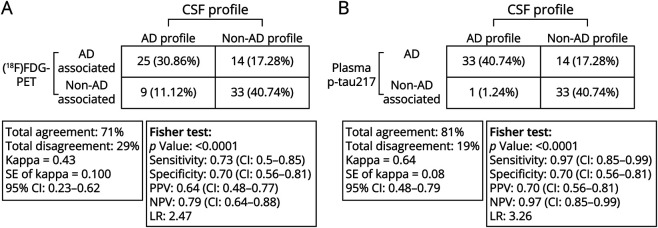
A total of 81 individuals with early onset and/or atypical dementia were included in this study (mean age = 65 years; 48/81 female (59%). Both [F]FDG-PET and plasma p-tau217 showed high levels of agreement with reference standard AD biomarkers ([F]FDG-PET area under the curve [AUC]: 71%; plasma p-tau217 AUC: 81%). Although both biomarkers had similar specificity for AD [F]FDG-PET: 70%, CI: 0.56-0.81; plasma p-tau217: 70%, CI: 0.56-0.81), plasma p-tau217 had higher sensitivity for AD (plasma p-tau217: 97%, CI: 0.85-0.99 vs [F]FDG-PET: 73%, CI: 0.57-0.85) ( = 0.01). Overall accuracy was also higher for plasma p-tau217 (AUC = 84%, CI: 0.75-0.93 vs 72%, CI: 0.60-0.83 of [F]FDG-PET) ( = 0.02). The same pattern of results was observed when using amyloid-PET as the reference standard.
Our study provides evidence that plasma p-tau217 has strong discriminative accuracy for AD among patients with early-onset and/or atypical dementia assessed in specialized settings. Future work should replicate these findings in secondary care settings.
比较磷酸化tau(p-tau)217血浆浓度免疫测定法与符合阿尔茨海默病(AD)生物标志物评估适用标准的个体中氟-18氟脱氧葡萄糖[F]FDG-PET视觉评估的诊断性能。
我们对在三级医疗记忆诊所接受评估的早发型(发病年龄<65岁)和/或非典型痴呆(发病时除记忆外的特征)个体进行了回顾性分析。所有参与者均接受了脑脊液生物标志物(Aβ42、p-tau181和总tau水平)测量,以及[F]FDG-PET扫描、淀粉样蛋白PET扫描和血浆p-tau217定量分析。为确定[F]FDG-PET图像是否与AD相符,由2名核医学专家对图像进行视觉评分。通过列联分析,我们评估了[F]FDG-PET扫描解读和血浆p-tau217对于脑脊液中AD生物标志物谱和淀粉样蛋白PET阳性的准确性。
本研究共纳入81例早发型和/或非典型痴呆个体(平均年龄=65岁;48/81为女性(59%))。[F]FDG-PET和血浆p-tau217与参考标准AD生物标志物均显示出高度一致性([F]FDG-PET曲线下面积[AUC]:71%;血浆p-tau217 AUC:81%)。尽管两种生物标志物对AD的特异性相似([F]FDG-PET:70%,CI:0.56 - 0.81;血浆p-tau217:70%,CI:0.56 - 0.81),但血浆p-tau217对AD的敏感性更高(血浆p-tau217:97%,CI:0.85 - 0.99;[F]FDG-PET:73%,CI:0.57 - 0.85)(P = 0.01)。血浆p-tau217的总体准确性也更高(AUC = 84%,CI:0.75 - 0.93;[F]FDG-PET为72%,CI:0.60 - 0.83)(P = 0.02)。以淀粉样蛋白PET作为参考标准时,观察到相同的结果模式。
我们的研究提供了证据,表明在专门环境中评估的早发型和/或非典型痴呆患者中,血浆p-tau217对AD具有很强的鉴别准确性。未来的工作应在二级医疗环境中重复这些发现。