Li Xiaoyu, Ye Siqi, Shen Qing, Liu Enci, An Xiujun, Qin Jinling, Liu Yang, Xing Xiuzhong, Chen Junping, Lu Bo
Department of Anesthesiology, Ningbo No.2 Hospital, No.41, Northwest Street, Ningbo, 315010, P.R. China.
Department of Anesthesiology, The Affiliated People's Hospital of Ningbo University, Ningbo, 315040, P.R. China.
BMC Anesthesiol. 2024 Dec 24;24(1):474. doi: 10.1186/s12871-024-02865-3.
Developing proficiency in ultrasound-guided nerve block (UGNB) demands an intricate understanding of cross-sectional anatomy as well as spatial reasoning, which is a big challenge for beginners. The aim of this pilot study was to evaluate the feasibility of virtual reality (VR)-facilitated anatomy education in the first performance of ultrasound-guided interscalene brachial plexus blockade among novice anesthesiologists. We carried out pilot testing of this hypothesis using a prospective, single blind, randomized controlled trial.
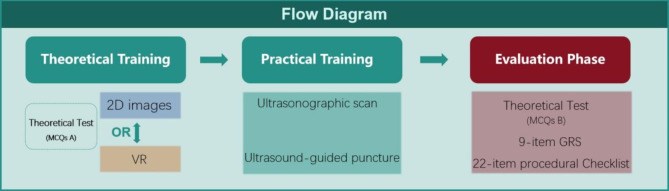
Twenty-one anesthesia trainees with no prior ultrasonography or nerve block training were included in this study. All participants underwent a training program encompassing theory and hands-on practice. Trainees were randomized into one of two groups: one received VR-assisted anatomy course while the other did not. Subsequently, both groups completed identical practical modules on ultrasound scanning and needle insertion. The primary end point was defined as the evaluation of trainees' performance during their initial ultrasound-guided interscalene brachial plexus block, assessed using both the Global Rating Scale (GRS) and a task-specific Checklist. The secondary end point included the improvement in scores for written multiple-choice questions (MCQs).
In evaluating practical ultrasound-guided nerve block skills, the VR group significantly outperformed the control group on the task-specific Checklist (29.23 ± 3.91 vs. 24.85 ± 5.13; P < 0.05), while both groups showed comparable performance on the GRS. Additionally, post-theoretical course MCQ scores increased substantially, with post-test results significantly surpassing pre-test scores in both groups (P < 0.001). However, intergroup analysis indicated no significant difference in score improvements between the VR and control groups (21.82 ± 12.30 vs. 18.33 ± 9.68, P > 0.05).
Overall, the findings of this pilot study suggest that immersive virtual reality training in anatomy may contribute to improving the proficiency of ultrasound-guided brachial plexus blocks among novice anesthesiologists. Incorporating VR into future anesthesia technique training programs should be considered.
ClinicalTrials.gov identifier: ChiCTR2300067437. Date of Registration Jan 9, 2023.
熟练掌握超声引导下神经阻滞(UGNB)需要对横断面解剖结构以及空间推理有深入理解,这对初学者来说是一项巨大挑战。本初步研究的目的是评估虚拟现实(VR)辅助解剖学教育在新手麻醉医生首次进行超声引导下肌间沟臂丛神经阻滞操作中的可行性。我们采用前瞻性、单盲、随机对照试验对这一假设进行了初步测试。
本研究纳入了21名此前未接受过超声检查或神经阻滞培训的麻醉学员。所有参与者都接受了包括理论和实践操作的培训课程。学员被随机分为两组:一组接受VR辅助解剖学课程,另一组未接受。随后,两组完成了相同的超声扫描和进针实践模块。主要终点定义为在学员首次进行超声引导下肌间沟臂丛神经阻滞期间对其操作表现的评估,使用全球评级量表(GRS)和特定任务检查表进行评估。次要终点包括书面多项选择题(MCQ)分数的提高。
在评估实际超声引导下神经阻滞技能时,VR组在特定任务检查表上的表现显著优于对照组(29.23±3.91对24.85±5.13;P<0.05),而两组在GRS上的表现相当。此外,理论课程后的MCQ分数大幅提高,两组的测试后结果均显著超过测试前分数(P<0.001)。然而,组间分析表明VR组和对照组在分数提高方面没有显著差异(21.82±12.30对18.33±9.68,P>0.05)。
总体而言,本初步研究结果表明,沉浸式虚拟现实解剖学培训可能有助于提高新手麻醉医生超声引导下臂丛神经阻滞的熟练程度。应考虑将VR纳入未来的麻醉技术培训项目。
ClinicalTrials.gov标识符:ChiCTR2300067437。注册日期:2023年1月9日。