Jennings A, Shannon O M, Gillings R, Lee V, Elsworthy R, Bundy R, Rao G, Hanson S, Hardeman W, Paddick S-M, Siervo M, Aldred S, Mathers J C, Hornberger M, Minihane A M
Norwich Medical School, University of East Anglia, Norwich, UK.
School of Biological Sciences, The Co-Centre for Sustainable Food Systems and The Institute for Global Food Security, Queens University Belfast, Belfast, UK.
BMC Med. 2024 Dec 23;22(1):600. doi: 10.1186/s12916-024-03815-z.
Despite an urgent need for multi-domain lifestyle interventions to reduce dementia risk, there is a lack of interventions which are informed by theory- and evidence-based behaviour change strategies, and no interventions in this domain have investigated the feasibility or effectiveness of behaviour change maintenance. We tested the feasibility, acceptability and cognitive effects of a personalised theory-based 24-week intervention to improve Mediterranean diet (MD) adherence alone, or in combination with physical activity (PA), in older-adults at risk of dementia, defined using a cardiovascular risk score.
Participants (n = 104, 74% female, 57-76 years) were randomised to three parallel intervention arms: (1) control, (2) MD, or (3) MD + PA for 24 weeks and invited to an optional 24-week follow-up period with no active intervention. Behaviour change was supported using personalised targets, a web-based intervention, group sessions and food provision. The primary outcome was behaviour change (MD adherence and PA levels), and the secondary outcomes included feasibility and acceptability, cognitive function, cardiometabolic health (BMI and 24-h ambulatory blood pressure) and process measures.
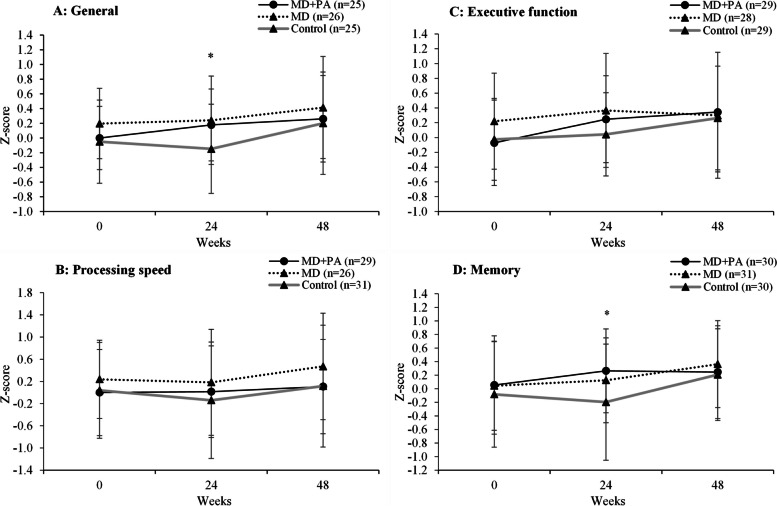
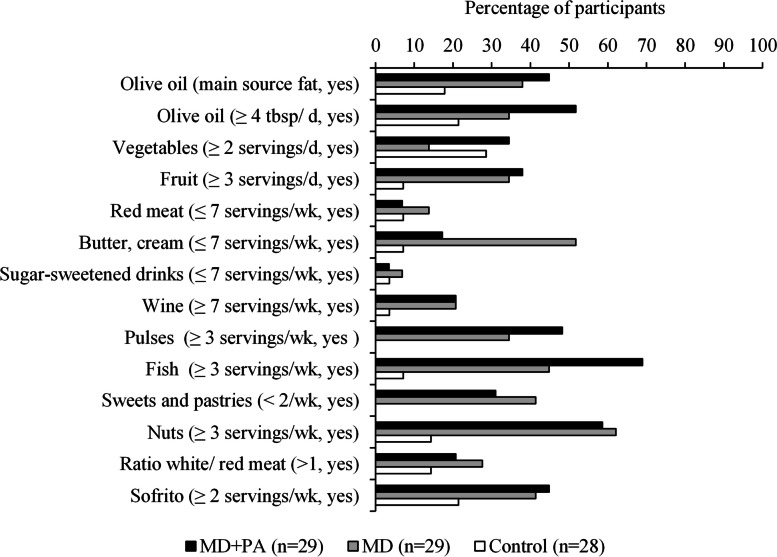
The intervention was feasible and acceptable with the intended number of participants completing the study. Participant engagement with group sessions and food provision components was high. There was improved MD adherence in the two MD groups compared with control at 24 weeks (3.7 points on a 14-point scale (95% CI 2.9, 4.5) and 48 weeks (2.7 points (95% CI 1.6, 3.7)). The intervention did not significantly change objectively measured PA. Improvements in general cognition (0.22 (95% CI 0.05, 0.35), memory (0.31 (95% CI 0.10, 0.51) and select cardiovascular outcomes captured as underpinning physiological mechanisms were observed in the MD groups at 24 weeks.
The intervention was successful in initiating and maintaining dietary behaviour change for up to 12 months which resulted in cognitive benefits. It provides a framework for future complex behaviour change interventions with a range of health and well-being endpoints.
ClinicalTrials.gov NCT03673722.
尽管迫切需要多领域生活方式干预措施来降低痴呆风险,但缺乏基于理论和证据的行为改变策略的干预措施,且该领域尚无干预措施研究行为改变维持的可行性或有效性。我们测试了一种基于理论的个性化24周干预措施的可行性、可接受性和认知效果,该干预措施旨在单独改善地中海饮食(MD)依从性,或与体育活动(PA)相结合,针对使用心血管风险评分定义的有痴呆风险的老年人。
参与者(n = 104,74%为女性,57 - 76岁)被随机分配到三个平行干预组:(1)对照组,(2)MD组,或(3)MD + PA组,为期24周,并被邀请参加一个无积极干预的可选24周随访期。使用个性化目标、基于网络的干预、小组会议和食物供应来支持行为改变。主要结局是行为改变(MD依从性和PA水平),次要结局包括可行性和可接受性、认知功能、心脏代谢健康(BMI和24小时动态血压)以及过程指标。
该干预措施可行且可接受,达到了完成研究的预期参与者数量。参与者对小组会议和食物供应部分的参与度很高。与对照组相比,两个MD组在24周时(14分制上提高3.7分(95%可信区间2.9,4.5))和48周时(提高2.7分(95%可信区间1.6,3.7))的MD依从性有所改善。该干预措施未显著改变客观测量的PA。在24周时,MD组在一般认知(0.22(95%可信区间0.05,0.35))、记忆(0.31(95%可信区间0.10,0.51))以及作为潜在生理机制的部分心血管结局方面有所改善。
该干预措施成功启动并维持了长达12个月的饮食行为改变,从而带来了认知益处。它为未来具有一系列健康和幸福终点的复杂行为改变干预提供了一个框架。
ClinicalTrials.gov NCT03673722。