Yang Ying, Lin Wenjun, Zhuo Yifen, Luo Yuxin, Wu Xiaoyan, Li Junyu, Yao Yusheng
Department of Anesthesiology, Shengli Clinical Medical College of Fujian Medical University, Fujian Provincial Hospital, Fuzhou, Fujian, People's Republic of China.
Department of Anesthesiology, Xiamen Haicang Hospital, Xiamen, Fujian, People's Republic of China.
Drug Des Devel Ther. 2024 Dec 18;18:6133-6143. doi: 10.2147/DDDT.S500316. eCollection 2024.
Intrathecal morphine is increasingly used for pain management in laparoscopic colorectal surgery. While ropivacaine shows advantages of reduced cardiotoxicity and faster motor recovery compared to bupivacaine, the impact of intrathecal morphine-ropivacaine combination on postoperative recovery quality remains unclear. This study aimed to evaluate this combination's effect on recovery outcomes after laparoscopic colorectal surgery.
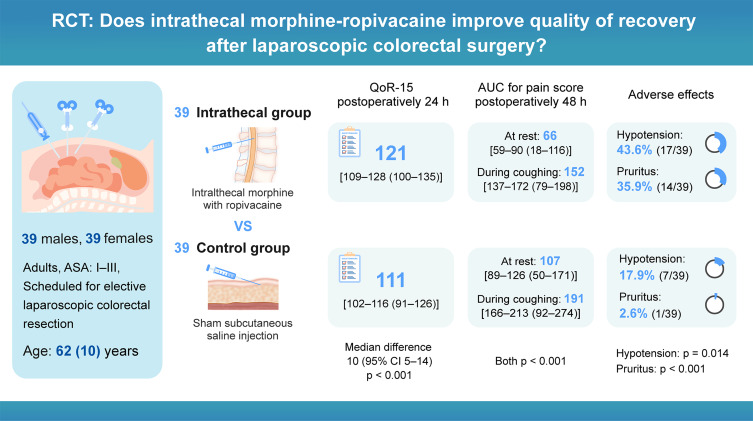
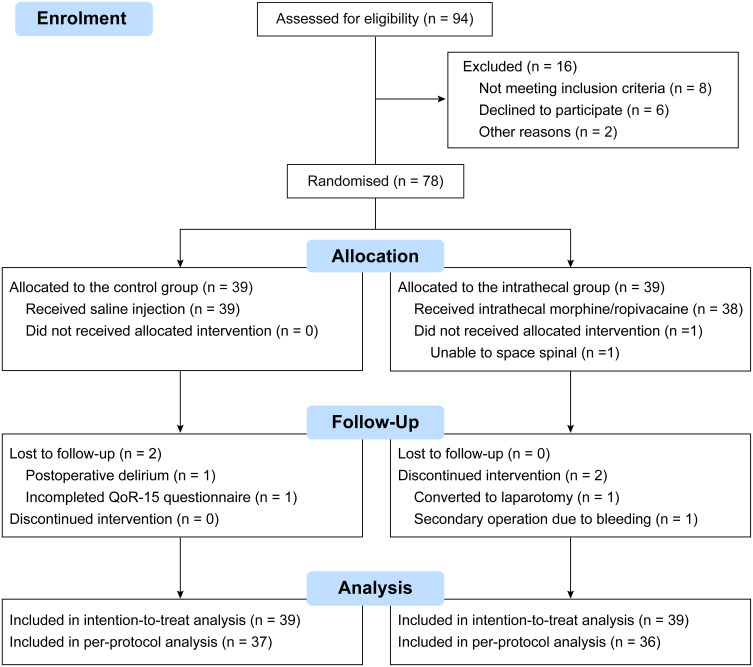
In this randomized, double-blind, placebo-controlled trial, 78 patients undergoing laparoscopic colorectal surgery received either preservative-free intrathecal morphine 250 μg with ropivacaine 15 mg (Intrathecal group) or a sham subcutaneous saline injection (Control group). The primary outcome was the Quality of Recovery-15 (QoR-15) score 24 hours after surgery. Secondary outcomes included pain scores, opioid consumption, and adverse effects.
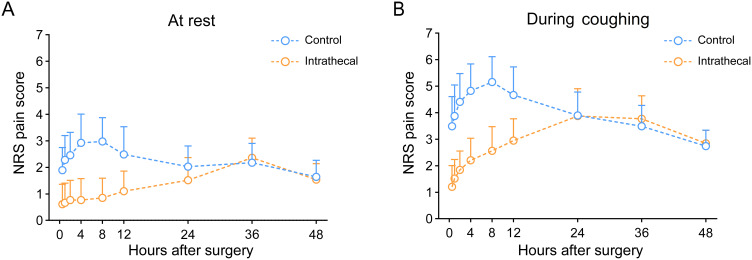
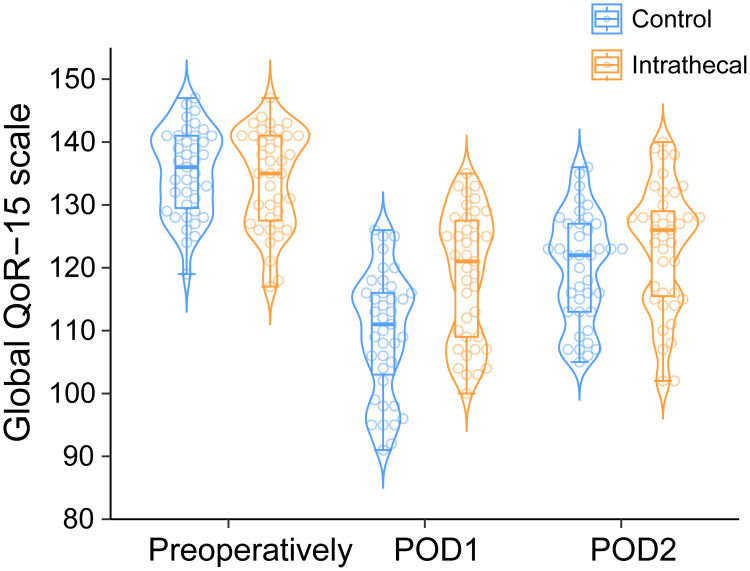
The intrathecal group showed significantly higher QoR-15 scores 24 hours postoperatively compared to the control group (median [IQR]: 121 [109-128] vs 111 [102-116], p < 0.001), with improvements in pain management (p < 0.001), physical comfort (p = 0.001), and physical independence (p = 0.002). The intrathecal group had lower pain scores at rest (area under the curve 0-48 h: 66 [59-90] vs 107 [89-126], p < 0.001) and during coughing (152 [137-172] vs 191 [166-213], p < 0.001), particularly from 0.5 to 24 hours. They also required less postoperative morphine (0-48 h: 10 [6-20] vs 26 [22-36] mg, p < 0.001). While hypotension (43.6% vs 17.9%, p = 0.014) and pruritus (35.9% vs 2.6%, p < 0.001) were more frequent in the intrathecal group, but no respiratory depression occurred in either group.
Intrathecal morphine-ropivacaine administration improves 24-hour postoperative recovery quality and provides superior pain relief after laparoscopic colorectal surgery, despite increased but manageable side effects. Further research should focus on dose optimization and comparative studies of different intrathecal local anesthetic combinations.
The Chinese Clinical Trial Registry, ChiCTR2100052337.
鞘内注射吗啡越来越多地用于腹腔镜结直肠手术的疼痛管理。虽然与布比卡因相比,罗哌卡因具有心脏毒性降低和运动恢复更快的优点,但鞘内注射吗啡-罗哌卡因联合用药对术后恢复质量的影响仍不明确。本研究旨在评估这种联合用药对腹腔镜结直肠手术后恢复结局的影响。
在这项随机、双盲、安慰剂对照试验中,78例行腹腔镜结直肠手术的患者接受了无防腐剂的鞘内注射250μg吗啡与15mg罗哌卡因(鞘内注射组)或皮下注射生理盐水假手术(对照组)。主要结局是术后24小时的恢复质量-15(QoR-15)评分。次要结局包括疼痛评分、阿片类药物消耗量和不良反应。
与对照组相比,鞘内注射组术后24小时的QoR-15评分显著更高(中位数[四分位间距]:121[109-128]对111[102-116],p<0.001),在疼痛管理(p<0.001)、身体舒适度(p=0.001)和身体独立性(p=0.002)方面均有改善。鞘内注射组静息时(曲线下面积0-48小时:66[59-90]对107[89-126],p<0.001)和咳嗽时(152[137-172]对191[166-213],p<0.001)的疼痛评分更低,尤其是在0.5至24小时。他们术后所需的吗啡也更少(0-48小时:10[6-20]对26[22-36]mg,p<0.001)。虽然鞘内注射组低血压(43.6%对17.9%,p=0.014)和瘙痒(35.9%对2.6%,p<0.001)更为常见,但两组均未发生呼吸抑制。
鞘内注射吗啡-罗哌卡因可改善腹腔镜结直肠手术后24小时的恢复质量,并提供更好的疼痛缓解,尽管副作用有所增加但仍可控制。进一步的研究应侧重于剂量优化和不同鞘内局部麻醉药联合用药的比较研究。
中国临床试验注册中心,ChiCTR2100052337。