Chen Ya-Ru, Zhu Fang-Yuan, Zhou Rong
Department of Cardiology, The Second Hospital of Shanxi Medical University, Taiyuan, Shanxi, China.
Front Cardiovasc Med. 2024 Dec 9;11:1494882. doi: 10.3389/fcvm.2024.1494882. eCollection 2024.
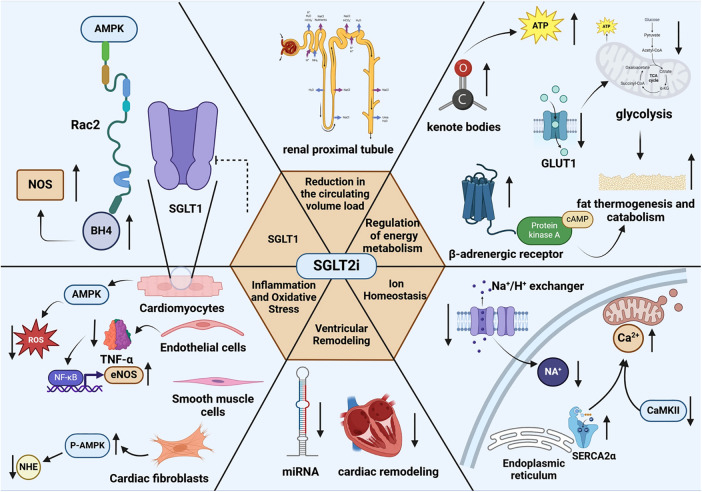
Sodium-glucose cotransporter-2 (SGLT2) inhibitors afford significant cardiovascular benefits to patients with diabetes mellitus and heart failure. Three large randomized clinical trials (EMPAREG-Outcomes, DECLARE-TIMI58, and DAPA-HF) have shown that SGLT2 inhibitors prevent cardiovascular events and reduce the risk of death and hospital admission resulting from heart failure. Patients without type 2 diabetes mellitus (T2DM) also experience a similar degree of cardiovascular benefit as those with T2DM do. SGLT2 inhibitors could improve cardiac function through potential non-hypoglycemic mechanisms, including the reduction of the circulatory volume load, regulation of energy metabolism, maintenance of ion homeostasis, alleviation of inflammation and oxidative stress, and direct inhibition of cardiac SGLT1 receptors and antimyocardial fibrosis. This article reviews the mechanism through which SGLT2 inhibitors prevent/alleviate heart failure through non-hypoglycemic pathways, to support their use for the treatment of heart failure in non-T2DM patients.
钠-葡萄糖协同转运蛋白2(SGLT2)抑制剂为糖尿病和心力衰竭患者带来显著的心血管益处。三项大型随机临床试验(EMPAREG-Outcomes、DECLARE-TIMI58和DAPA-HF)表明,SGLT2抑制剂可预防心血管事件,并降低因心力衰竭导致的死亡和住院风险。非2型糖尿病(T2DM)患者也能获得与T2DM患者相似程度的心血管益处。SGLT2抑制剂可通过潜在的非降糖机制改善心脏功能,包括减少循环容量负荷、调节能量代谢、维持离子稳态、减轻炎症和氧化应激,以及直接抑制心脏SGLT1受体和抗心肌纤维化。本文综述了SGLT2抑制剂通过非降糖途径预防/减轻心力衰竭的机制,以支持其用于治疗非T2DM患者的心力衰竭。