Mboizi Vincent, Nabaggala Catherine, Munube Deogratias, Ssenkusu John M, Kasirye Phillip, Kamya Samson, Kawooya Michael G, Boehme Amelia, Minja Frank, Mupere Ezekiel, Opoka Robert, Rosano Caterina, Idro Richard, Green Nancy S
Global Health Uganda, Kampala, Uganda.
Department of Paediatrics and Child Health, Makerere University College of Health Sciences, Kampala, Uganda.
Contemp Clin Trials Commun. 2024 Nov 28;42:101404. doi: 10.1016/j.conctc.2024.101404. eCollection 2024 Dec.
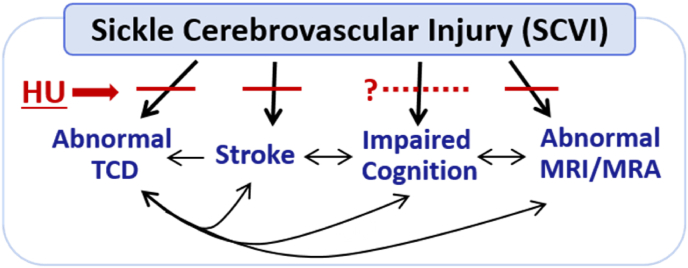
Children with sickle cell anemia (SCA) in Sub-Saharan Africa are at high risk of sickle cerebrovascular injury (SCVI). Hydroxyurea, a commonly used disease-modifying therapy, may reduce SCVI resulting in potential impact on reducing stroke and cognitive dysfunction. We aim to test the impact of daily hydroxyurea therapy on these outcomes in Ugandan children with SCA. We hypothesized that hydroxyurea therapy over 36 months will prevent, stabilize or improve these complications of SCA.
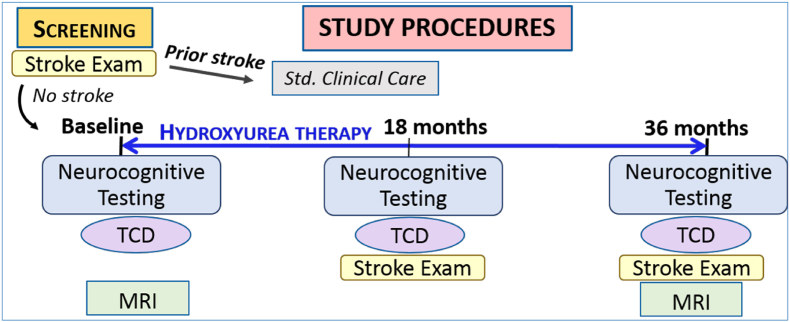
The BRAIN SAFE II study is an open label, single arm trial of daily hydroxyurea in 270 children with SCA (HbSS) in Uganda, ages 3-9 years. Following baseline assessments, participants began hydroxyurea therapy and are followed according to local guidelines. Standard hydroxyurea dose is escalated to maximum tolerated dose (MTD). SCVI is assessed by cerebral arterial velocity using Doppler ultrasound, with cognitive function determined by formal neurocognitive testing (primary outcomes). Structural SCVI is assessed by magnetic resonance imaging (MRI) and angiography (MRA) in a sub-sample of 90 participants ages >5 years. At trial midpoint (18 months) and completion (36 months), outcomes of age-specific assessments will be compared to baseline, as well as biomarkers of anemia, inflammation and malnutrition (secondary outcomes) to determine their relationships to primary outcomes.
This trial will examine the impact of hydroxyurea on preventing or ameliorating SCA SCVI in children, assessed by reducing incident stroke, stroke risk and neurocognitive dysfunction. Trial results will provide critical insight into the role of hydroxyurea therapy on critical manifestations of SCVI in children with SCA.
https://clinicaltrials.gov/ct2/show/NCT04750707 (registered 11 February 2021).
BRAIN SAFE II Protocol Version 3.0, Mar 02, 2022.
撒哈拉以南非洲地区的镰状细胞贫血(SCA)患儿发生镰状脑血管损伤(SCVI)的风险很高。羟基脲是一种常用的病情改善疗法,可能会减少SCVI,从而对降低中风和认知功能障碍产生潜在影响。我们旨在测试每日羟基脲疗法对乌干达SCA患儿这些结局的影响。我们假设,36个月的羟基脲疗法将预防、稳定或改善SCA的这些并发症。
BRAIN SAFE II研究是一项开放标签、单臂试验,对乌干达270名年龄在3至9岁的SCA(HbSS)患儿每日使用羟基脲进行治疗。在基线评估后,参与者开始接受羟基脲治疗,并按照当地指南进行随访。标准羟基脲剂量逐步增加至最大耐受剂量(MTD)。通过多普勒超声测量脑动脉速度评估SCVI,通过正式的神经认知测试确定认知功能(主要结局)。在90名年龄大于5岁的参与者子样本中,通过磁共振成像(MRI)和血管造影(MRA)评估结构性SCVI。在试验中点(18个月)和结束时(36个月),将特定年龄评估的结局与基线进行比较,并比较贫血、炎症和营养不良的生物标志物(次要结局),以确定它们与主要结局之间的关系。
本试验将通过减少中风发生率及中风风险和神经认知功能障碍,研究羟基脲对预防或改善儿童SCA的SCVI的影响。试验结果将为羟基脲疗法在SCA患儿SCVI关键表现中的作用提供重要见解。
https://clinicaltrials.gov/ct2/show/NCT04750707(2021年2月11日注册)。
BRAIN SAFE II方案版本3.0,2022年3月2日。