van Noort Maya T, van Schie Paul, Slot K Mariam, van de Pol Laura A, Buizer Annemieke I, de Groot Vincent
Department of Rehabilitation Medicine, Amsterdam University Medical Center, Amsterdam, The Netherlands.
Department of Neurosurgery, Amsterdam University Medical Center, Amsterdam, The Netherlands.
J Neurol Surg Rep. 2024 Dec 23;85(4):e184-e186. doi: 10.1055/a-2482-9156. eCollection 2024 Oct.
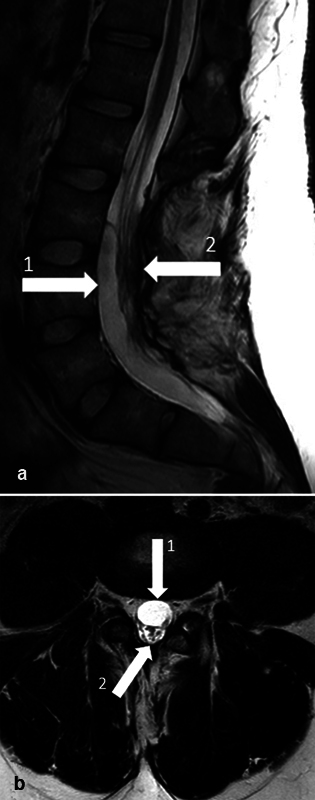
Selective dorsal rhizotomy (SDR) is a surgical technique to treat spasticity, mainly in children with spastic cerebral palsy (CP). In this report, a unique case of a late arachnoid cyst, causing radiating pain in the left leg, is presented. This is relevant to clinicians managing the long-term follow-up of patients who underwent selective dorsal rhizotomy (SDR). A 25-year-old male with bilateral spastic CP, who underwent SDR at the age of 7, presented with symptoms of progressive radiating pain in the left leg. Magnetic resonance imaging (MRI) revealed the presence of a large arachnoid cyst and a remarkable dorsal position of the cauda equina. After dissection of the cyst, the previously experienced radiating pain immediately subsided; however, the patient developed urinary retention and constipation. Cauda compression was ruled out by MRI. The constipation subsided quickly, and the patient performed self-catheterization until 1 month postoperatively for the urinary retention after which there were no signs of ongoing bladder dysfunction. Arachnoid cyst formation can be a late complication of SDR and can cause lumbosacral radicular syndrome in the late postoperative course in select cases.
选择性脊神经后根切断术(SDR)是一种治疗痉挛的手术技术,主要用于痉挛型脑瘫(CP)患儿。在本报告中,呈现了一例独特的迟发性蛛网膜囊肿病例,该囊肿导致左腿放射性疼痛。这对于管理接受选择性脊神经后根切断术(SDR)患者长期随访的临床医生具有重要意义。
一名25岁双侧痉挛型CP男性,7岁时接受了SDR,出现左腿进行性放射性疼痛症状。磁共振成像(MRI)显示存在一个大的蛛网膜囊肿以及马尾显著背侧移位。囊肿切除后,先前经历的放射性疼痛立即消退;然而,患者出现了尿潴留和便秘。MRI排除了马尾受压。便秘很快缓解,患者在术后1个月内自行导尿以解决尿潴留问题,此后未出现持续膀胱功能障碍的迹象。
蛛网膜囊肿形成可能是SDR的一种晚期并发症,在某些病例中可在术后晚期导致腰骶神经根综合征。