Jiang Chang, Li Maichao, Chen Ying, He Yuwei, Li Xinde, Cui Lingling, Qi Han, Cheng Zan, Zhang Xiaoqing, Li Changgui, Lu Jie
Shandong Provincial Clinical Research Center for Immune Diseases and Gout, Qingdao, People's Republic of China.
Shandong Provincial Key Laboratory of Metabolic Diseases and Qingdao Key Laboratory of Gout, The Affiliated Hospital of Qingdao University, Qingdao, People's Republic of China.
J Inflamm Res. 2024 Dec 19;17:11235-11245. doi: 10.2147/JIR.S493376. eCollection 2024.
Previous studies have linked high-density lipoprotein cholesterol (HDL-C) to gout, but little is known about the dose-effect relationship between serum HDL-C levels and gout flares. This study aimed to quantify the association between the two during urate-lowering therapy initiation and develop a regression equation to predict gout flares.
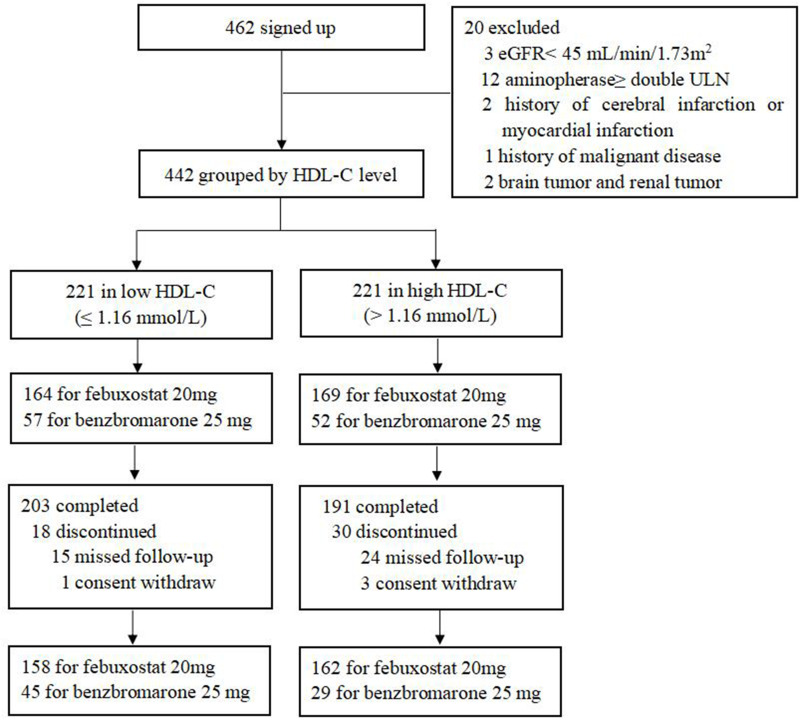
We conducted a prospective, observational, single-center cohort study of men with gout. Patients were identified and grouped according to the level of serum HDL-C (1.16 mmol/L) at baseline and followed-up every four weeks until 12 weeks.
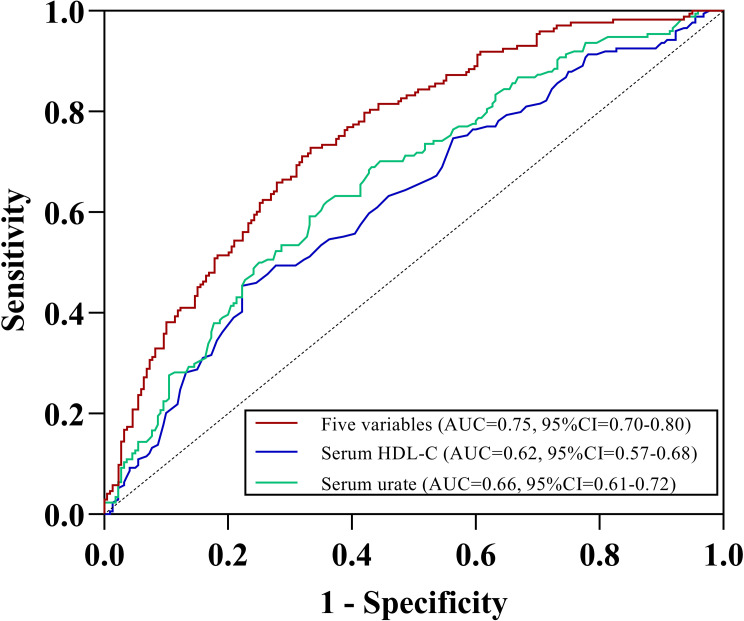
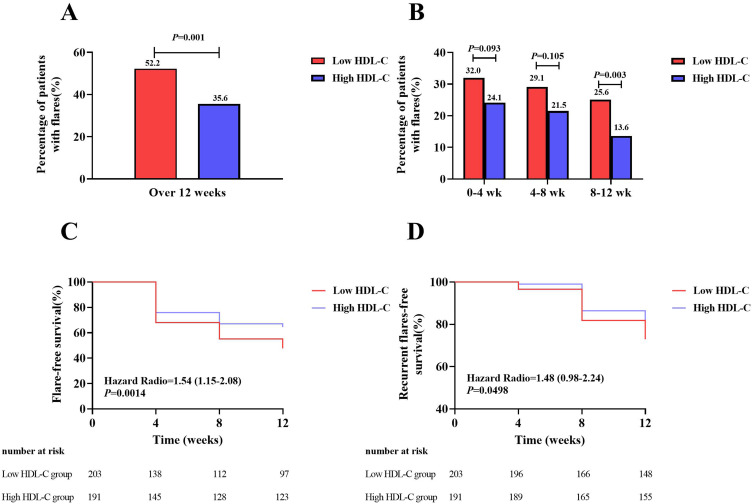
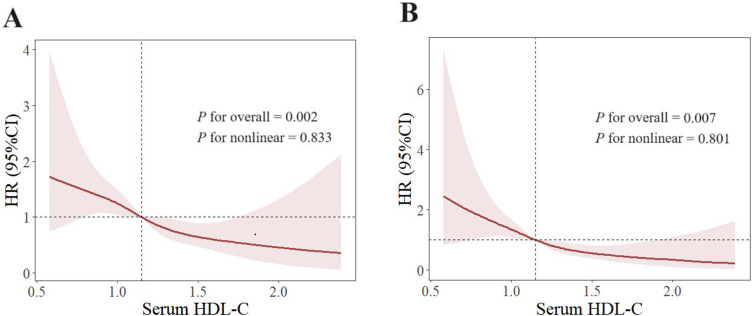
A total of 394 participants completed the study (203 in the low HDL-C group; 191 in the high HDL-C group). The proportion of participants with gout flares in the low HDL-C group was significantly higher than in the high HDL-C group after 12 weeks follow-up (52.2% versus 35.6%, =0.001). Patients with lower serum HDL-C level had higher risk of gout flares analyzed by restricted cubic spline and when serum HDL-C level = 1.15mmol/L, flare = 1. When combined with well-known risk factors, serum HDL-C predicted gout flares with an area under curve (AUC) of 0.75 (95% CI=0.70-0.80). Based on the logistic regression coefficients, we derived the following regression equation: Logit (P)= -2.282+0.05× [disease duration]+1.015× [recurrent flares in the last year]+0.698× [palpable tophus]+0.345× [serum urate]-1.349×[serum HDL-C].
Patients with gout presented a negative linear relationship between serum HDL-C and gout flares. Together with common clinical indicators, the AUC for gout flare prediction increased to 0.75. For patients with gout, remaining serum HDL-C level above 1.15 mmol/L may reduce the risk of gout flares.
既往研究已将高密度脂蛋白胆固醇(HDL-C)与痛风联系起来,但血清HDL-C水平与痛风发作之间的剂量效应关系却鲜为人知。本研究旨在量化降尿酸治疗起始阶段二者之间的关联,并建立一个回归方程来预测痛风发作。
我们对男性痛风患者进行了一项前瞻性、观察性、单中心队列研究。根据基线时血清HDL-C水平(<1.16 mmol/L)对患者进行识别和分组,并每四周随访一次,直至12周。
共有394名参与者完成了研究(HDL-C水平低的组有203人;HDL-C水平高的组有191人)。随访12周后,HDL-C水平低的组中痛风发作的参与者比例显著高于HDL-C水平高的组(52.2%对35.6%,P = 0.001)。通过限制性立方样条分析发现,血清HDL-C水平较低的患者痛风发作风险较高,且当血清HDL-C水平 = 1.15mmol/L时,发作风险 = 1。当与已知风险因素相结合时,血清HDL-C预测痛风发作的曲线下面积(AUC)为0.75(95%CI = 0.70 - 0.80)。基于逻辑回归系数,我们得出以下回归方程:Logit(P)= -2.282 + 0.05×[疾病持续时间] + 1.015×[去年复发发作次数] + 0.698×[可触及痛风石] + 0.345×[血清尿酸盐] - 1.349×[血清HDL-C]。
痛风患者血清HDL-C与痛风发作之间呈负线性关系。与常见临床指标一起,痛风发作预测的AUC增加到0.75。对于痛风患者,将血清HDL-C水平维持在1.15 mmol/L以上可能会降低痛风发作的风险。