Yang Hang, Ying Jie, Zu Tong, Meng Xiao-Ming, Jin Juan
School of Basic Medicine, Anhui Medical University, Hefei, Anhui 230032, P.R. China.
Inflammation and Immune Mediated Diseases Laboratory of Anhui Province, Anhui Institute of Innovative Drugs, School of Pharmacy, Anhui Medical University, The Key Laboratory of Anti‑Inflammatory of Immune Medicines, Ministry of Education, Hefei, Anhui 230032, P.R. China.
Mol Med Rep. 2025 Mar;31(3). doi: 10.3892/mmr.2024.13424. Epub 2024 Dec 24.
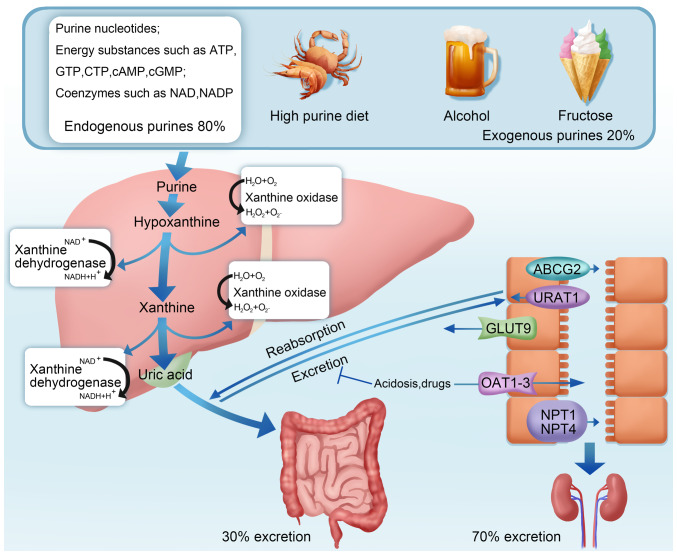
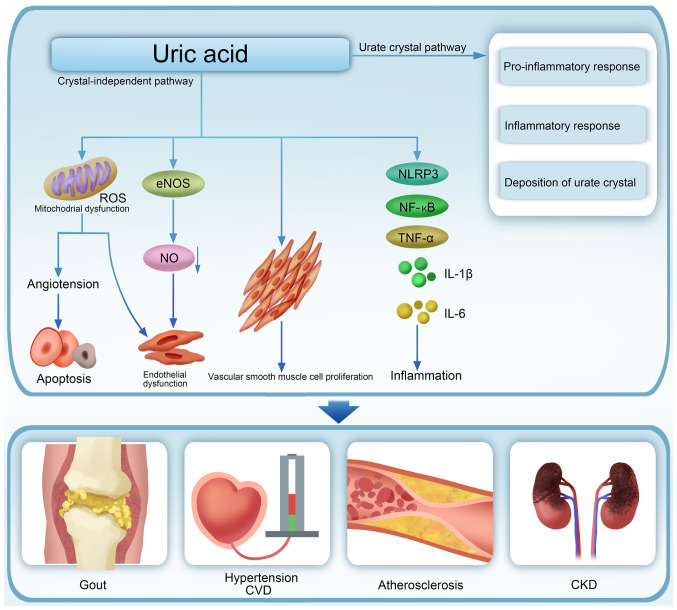
The incidence of hyperuricemia has increased recently, posing a serious threat to public health. Hyperuricemia is associated with an increased risk of gout, chronic kidney disease (CKD), obesity, metabolic syndrome, type 2 diabetes mellitus, hypertension, hypertriglyceridaemia, metabolic dysfunction‑associated steatotic liver disease, acute kidney injury, coronary heart disease and cardiovascular disease (CVD). These diseases are commonly accompanied by varying degrees of kidney damage. A number of randomized controlled clinical trials have investigated the effectiveness of UA‑lowering therapies in preventing kidney disease progression. The present review provided fundamental insights into the pathogenesis, principles and therapeutic approaches for managing hyperuricemia in patients with aforementioned diseases and assesses the effect of uric acid‑lowering therapy on diabetic nephropathy, systemic lupus erythematosus, CKD, CVD and obesity progression.
近年来,高尿酸血症的发病率呈上升趋势,对公众健康构成严重威胁。高尿酸血症与痛风、慢性肾脏病(CKD)、肥胖、代谢综合征、2型糖尿病、高血压、高甘油三酯血症、代谢功能障碍相关脂肪性肝病、急性肾损伤、冠心病和心血管疾病(CVD)的风险增加有关。这些疾病通常伴有不同程度的肾损害。多项随机对照临床试验研究了降尿酸治疗在预防肾脏疾病进展方面的有效性。本综述对上述疾病患者高尿酸血症的发病机制、治疗原则和治疗方法提供了基本见解,并评估了降尿酸治疗对糖尿病肾病、系统性红斑狼疮、CKD、CVD和肥胖进展的影响。