O'Reilly Lauren, Sun Dayu, Schwartz Katherine, Gillenwater Logan, Dir Allyson, Monahan Patrick, Aarons Gregory A, Saldana Lisa, Adams Zachary, Zapolski Tamika, Hulvershorn Leslie, Aalsma Matthew C
Department of Pediatrics, Indiana University School of Medicine, 410 West 10th St., Indianapolis, IN, 46202, USA.
Department of Biostatistics and Health Data Science, Indiana University School of Medicine, Indianapolis, IN, USA.
Implement Sci Commun. 2024 Dec 24;5(1):142. doi: 10.1186/s43058-024-00686-6.
Youth involved in the legal system have disproportionately higher rates of problematic substance use than non-involved youth. Identifying and connecting legal-involved youth to substance use intervention is critical and relies on the connection between legal and behavioral health agencies, which may be facilitated by learning health systems (LHS). We analyzed the impact of an LHS intervention on youth legal and behavioral health personnel ratings of their cross-system collaboration. We also examined organizational climate toward evidence-based practice (EBP) over and above the LHS intervention.
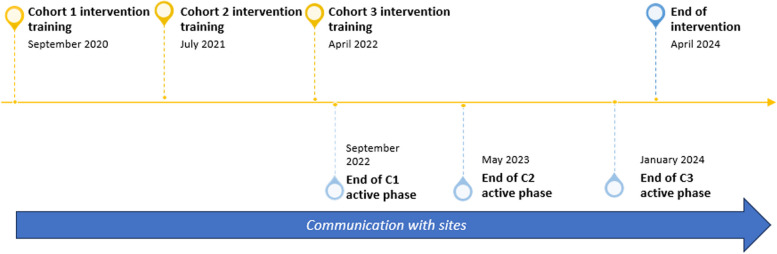
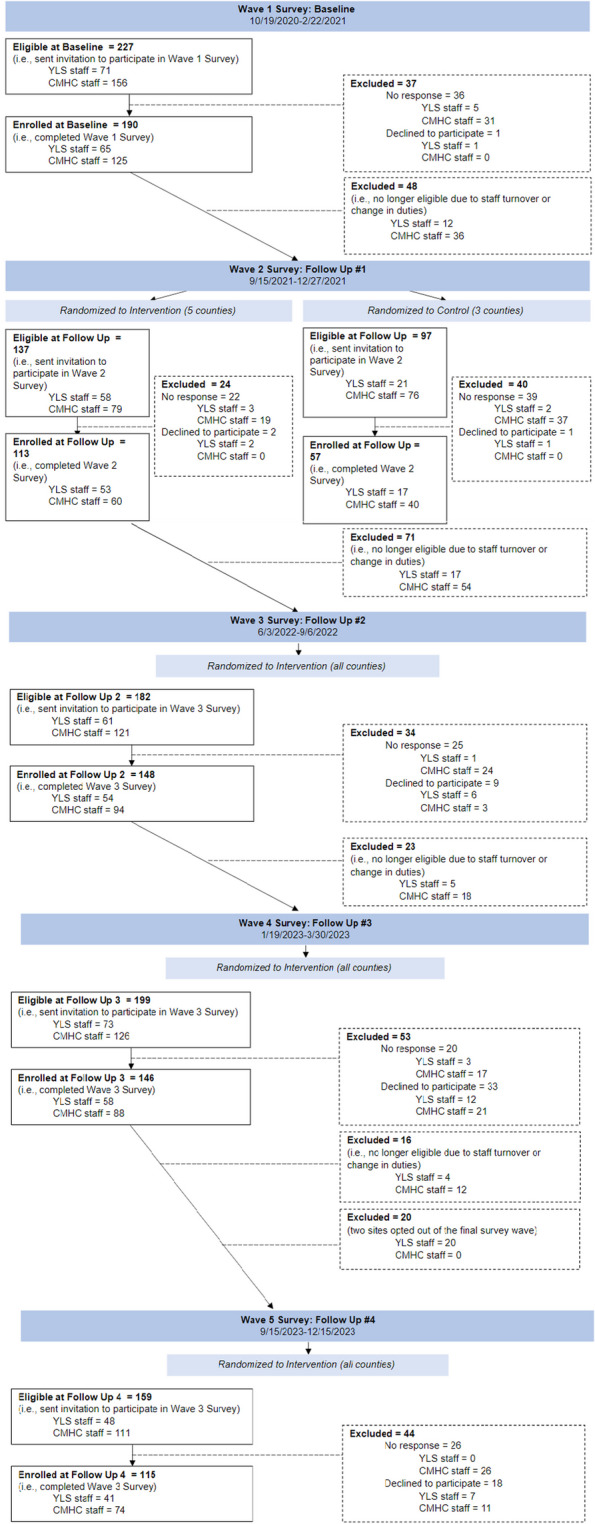
Data were derived from a type II hybrid effectiveness trial implementing an LHS intervention with youth legal and community mental health centers (CMHCs) in eight Indiana counties. Using a stepped wedge design, counties were randomly assigned to one of three cohorts and stepped in at nine-month intervals. Counties were in the treatment phase for 18 months, after which they were in the maintenance phase. Youth legal system and CMHC personnel completed five waves of data collection (n=307 total respondents, ranging from 108-178 per wave). Cross-system collaboration was measured via the Cultural Exchange Inventory, organizational EBP climate via the Implementation Climate Scale and Implementation Citizenship Behavior Scale, and intervention via a dummy-coded indicator variable. We conducted linear mixed models to examine: 1) the treatment indicator, and 2) the treatment indicator and organizational EBP climate variables on cross-system collaboration.
The treatment indicator was not significantly associated with cross-system collaboration. When including the organizational EBP climate variables, the treatment indicator significantly predicted cross-system collaboration. Compared to the control phase, treatment (B=0.41, standard error [SE]=0.20) and maintenance (B=0.60, SE=0.29) phases were associated with greater cross-system collaboration output.
The analysis may have been underpowered to detect an effect; third variables may have explained variance in cross-system collaboration, and, thus, the inclusion of important covariates may have reduced residual errors and increased the estimation precision. The LHS intervention may have affected cross-system collaboration perception and offers a promising avenue of research to determine how systems work together to improve legal-involved-youth substance use outcomes. Future research is needed to replicate results among a larger sample and examine youth-level outcomes.
Clinicaltrials.gov identifier: NCT04499079. Registered 30 July 2020. https://clinicaltrials.gov/study/NCT04499079 .
与未涉及法律系统的青少年相比,涉及法律系统的青少年出现问题性物质使用的比例要高得多。识别涉及法律事务的青少年并为其提供物质使用干预措施至关重要,而这依赖于法律机构与行为健康机构之间的联系,学习健康系统(LHS)可能会促进这种联系。我们分析了LHS干预措施对青少年法律和行为健康工作人员对跨系统协作的评价的影响。我们还研究了在LHS干预之外,组织对循证实践(EBP)的氛围。
数据来自一项II型混合效果试验,该试验在印第安纳州的八个县对青少年法律和社区心理健康中心(CMHC)实施了LHS干预措施。采用阶梯楔形设计,各县被随机分配到三个队列之一,并每隔九个月加入。各县处于治疗阶段18个月,之后进入维持阶段。青少年法律系统和CMHC工作人员完成了五轮数据收集(总共有307名受访者,每轮从108 - 178人不等)。通过文化交流量表测量跨系统协作,通过实施氛围量表和实施公民行为量表测量组织的EBP氛围,通过一个虚拟编码的指标变量测量干预措施。我们进行了线性混合模型分析,以检验:1)治疗指标,以及2)治疗指标和组织EBP氛围变量对跨系统协作的影响。
治疗指标与跨系统协作没有显著关联。当纳入组织EBP氛围变量时,治疗指标显著预测了跨系统协作。与对照阶段相比,治疗阶段(B = 0.41,标准误差[SE] = 0.20)和维持阶段(B = 0.60,SE = 0.29)与更大的跨系统协作产出相关。
该分析可能因检验效能不足而未能检测到效果;可能存在其他变量解释了跨系统协作中的差异,因此,纳入重要的协变量可能减少了残差误差并提高了估计精度。LHS干预措施可能影响了对跨系统协作的认知,并为确定各系统如何共同努力改善涉及法律事务的青少年物质使用结果提供了一个有前景的研究途径。未来需要进行研究,在更大的样本中复制这些结果并检验青少年层面的结果。
Clinicaltrials.gov标识符:NCT04499079。于2020年7月30日注册。https://clinicaltrials.gov/study/NCT04499079 。